If you’re standing in a smoky home thinking, “how do you get smoke out of a house?”—take a breath (preferably in fresh air) and know this: you can fix it, and you don’t need to panic. The biggest mistake people make is trying to “cover” smoke with sprays or candles. That usually makes the smell stick around longer.
A simple rule helps you win fast: remove the smoke particles first, then remove the odor.
Smoke isn’t just a smell—it’s tiny particles that settle on walls, fabrics, carpets, and even inside vents. If you only chase the smell, those particles keep releasing odor back into the air.
This guide covers the three most common situations people deal with:
- A house filled with smoke from cooking (burnt oil, toast, spices, or a forgotten pan)
- Cigarette smoke (which clings to surfaces and HVAC systems)
- Fire or wildfire smoke (often the toughest because it can leave soot and deeper residue)
And if you’re a new parent, speed and safety matter even more. Babies breathe faster than adults, their lungs are still developing, and they’re often close to the floor—exactly where heavier particles can linger. Strong fragrances and harsh chemicals can also irritate sensitive noses and throats, disrupt sleep, and make the whole house feel uncomfortable.
The good news: with the right order of steps—and a few practical, parent-friendly tricks—you can clear the air quickly and get your home back to normal.
The fastest way to get smoke out of a house (the 15–30 minute clearing routine)
If you’re urgently searching “how do you get smoke out of a house fast?”, this is the part you need.
In most cases—especially after cooking smoke—you can dramatically improve the air within 15–30 minutes if you focus on airflow first, cleaning second.
Create cross-ventilation the right way (not just “open a window”)
Opening one window isn’t enough. You need air movement with direction.
Here’s the simple setup:
- Open windows or doors on opposite sides of the house or apartment.
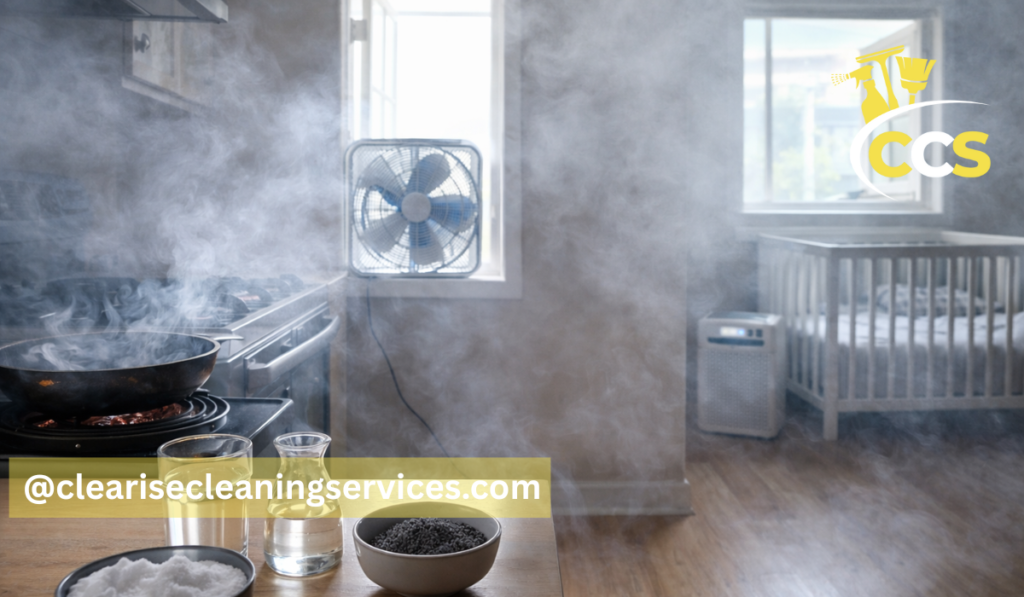
- Place a box fan facing outward in one window. This fan’s job is to push smoky air outside.
- On the opposite side, crack a window or door slightly to pull fresh air in.
This creates a pressure flow: old air out, fresh air in. Without this push-pull effect, smoke just lingers and circulates.
If you only have one window:
- Use a fan facing outward.
- Open the door to create at least some airflow from the hallway or another room.
For apartments, bathroom exhaust fans and kitchen range hoods can help—but they’re usually not strong enough alone. Think of them as backup, not the main solution.
Add filtration (optional—but huge for parents)
Ventilation removes airborne particles. Filtration captures what’s still floating.
If you have an air purifier:
- Use one with a true HEPA filter.
- Place it in the smokiest room first.
- If you’re a new parent, run another purifier (if available) in the baby’s room with the door closed to create a cleaner-air zone.
HEPA filters trap very fine particles—including smoke residue that you can’t see but can still smell.
If you don’t own a purifier:
- Replace your HVAC filter if it’s old.
- Set the fan to “on” (not just “auto”) for an hour to circulate air through the system filter.
This step makes a noticeable difference, especially when the house was filled with smoke from cooking or light cigarette smoke exposure.
Quick odor absorbers while air is moving
While ventilation and filtration are working, you can support the process with simple absorbers:
- Small bowls of white vinegar
- Open containers of baking soda
- Activated charcoal (even charcoal pouches used for closets)
Place them around the room, especially near the strongest smell.
Important: These do not replace cleaning. They help reduce lingering odor while you ventilate and prepare for deeper cleanup.
Avoid candles or fragrance sprays at this stage. They only mask the smell and add more particles to the air.
Mini FAQ: How long does it take for smoke to clear out of a room?
Air can clear surprisingly fast—often within minutes to a couple of hours, depending on:
- How much smoke there was
- How strong your ventilation is
- Humidity levels
- Room size
However, the odor can last much longer because smoke particles settle onto walls, furniture, carpets, and fabrics. That’s why ventilation alone may fix the air but not the smell.
Next, you’ll see why identifying the type of smoke matters before cleaning.
Identify the smoke type (because cooking vs cigarette vs fire needs different cleaning)
Not all smoke behaves the same. If you treat every situation the same way, you’ll waste time and miss the real source of the odor.
Cooking smoke (oil + protein residue)
Cooking smoke—like burnt toast, overheated oil, or scorched food—usually leaves:
- A thin greasy film
- Strong but localized odor (often kitchen-centered)
- Smell that fades faster once cleaned
Because it contains oil and food proteins, it sticks to:
- Cabinet fronts
- Backsplashes
- Range hoods
- Countertops
This type of smoke requires degreasing, not just airing out. If you skip wiping surfaces, the smell often returns the next day.
Cigarette smoke (tar + nicotine)
Cigarette smoke behaves very differently.
It contains tar and nicotine that:
- Stick to painted walls and ceilings
- Absorb into curtains, sofas, and carpets
- Enter HVAC ducts and vents
- Gradually “release” odor back into the air
This is why many people feel like cigarette smell “comes back” even after cleaning.
If you’re wondering:
- How to remove cigarette smell from room instantly?
You can reduce it quickly with ventilation—but full removal requires surface cleaning and fabric treatment. - How long does it take to get cigarette smell out of house?
Light exposure may clear in days. Heavy, long-term smoking can take weeks and sometimes professional help.
Fire or wildfire smoke (soot + ash + acidic residue)
Fire smoke is the most serious type.
It can include:
- Soot particles
- Ash
- Acidic combustion residue
- Melted material fumes
Even if there was no visible flame damage, wildfire smoke or small indoor fires can push fine soot into:
- HVAC systems
- Insulation
- Soft materials
This type sometimes requires soot-safe cleaning methods and, in stronger cases, professional deodorization.
If the smell feels harsh, chemical, or throat-irritating even after ventilation, treat it more seriously than cooking smoke.
House filled with smoke from cooking: step-by-step cleanup that actually removes it
Cooking smoke is one of the most common “oh no” home problems—burnt oil, spices, toast, or a pan left a little too long. The good news: it’s usually fixable quickly if you remove the greasy residue that holds the smell.
Vent + fan first (yes, again—then clean)
Before you scrub anything, do 10–15 minutes of proper airflow:
- Open windows/doors on opposite sides.
- Put a box fan in a window facing outward to push smoky air out.
This matters because you’ll clean faster when the air isn’t thick—and you’ll avoid breathing in as much residue while working.
Parent note: If you have a baby at home, this is the perfect moment to keep them in a clean-air room with the door closed and a purifier running (if you have one).
Degrease the hotspot surfaces (where smell hides)
Cooking smoke isn’t just “in the air.” It often leaves an invisible film that keeps releasing odor.
Start with the areas closest to the source:
- Range hood exterior (and underside)
- Backsplash
- Cabinet fronts and handles (especially the ones above/around the stove)
- Countertops
- Microwave front and the inside edge/vent area (grease collects here)
A simple approach:
- Use warm water + a grease-cutting dish soap on a microfiber cloth.
- Rinse with a clean damp cloth and dry—smell sticks more in damp spaces.
Don’t forget the range hood filter:
- If it’s metal, many are washable (check the manual). A dirty hood filter can keep the odor cycling every time you cook.
- If it’s charcoal (common in some recirculating hoods), it may need replacing.
Soft items trap cooking odor
If the house filled with smoke from cooking, soft materials can hold onto it for days.
Focus on what’s closest to the kitchen or open-plan living area:
- Wash curtains, cushion covers, and throw blankets
- If the smell reached bedrooms, wash bedding too
For rugs or carpets:
- Sprinkle baking soda lightly, let it sit for 15–30 minutes (longer if safe), then vacuum.
- If your vacuum has a HEPA filter, even better.
This step often makes the “next morning smell” disappear, which is when most people realize ventilation alone wasn’t enough.
Parent tip (human-style)
If the smell is strongest in one corner, that’s usually where airflow stalled. Aim the exhaust fan toward that area for 10 minutes (still facing outward) before doing your final wipe-down. It sounds small, but it’s the difference between “mostly gone” and “actually gone.”
How to remove cigarette smell from room instantly (realistic quick wins)
First, a truth that saves time: “Instant” usually means “noticeably better fast,” not “completely erased.” Cigarette odor is stubborn because smoke particles settle everywhere and keep releasing smell.
Instant = reduce smell fast, not erase it
To get quick results in 20–30 minutes:
- Set up cross-ventilation (windows/doors opposite sides)
- Use a fan facing outward to exhaust smoky air
- Add odor absorbers while air is moving:
- Vinegar bowls
- Baking soda containers
- Activated charcoal (especially effective for persistent odors)
If you have an air purifier, run it on high in the affected room during this time.
What NOT to do
Avoid the common trap:
- Don’t rely on air fresheners, incense, candles, or heavy sprays.
They mix with smoke odor and can create an even more unpleasant “sweet-smoke” smell. And because smoke particles remain, the odor usually returns once the fragrance fades.
Quick fabric rescue (if guests smoked)
Even one smoking session can leave odor in fabric surfaces.
Fast wins:
- Wash anything washable: blankets, cushion covers, curtains
- If you have a steamer, steam-clean upholstery (sofas, chairs, fabric headboards)
- Wipe hard surfaces because smoke residue settles everywhere:
- Tables, shelves, window sills
- Door handles and light switches (high-touch spots hold residue)
Parent-friendly tip: If you can’t deep clean immediately, at least remove soft items from the room (bag them for washing) and keep ventilation + filtration running. That alone can make the space feel livable again.
Deep clean plan for cigarette smoke that won’t quit
If you’ve ventilated, cleaned surfaces, and the smell still lingers, you’re likely dealing with embedded residue. Cigarette smoke contains tar and nicotine that cling to porous materials and slowly release odor back into the air.
This is where surface-level cleaning isn’t enough—you need a structured plan.
Walls and ceilings are odor reservoirs
Most people forget this: walls and ceilings absorb smoke over time.
You may not see stains, but odor molecules settle and bond to paint.
Step-by-step approach:
- Dust walls and ceilings first (use a microfiber cloth or vacuum with brush attachment).
- Wash surfaces using warm water and a mild detergent or degreasing solution.
- Rinse with clean water and dry completely.
If repainting is needed:
- Never paint over smoke residue without cleaning first.
- Otherwise, you trap odor underneath and it can bleed through later.
- In heavier cases, a stain-blocking primer designed for odor control may be required after cleaning.
This step alone often reduces lingering smell more than any air spray ever could.
Floors and soft materials are usually the #1 culprit
If cigarette odor “comes back” the next day, the real source is often below you.
Focus on:
- Carpets and carpet padding (underlay)
- Area rugs
- Drapes and curtains
- Upholstered furniture
- Mattresses
Deep cleaning options:
- Steam clean carpets and upholstery.
- Wash removable fabrics in warm water if safe for the material.
- Use baking soda before vacuuming to help neutralize odor.
In heavy, long-term smoking homes, carpet padding and even insulation can hold odor permanently. In those cases, replacement may be more practical than repeated cleaning.
For new parents, this matters especially in bedrooms and nurseries, where babies spend long periods close to surfaces.
HVAC: How to get cigarette smell out of vents in house
Smoke doesn’t stay in one room—it travels through airflow systems.
If odor persists throughout the house, check the HVAC system.
Start with:
- Replace HVAC filters immediately (even if they “look fine”).
- Remove and wash vent covers/registers with soap and warm water.
- Vacuum inside reachable duct openings carefully.
If the smell continues after replacing filters and cleaning vents, professional duct cleaning may be worth considering—especially if the home had years of smoking exposure.
Important: HVAC cleaning should be done by reputable professionals using proper containment methods. Avoid unverified “quick fogging” services without explanation of their process.
How long does it take to get cigarette smell out of house?
This depends entirely on exposure level.
- Light exposure (occasional smoking):
A few days to a couple of weeks with ventilation and surface cleaning. - Moderate exposure (frequent indoor smoking):
Several weeks of structured cleaning and fabric treatment. - Heavy or years of smoking:
It may take months and can require replacing porous materials like carpet, padding, or insulation, plus professional deodorization methods.
There’s no instant cure for deeply embedded smoke—but systematic cleaning works.
How to get fire smoke smell out of house fast (after small fire or wildfire haze)
Fire smoke behaves differently than cooking or cigarette smoke. It often contains soot and acidic residue that require careful handling.
If you’re asking “how to get fire smoke smell out of house fast,” speed matters—but safety matters more.
Clean soot safely (basic guidance)
If you see visible soot:
- Wear gloves and, ideally, a protective mask.
- Avoid dry wiping heavy soot—it can smear and push particles deeper into surfaces.
- Use appropriate cleaning solutions designed for soot removal.
- Rinse surfaces thoroughly and dry completely.
For wildfire haze without visible soot:
- Focus on ventilation and filtration first.
- Wipe horizontal surfaces where fine ash settles.
If soot covers large areas, or if walls feel sticky or oily, professional cleaning may prevent permanent staining.
Odor absorbers that are commonly recommended
For lingering fire smoke odor:
- Place bowls of baking soda around rooms for several days.
- Use vinegar bowls as an additional odor-neutralizing method.
- Continue running HEPA air purifiers if available.
These methods support cleanup—but remember, they work best after residue has been removed.
When “fast” isn’t possible
Sometimes the smell doesn’t fade because smoke penetrated deeper materials:
- Insulation
- Subflooring
- HVAC ducts
- Wall cavities
When that happens, DIY efforts may stall. At this stage, professional deodorization methods such as thermal fogging, hydroxyl treatment, or other restoration techniques may be necessary.
If the smell irritates your throat or eyes days later, treat it as a structural issue—not just an odor issue.
For families with infants, prolonged smoke odor isn’t something to ignore. If basic ventilation and cleaning don’t solve the problem within a reasonable timeframe, it’s worth having the home professionally assessed.
Professional options (and when DIY stops working)
Sometimes, no matter how carefully you ventilate and clean, the smell lingers. That usually means smoke has penetrated deeper materials—insulation, subfloors, wall cavities, or ductwork. At this point, professional help may be the most efficient and safest path forward.
The 3 common professional deodorization methods
Restoration professionals typically use one or more of these approaches:
- Thermal Fogging
This method releases a fine deodorizing fog that penetrates materials similarly to how smoke did. The idea is to neutralize odor molecules inside porous surfaces, not just on top of them. - Ozone Treatment
Ozone machines generate ozone gas, which can break down odor-causing compounds. It’s often used in vacant properties after heavy smoke exposure. - Hydroxyl Generators
Hydroxyl systems create reactive molecules that help neutralize odors over time. They’re sometimes considered a safer alternative to ozone in occupied settings, depending on the situation.
Professionals choose the method based on:
- Type of smoke (cigarette vs fire)
- Level of contamination
- Materials involved
- Whether the home is occupied
There is no universal “best” method—context matters.
Important safety note (especially for babies)
Some professional methods—particularly high-concentration ozone—can be harmful if used incorrectly or while people (or pets) are present.
Important considerations:
- Ozone treatments typically require the home to be vacant during treatment.
- DIY ozone machines purchased online can be risky if misused.
- Fogging chemicals must be applied correctly and followed by proper ventilation.
For families with infants, always ask whether the method is safe for re-entry and how long the home should remain unoccupied.
When in doubt, prioritize companies that clearly explain:
- Safety precautions
- Air quality considerations
- Re-entry timelines
How to choose a reputable smoke-odor professional
If you decide to escalate, ask direct questions:
- What method do you recommend and why?
(Fogging vs ozone vs hydroxyl—there should be a clear reason.) - What source removal steps will you do first?
Professionals should clean and remove contaminated materials before deodorizing. Deodorization alone isn’t enough. - How will you protect HVAC systems and soft goods?
Proper containment and filter management matter. - Is the home safe for children and pets after treatment?
Get specific timelines.
A trustworthy provider will explain the process in simple terms and avoid exaggerated promises like “instant permanent results.”
New-parent focused checklist: clearing smoke without exposing baby to harsh chemicals
If you’re managing smoke in a home with a newborn or young child, your priority is clean air—not fragrance.
Baby-safe priorities
- Start with ventilation and HEPA filtration.
- Use mild cleaners instead of strong chemical sprays.
- Keep baby out of affected rooms during cleaning.
- Continue ventilating until odor is genuinely reduced—not just masked.
Babies breathe faster than adults, so even mild lingering smoke can feel stronger to them.
Nursery reset (quick version)
If smoke reached the nursery:
- Wash crib sheets, blankets, and fabric items.
- Vacuum the room thoroughly (HEPA vacuum if available).
- Wipe down hard surfaces.
- Run an air purifier overnight with the door closed.
This creates a safe “clean-air zone” while the rest of the house continues clearing.
If you only have 20 minutes: mini-plan
When time is tight:
- Place a fan in one window facing outward.
- Crack another window for fresh air.
- Turn purifier to high in the baby’s room.
- Remove smoky fabrics from the main area (place them in a laundry basket for washing).
Even these simple steps can significantly reduce exposure.
Conclusion
If you’re wondering, “how do you get smoke out of a house?”, the answer follows a clear order.
- Stop the source and ventilate correctly.
- Filter the air with HEPA if possible.
- Remove residue from surfaces and fabrics.
- Escalate to professional deodorization when the smell is deeply embedded.
Smoke odor isn’t just about what you smell—it’s about where particles have settled. Once you focus on removing those particles instead of masking them, the solution becomes much more straightforward.
With the right steps—and a calm, systematic approach—you can restore clean air to your home safely and effectively.
Quick FAQ
How Do You Get Smoke Out Of A House Fast?
Create cross-ventilation with a fan exhausting air outward, use a HEPA purifier, remove soft items that trap odor, and wipe hard surfaces. Removing particles first is the fastest path to improvement.
How Long Does It Take For Smoke To Clear Out Of A Room?
Air can clear within minutes to hours depending on airflow. Odor lasts longer because smoke bonds to fabrics and walls. Cleaning those surfaces is what fully resolves the smell.
How To Get Smoke Out Of House From Cooking?
Ventilate immediately, degrease kitchen surfaces, wash fabrics near the smoke source, and clean or replace range hood filters. Cooking smoke usually responds quickly to proper surface cleaning.
How To Remove Cigarette Smell From Room Instantly?
You can reduce it quickly using air exchange and odor absorbers like charcoal or baking soda. However, full removal requires washing surfaces and treating fabrics because tar and nicotine cling to materials.
How Do You Get Smoke Out Of A House Reddit-style (What People Say Worked)?
Across many homeowner discussions, the common themes are:
- Aggressive ventilation with outward-facing fans
- Vinegar or charcoal as temporary odor helpers
- Realizing the smell lives in fabrics and walls—not just in the air
The takeaway: air fresheners don’t solve it. Surface cleaning does.
Disclaimer: This article provides general guidance for informational purposes only and is not a substitute for professional advice. Smoke exposure can pose health risks, especially for infants, elderly individuals, or those with respiratory conditions. If you experience breathing difficulties, persistent strong odors, visible soot damage, or signs of structural or electrical damage, contact a qualified professional or emergency services immediately. Always follow product instructions and safety guidelines when using cleaning tools or equipment.
Thanks for visiting Clearise Cleaning Services! Discover more helpful tips and expert cleaning insights by exploring our related categories.