Low water pressure can make simple daily tasks feel frustrating. A shower may feel weak, the washing machine may take longer to fill, the kitchen faucet may run slowly, or more than one tap may not work well at the same time. When this happens, many homeowners start searching for how to increase water pressure in house because they want a stronger, more comfortable water flow without creating new plumbing problems.
Low water pressure can happen in both old and new homes. In older houses, the cause may be corroded pipes, mineral buildup, or outdated plumbing. In newer homes, it may be linked to a pressure reducing valve, a partially closed valve, fixture blockages, or supply issues from the city or well system. It is also important to understand the difference between low water pressure and low water flow. Pressure is the force pushing water through your pipes, while flow is the amount of water coming out. A clogged showerhead may reduce flow even when the actual pressure is fine.
In this guide, you will learn the safest ways to improve water pressure, how to test your home’s PSI, what DIY checks you can do first, when a water pressure booster may help, and when it is better to call a plumber. The goal is not just to increase pressure, but to do it safely so your pipes, fixtures, and appliances stay protected.
Quick Guide Table
| Problem | Possible Cause | Best Fix |
| Low pressure in one faucet | Clogged aerator | Clean or replace the aerator |
| Weak shower pressure | Mineral buildup | Soak showerhead in vinegar |
| Low pressure in whole house | PRV set too low | Test PSI and adjust PRV carefully |
| Pressure drops suddenly | Hidden leak | Check meter and inspect for leaks |
| City water pressure is weak | Low supply pressure | Contact provider or use booster pump |
| Well water pressure is weak | Pump or pressure tank issue | Check pressure switch and tank |
| Pressure is too high | PRV failure or wrong setting | Keep pressure below safe limits |
Step-by-Step Guide
- Check if the main water valve is fully open.
- Clean faucet aerators and showerheads.
- Test your home’s water pressure with a pressure gauge.
- Look for hidden leaks or unusual water meter movement.
- Adjust the pressure reducing valve slowly if needed.
- Check the pressure tank or well pump if you use well water.
- Consider a water pressure booster if the supply pressure is naturally low.
- Call a plumber if pressure problems continue or affect the whole house.
Understanding What Causes Low Water Pressure in a House
Before you try to fix the problem, it helps to know what may be causing it. A very common reason is a partially closed main shut-off valve. If the main valve near the meter or where the water line enters your home is not fully open, water may not move through the plumbing system properly.
Mineral buildup is another common issue. Over time, small deposits from hard water can collect inside faucet aerators and showerheads. This can make the water feel weak even if the pressure in the pipes is normal. Cleaning these fixtures often makes a noticeable difference.
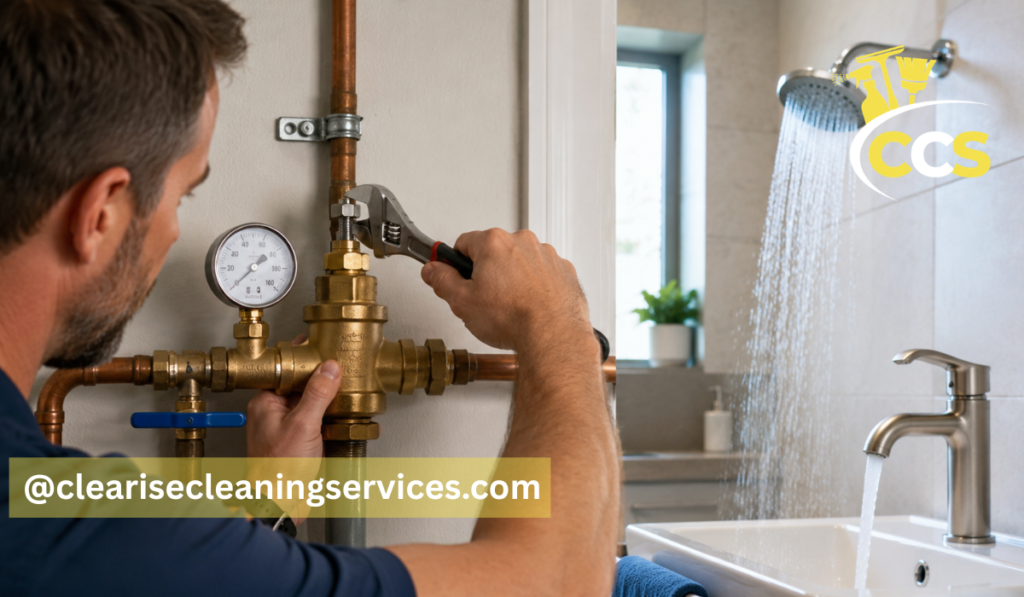
A faulty pressure reducing valve, also called a PRV, can also affect the whole house. This valve controls the pressure coming from the main water supply. If it is set too low or begins to fail, the entire home may have weak water pressure. A PRV is often installed near the main shut-off valve or where the main line enters the house.
Hidden leaks are another possible cause. Even a small leak inside a wall, under the floor, or underground can reduce pressure because water is escaping before it reaches your fixtures. Corroded or outdated pipes can also restrict water movement, especially in older homes with galvanized steel pipes.
Sometimes the problem is not inside your home at all. Municipal supply problems can cause low pressure in homes connected to city water. If you use a well, the issue may involve the well pump, pressure switch, or pressure tank. A weak or waterlogged pressure tank can cause uneven pressure, short pump cycling, or poor water flow throughout the house.
How to Test Water Pressure Before Making Any Changes
Testing your water pressure is one of the smartest steps before making adjustments. Most homes work well around the middle range of residential pressure. Many plumbing sources describe normal home water pressure as roughly 45 to 80 PSI, while pressure above 80 PSI is usually considered too high for residential plumbing.
To test your pressure, you can use a simple water pressure gauge. This tool usually attaches to an outdoor hose bib, laundry faucet, or another threaded faucet. Make sure no water is being used inside the house during the test. Then turn the faucet on fully and read the number on the gauge.
Testing matters because guessing can lead to damage. If your pressure is already close to 80 PSI, increasing it further may put stress on pipes, water heaters, washing machines, dishwashers, and fixture seals. High pressure can also cause banging pipes, leaks, and wasted water. If your reading is very low, the cause may be a closed valve, faulty PRV, clogged pipe, supply issue, or well system problem.
It is also helpful to test pressure at different times of the day. City water pressure can change depending on neighborhood demand. For example, pressure may feel lower in the morning or evening when many people are using water at the same time.
Simple DIY Methods to Increase Water Pressure in House
If you want to know how to increase water pressure in house DIY, start with simple checks before touching any major plumbing parts. First, make sure the main water valve is fully open. If your home has a wheel-style valve, turn it counterclockwise until it stops. If it has a lever handle, the handle should usually be in line with the pipe.
Next, clean faucet aerators. Unscrew the small screen at the end of the faucet, rinse out debris, and soak it in white vinegar if there is mineral buildup. Showerheads can also be removed and soaked in vinegar to help dissolve deposits. This is one of the easiest ways to improve weak water flow at a single fixture.
Check whether the pressure is low everywhere or only in one room. If only one faucet or shower has weak flow, the problem is likely local to that fixture or branch line. If the whole house has low pressure, the issue is more likely connected to the main valve, PRV, main line, supply source, or well system.
You should also inspect visible pipes and areas around toilets, sinks, water heaters, and outdoor faucets for signs of leaks. Look for damp spots, moldy smells, water stains, or unexplained increases in your water bill. If your home has sediment in the plumbing, flushing lines may help, but heavy sediment or pipe corrosion often needs professional attention.
DIY fixes are enough when the problem is caused by clogged fixtures, a partly closed valve, or minor buildup. If the pressure remains low after these steps, move on to testing the PSI and checking the pressure control system.
Adjusting the Pressure Reducing Valve Safely
A pressure reducing valve controls incoming water pressure and helps protect your plumbing from pressure that is too high. Many municipal systems may deliver water at higher pressure than a home should use, and the PRV lowers it to a safer level before it moves through your pipes. PRVs are commonly used when incoming pressure is above 80 PSI.
To locate the PRV, look near the main shut-off valve, water meter, basement, crawlspace, garage, or where the main water line enters the home. It is often a bell-shaped brass valve with an adjustment screw and locknut.
If your pressure is low throughout the whole house and your home has a PRV, it may be set too low. To adjust it, first attach a pressure gauge so you can monitor the change. Loosen the locknut, then turn the adjustment screw clockwise slightly to raise pressure. Make only a quarter turn at a time, then test again. Do not keep turning the screw without checking the gauge.
A safe approach is to keep the pressure below 80 PSI. Many homes feel comfortable around 50 to 60 PSI, but the right setting can depend on your plumbing system, fixtures, and local code. Sustained pressure above 80 PSI can damage plumbing systems and fixtures over time.
If turning the screw does not change the pressure, the PRV may be worn out or stuck. If the pressure rises and falls strangely, or if it creeps higher on its own, the valve may need replacement instead of adjustment.
How to Increase Water Pressure Without a Pump
Many homeowners prefer to learn how to increase water pressure without a pump because a pump costs more and may not be needed. In many cases, better pressure comes from basic maintenance.
Cleaning clogged fixtures, replacing old aerators, opening valves fully, and fixing small plumbing restrictions can improve water flow without adding equipment. If old shut-off valves are partly blocked or no longer open fully, replacing them can help water move more freely.
In some homes, the issue is not pressure but pipe size or pipe condition. Very old pipes may be narrowed by corrosion or mineral buildup. In that case, installing a pump may not solve the real problem. The stronger pressure may still be blocked by restricted pipes. Replacing badly corroded lines with modern materials such as copper or PEX may be the better long-term solution.
A pump is usually not necessary when the pressure problem is limited to one faucet, one shower, or one bathroom. It is also not the first solution if the PRV is set too low, the main valve is partly closed, or fixtures are clogged.
Using a Water Pressure Booster Pump for Better Flow
A water pressure booster pump is designed to increase water pressure when the incoming supply is too weak. It is often used in homes where city water pressure is naturally low, where the house is far from the main supply line, or where several fixtures need stronger flow at the same time.
If you are searching for how to increase water pressure in house with pump, it is important to know that a booster pump should be chosen carefully. A pump that is too small may not solve the problem. A pump that is too powerful may create pressure that is unsafe for your plumbing.
A booster pump usually works by pushing water through the home with extra force. Some systems include a small pressure tank to help keep the pressure steady and reduce how often the pump turns on and off. The best location is often near where the main water line enters the home, but the correct setup depends on the plumbing layout.
Booster pumps require proper installation, electrical safety, pressure controls, and sometimes permits or code checks. If the entire home has low pressure and the city supply is confirmed to be weak, a booster pump may be a good solution. However, it is usually best installed by a licensed plumber.
How to Increase Water Pressure in House With City Water
If your home uses city water, the first step is to find out whether the problem is inside your home or coming from the municipal supply. Ask nearby neighbors if they are having the same issue. If several homes have low pressure, the cause may be related to the city system, maintenance work, high demand, or a main line problem.
For city water homes, check the main shut-off valve, water meter valve, PRV, and outdoor hose bib pressure. A pressure gauge reading at an outdoor faucet can help show whether your home is receiving enough pressure from the supply.
If the incoming pressure is good but the pressure inside the home is weak, the issue may be a PRV setting, clogged pipes, fixture buildup, or leaks. If the incoming pressure is low before it reaches your plumbing system, you may need to contact your water provider or consider a booster system.
When learning how to increase water pressure in house with city water, do not assume that turning valves halfway will control pressure properly. Shut-off valves are made to open or close water flow, not to regulate pressure. A PRV or booster system is the correct tool for pressure control.
How to Increase Water Pressure in House With Well Water
Homes with wells work differently from city water homes. If you want to know how to increase water pressure in house with well, you need to check the well pump, pressure switch, pressure tank, filters, and plumbing lines.
The well pump pulls water from the well and sends it into the home. The pressure switch tells the pump when to turn on and off. If the switch is set too low, worn out, or not working correctly, the pressure may feel weak. Many well systems use settings such as 30/50 or 40/60 PSI, meaning the pump turns on at the lower number and turns off at the higher number.
The pressure tank also plays a major role. If the tank is waterlogged, damaged, or not holding air correctly, the water pressure may rise and fall quickly. The pump may also turn on and off too often, which can shorten its life.
Sediment is another common problem in well systems. Sand, minerals, or debris can clog filters, fixtures, and pipes. If you have well water and pressure is slowly getting worse, check filters and consider whether sediment buildup is restricting flow. If the pump is old, noisy, or unable to reach the proper pressure, professional service may be needed.
How to Increase Water Pressure in House With Pressure Tank
A pressure tank helps store pressurized water so your pump does not need to run every time you open a faucet. If you are trying to understand how to increase water pressure in house with pressure tank, start by checking whether the tank is working correctly.
The tank has air pressure inside it, and that air pressure must match the system settings. If the air charge is too low or too high, the system may not deliver steady water pressure. In many well systems, the tank air pressure is set slightly below the pump’s cut-in pressure, but you should follow the tank and pump manufacturer’s instructions or ask a plumber if you are unsure.
A waterlogged pressure tank is a common problem. This happens when the tank loses its air cushion and fills with too much water. Signs may include rapid pump cycling, uneven water pressure, clicking sounds from the switch, or pressure that drops quickly when water is used.
Regular maintenance can help. Check the pressure tank, inspect the pressure switch, replace clogged filters, and watch for changes in pump behavior. If the tank is old, leaking, rusted, or unable to hold air, replacement may be necessary.
Plumbing Problems That Can Secretly Reduce Water Pressure
Some pressure problems are easy to see, while others stay hidden. A leak inside a wall, under a slab, or underground can quietly reduce pressure and cause expensive damage. If you notice damp flooring, musty smells, water stains, or a water meter that moves when all fixtures are off, there may be a hidden leak.
Pipe corrosion is another hidden cause, especially in older homes. Galvanized steel pipes can become narrow inside as they age. Even if the outside of the pipe looks fine, the inside may be heavily restricted. This can reduce both pressure and flow.
Undersized plumbing can also cause weak pressure when several fixtures run at once. For example, a shower may work fine until someone starts the washing machine. Sediment buildup inside pipes or water heaters can create similar problems.
Water softeners and filters can also restrict flow if they are clogged, undersized, or not maintained. Seasonal changes may play a role too. In dry seasons or high-demand periods, city or well systems may not perform the same as usual.
Mistakes to Avoid When Trying to Increase Water Pressure
One of the biggest mistakes is turning the pressure too high. Stronger pressure may feel good at first, but it can damage pipes, seals, water heaters, toilets, washing machine hoses, and other appliances. Keeping pressure under safe limits is more important than chasing the strongest possible flow.
Another mistake is ignoring leaks. If water is escaping somewhere in the system, increasing pressure can make the leak worse. Always check for leaks before adjusting a PRV or adding a pump.
Using an oversized pump is also risky. A water pressure booster should match your home’s needs. Too much pressure can create noise, pipe stress, and premature fixture failure.
Some homeowners adjust the PRV too quickly. A quarter turn at a time is safer because it lets you monitor the change. Skipping pressure testing is another common mistake. Without a gauge, you are guessing, and guessing can lead to plumbing damage.
Signs It’s Time to Call a Professional Plumber
Some water pressure problems are simple, but others need professional help. If pressure is low throughout the entire house and basic checks do not help, a plumber can test the system and find the real cause.
Sudden pressure changes are another warning sign. If your water pressure drops quickly without an obvious reason, there may be a leak, failing PRV, broken pipe, or supply problem. Strange noises such as banging, humming, or clicking can also point to pressure issues or pump problems.
Recurring pressure problems should not be ignored. If you keep cleaning fixtures but the pressure keeps dropping, there may be sediment, pipe corrosion, or a deeper plumbing restriction. Water discoloration along with low pressure may suggest rust, sediment, or pipe deterioration.
You should also call a professional if you need a booster pump, pressure tank replacement, PRV replacement, or well system adjustment. These jobs can affect the safety and performance of the whole plumbing system.
Conclusion
Learning how to increase water pressure in house starts with finding the real cause. Sometimes the fix is simple, such as opening the main valve, cleaning aerators, or removing buildup from a showerhead. Other times, the problem may involve a PRV, hidden leak, corroded pipe, weak city supply, well pump, booster pump, or pressure tank.
The safest approach is to test your water pressure before making changes. A pressure gauge gives you real numbers, helps prevent guesswork, and protects your plumbing from excessive PSI. If the pressure is too low, you can move step by step through simple DIY checks, PRV adjustment, fixture cleaning, leak detection, and supply testing.
For homes with city water, the solution may be a PRV adjustment or water pressure booster. For homes with well water, the answer may involve the pump, pressure switch, filters, or pressure tank. The key is to improve pressure without pushing the system beyond safe limits.
Good water pressure should make daily life easier, not put your plumbing at risk. With careful testing, proper maintenance, and professional help when needed, you can enjoy stronger, steadier water flow while keeping your home’s pipes and fixtures safe for the long term.
FAQs
How Can I Increase Water Pressure In My House Quickly?
Start by opening the main water valve fully, cleaning faucet aerators, and removing mineral buildup from showerheads. These simple fixes often improve water pressure without major plumbing work.
What Is A Safe Water Pressure For A House?
Most homes work well around 45 to 60 PSI. Avoid going above 80 PSI because high pressure can damage pipes, fixtures, appliances, and water heaters.
Can I Increase Water Pressure Without A Pump?
Yes, you can often improve pressure by cleaning clogged fixtures, fixing leaks, adjusting the PRV, replacing old valves, or removing pipe restrictions before installing a pump.
Do I Need A Booster Pump For Low Water Pressure?
A booster pump may help if your incoming city water pressure is naturally weak. However, you should test your PSI first and confirm there are no leaks or clogged pipes.
Why Is My Water Pressure Low Only In One Bathroom?
If only one bathroom has low pressure, the issue is likely a clogged showerhead, faucet aerator, local valve, or pipe restriction in that specific area.
Disclaimer: This article is for general informational purposes only. Water pressure problems can vary depending on your plumbing system, city supply, or well setup. Always test pressure carefully and contact a licensed plumber for leaks, pump installation, pressure tank issues, or major plumbing repairs.
Thanks for visiting Clearise Cleaning Services! Discover more helpful tips and expert cleaning insights by exploring our related categories.