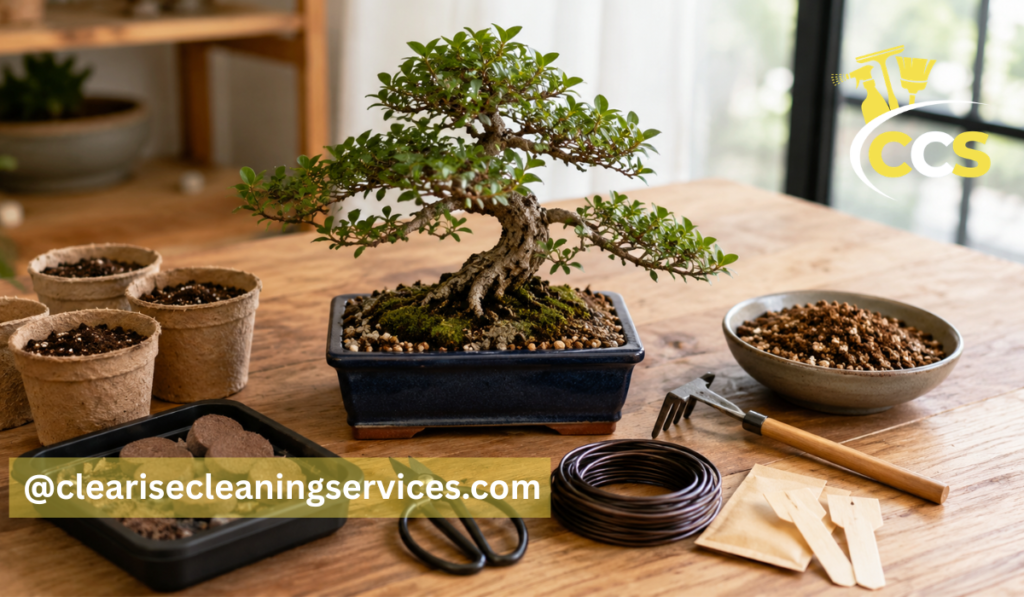
A bonsai tree starter kit is a collection of basic supplies designed to help someone begin growing and training a small tree. Depending on the kit, it may contain seeds, soil, small pots, labels, pruning scissors, training wire, and a care guide. Other kits include a living nursery tree that has already passed the difficult germination stage.
This difference is important because seed-growing kits and live tree kits offer very different experiences. A seed kit allows you to watch a tree develop from the beginning, but it requires patience. The young plant may need several years of growth before its trunk and branches are strong enough for meaningful bonsai styling. A live tree or pre-bonsai kit lets you start learning watering, pruning, branch selection, and light wiring much sooner.
Beginners should also know that there is no special type of “bonsai seed.” Bonsai trees grow from ordinary tree seeds. They become bonsai through long-term care, pruning, root work, and shaping. Choosing the right bonsai tree starter kit therefore depends less on the picture on the box and more on the tree species, the supplies included, and the amount of time you want to invest. Seed Kits vs. Live Tree Starter Kits
A seed kit is best viewed as a tree-growing project rather than an instant bonsai project. You begin by preparing and planting the seeds, then caring for the seedlings while they develop roots, height, and trunk thickness. Some species germinate easily, while others need soaking, cold treatment, or a carefully timed planting season. Even when germination succeeds, the result is a young seedling rather than a finished miniature tree.
A live tree starter kit begins further along the process. It usually contains a nursery sapling or pre-bonsai tree with an established root system and several usable branches. You can study the tree’s shape, remove weak growth, and begin gentle training after it has settled into its new environment. This makes a live kit more satisfying for a beginner who wants to practise the physical skills of bonsai.
Seed kits are usually cheaper and can be rewarding for patient growers, families, and educational projects. However, germination is never guaranteed, and growing a useful trunk can take years. Live tree kits cost more but normally offer a higher chance of early success because the tree is already alive and established.
Choose seeds when the full growing journey is the main goal. Choose a live tree when you want to learn bonsai care and styling without waiting through the earliest stages. How to Find the Best Bonsai Tree Starter Kit
The best bonsai tree starter kit is not always the one with the largest number of tools. Start by checking whether the package contains seeds or a living tree. Product titles can be unclear, so read the full description and look closely at photographs of the actual contents.
Next, check the tree species. A good kit should name each species clearly and provide care instructions for it. Avoid kits that use only broad terms such as “mystery bonsai” or promise that every tree will grow well indoors. A species that needs winter dormancy will not become an indoor tree simply because it is sold in a small pot.
Look at the soil and container as well. The growing medium should drain freely, and every pot should have drainage holes. Basic scissors and wire can be useful, but healthy plant material and correct care information are more important than decorative markers, wooden boxes, or extra accessories.
Quick Guide: Seed Kit vs. Live Tree Kit
| Feature | Seed-Based Kit | Live Tree Kit |
| Starting material | Tree seeds | Living sapling or pre-bonsai |
| Time before styling | Usually several years | Often possible after the tree settles |
| Difficulty level | Medium to high | Low to medium |
| Main challenge | Germination and early growth | Watering, pruning, and placement |
| Success rate | Depends on seed quality and care | Generally higher with a healthy tree |
| Best for | Patient growers and educational projects | Beginners wanting practical bonsai experience |
| Typical supplies | Seeds, soil discs, small pots, labels | Live tree, pot, soil, wire, and shears |
| Indoor suitability | Depends entirely on the species | Choose ficus, jade, or another indoor-suitable species |
| Typical cost | Usually lower | Usually higher |
| Best overall choice | Long-term growing experience | Immediate learning and earlier styling |
The right kit should fit your climate, available light, and level of experience rather than simply looking attractive as a gift. Most traditional temperate bonsai species need outdoor conditions, while only certain tropical and subtropical species can live indoors for long periods. Bonsai Tree Starter Kit for Beginners
A bonsai tree starter kit for beginners should remove confusion instead of creating more of it. Clear species labels, simple instructions, suitable soil, and a proper pot are more valuable than a large collection of low-quality tools. The guide should explain where the tree belongs, how to check moisture, and when to avoid pruning or repotting.
For indoor growing, ficus and dwarf jade are often practical beginner choices because they can live indoors when they receive strong light and stable temperatures. Dwarf jade also stores water in its leaves, so it can handle a short dry period better than many other trees.
For outdoor growing, Chinese elm is widely used by beginners, although its exact winter needs depend on the climate and how the tree was grown before purchase. It needs plenty of light and should not be treated as a low-light desk decoration. ive tree is usually easier for someone who wants to understand bonsai as an art. It allows the owner to observe branch structure and practise basic care from the first week. A seed kit may still be a good beginner purchase when the buyer understands that the first stage is ordinary seedling care and that styling will come much later.
Choosing a Bonsai Tree Starter Kit for Indoor Growing
An indoor bonsai tree starter kit should contain a tropical or subtropical species that can cope with warm, stable household conditions. Ficus and dwarf jade are common choices. Fukien tea, Hawaiian umbrella, and sweet plum may also be sold for indoor use, but their care can be less forgiving for a new grower.
Light is often the greatest challenge indoors. A small tree placed far from a window may stay green for a while but slowly weaken. Choose the brightest practical location, usually close to a suitable window, and turn the tree from time to time so growth remains balanced. Good airflow is helpful, but strong heating or air-conditioning drafts can dry or stress the plant.
Humidity matters, yet it does not replace correct watering. A humidity tray may slightly improve the immediate area around the tree, but the roots still need both moisture and air. Water only after checking the soil, and allow extra water to leave through the drainage holes.
Most temperate trees are not indoor plants. Junipers, Japanese maples, pines, and many other traditional bonsai species need outdoor light and seasonal change. A juniper may be displayed indoors briefly, but it should live outside for the long term. Understanding a Japanese Bonsai Tree Starter Kit
The phrase “Japanese bonsai tree starter kit” can describe several different products. It may contain a species native to Japan, a tree commonly used in Japanese bonsai, a Japanese-style pot, or simply packaging inspired by Japanese design. The label does not automatically prove that the seeds or tree came from Japan.
Japanese maple, Japanese black pine, and juniper are common names in these kits. They can produce beautiful bonsai, but they are not simple indoor desk plants. Japanese maples are deciduous trees that naturally lose their leaves and enter winter dormancy. Junipers also need outdoor conditions, strong light, fresh air, and seasonal temperature changes. ore buying, confirm the full botanical or common species name, whether the product contains seeds or a live plant, and whether your climate can support its needs. Also check whether the seller provides proper germination directions.
A Japanese species may be a rewarding choice, but only when you can provide the correct outdoor environment. Buyers living in very hot climates may also need to protect sensitive species from intense afternoon heat.
Essential Items Every Quality Kit Should Include
A quality kit begins with viable seeds or a healthy living sapling. Seeds should be identified by species and packed with useful preparation information. A live tree should have firm growth, normal leaf colour for the season, and no clear signs of pests, rot, or severe dryness.
The soil should hold enough moisture for the roots while still allowing water and air to move through it. Bonsai mixes often use mineral ingredients such as akadama, pumice, and lava rock, although the best mix varies by tree, climate, and watering habits. Dense garden soil is generally unsuitable for a small bonsai pot because it may drain poorly and become compacted. raining pot should have open drainage holes. Pruning scissors should make clean cuts, and training wire should be flexible enough to shape young branches without damaging them. Labels are useful in seed kits, especially when several species are planted.
Most importantly, the instructions should be species-specific rather than giving one care routine for every tree. A kit containing several types of seeds may need separate instructions because their germination and growing needs can be different.
Bonsai Tree Growing Kit Instructions for Seeds
Read the bonsai tree growing kit instructions for each species before opening the seed packets. Different trees may need different preparation. Some seeds can be planted after a short soak, while others require cold stratification.
Cold stratification keeps seeds in a cool, moist setting for a set period to copy winter conditions and help break dormancy. The required time varies by species, so a single method should not be applied to every packet. a clean container and a light, well-draining growing medium. Plant seeds at the depth recommended for that species. Keep the medium evenly moist but not waterlogged. Constantly wet soil can reduce airflow and encourage mould, while dry soil may stop germination or kill a new root.
Place the container where temperature and light match the instructions. Many seeds do not need strong light before they sprout, but seedlings need suitable light soon after they appear. Remove covers gradually if the kit uses a humidity dome or plastic bag, since young plants also need airflow.
Do not begin heavy pruning or wiring when the seedlings are tiny. The early goal is healthy roots, steady growth, and a stronger trunk. Keep records of planting dates, treatment periods, and germination so you can adjust your method if some seeds fail.
Starting With a Live Bonsai Tree
When a live tree arrives, unpack it carefully and inspect the leaves, branches, trunk, soil, and drainage holes. Some leaf drop can happen after shipping, especially when light and temperature change. However, widespread damage, bad smells, soft roots, or standing water may point to a more serious problem.
Place the tree in the correct location for its species and allow it time to adjust. Do not immediately repot, heavily prune, and wire it on the same day. Each major action causes stress, and combining them can weaken a tree that is already recovering from transport.
Begin by removing clearly dead twigs and learning how the tree responds to watering. Once it shows stable growth, you can select branches and make light cuts. If wire is used, wrap it gently and check it often. Growing branches can thicken quickly, causing wire to leave deep marks.
Repotting should be timed according to the species, season, soil condition, and health of the tree. A decorative pot included in the box is not a reason to disturb healthy roots at the wrong time. Protecting the health of the tree is more important than achieving a finished appearance immediately.
Basic Bonsai Care After Starting the Kit
Watering should be based on the condition of the soil, not a fixed schedule printed on a tag. Check the surface and slightly below it. When the tree needs water, soak the soil thoroughly until water leaves the drainage holes. Then allow the pot to drain.
Weather, pot size, species, season, and root growth can all change how quickly the soil dries. A bonsai may need more frequent watering during hot, windy weather and much less during cool or inactive periods. ce the tree according to its species. Indoor trees need strong natural light and stable warmth, while outdoor trees need natural seasonal conditions. Protect sensitive roots from extreme heat or severe frost when necessary, but do not remove an outdoor species from its normal yearly cycle.
Fertilize during active growth, using a suitable product at the recommended strength. Avoid feeding a severely stressed, newly repotted, or unhealthy tree until the cause of the problem is understood.
Watch for weak growth, yellowing, dry leaf edges, insects, blocked drainage, and soil that stays wet for too long. Early observation is often more useful than buying another tool.
Common Starter Kit Mistakes to Avoid
Overwatering is one of the most common problems. Beginners may water every day because the pot is small, even when the soil is still wet. This reduces air around the roots and may lead to root damage. The opposite mistake is allowing the small root ball to dry completely during hot or windy weather.
Another mistake is treating every kit as an indoor kit. A juniper or Japanese maple may look attractive on a desk, but it cannot remain healthy there throughout the year. Outdoor species need stronger light, fresh air, and normal seasonal changes. d-kit owners may also expect a mature bonsai within a few months. In reality, the first years are mainly about developing the tree. Bonsai grown from seeds begin as ordinary seedlings and may require years before they are ready for serious styling.
Live-tree owners sometimes move too quickly in the other direction by pruning, wiring, and repotting at once. Good bonsai work is gradual. The health of the tree should always come before an immediate visual result.
Comparing Price, Quality, and Long-Term Value
A low-priced seed kit can be enjoyable, but its value depends on seed freshness, correct identification, useful instructions, and suitable supplies. Extra tools do not make up for old seeds or poor soil. Compare the cost of the kit with the cost of buying fresh seeds from a reliable seed seller and basic planting supplies separately.
With a live tree kit, much of the price reflects the age, health, species, trunk development, pot, and shipping care. A small but healthy pre-bonsai in a training pot may offer better long-term value than a weak tree placed in an expensive decorative container.
Also consider future costs. Seedlings may need larger training containers, fresh soil, and several years of care before styling. A live tree may soon need better tools, replacement wire, fertilizer, or repotting supplies.
The cheapest starting price is therefore not always the lowest total cost. Good value means receiving healthy material that fits your goals and growing conditions. Decorative packaging may make a kit more attractive as a gift, but it does not improve the health of the seeds or tree.
Buying a Bonsai Tree Starter Kit for Sale Online
When browsing a bonsai tree starter kit on Amazon or another marketplace, read beyond the main photograph. Confirm whether the listing includes seeds or a live tree, the number and names of species, pot size, soil type, tool quality, and the exact instructions provided.
Study recent customer photographs rather than relying only on polished advertising images. Reviews can reveal repeated issues such as damaged packaging, missing labels, mouldy soil, weak seedlings, or a live tree arriving dry.
However, germination complaints should be judged carefully because results also depend on storage, planting method, temperature, and species treatment. A failed seed does not always prove that the kit is faulty, but a repeated pattern of poor results may be a warning sign.
For live trees, check shipping areas, seasonal restrictions, weather protection, and the seller’s policy for plants damaged in transit. Ordering during extreme heat or freezing weather may place additional stress on the tree.
Avoid listings that promise guaranteed instant bonsai, unusually fast trunk growth, or indoor success for every species. A realistic seller explains both the appeal and the limits of the product.
Using Reddit Reviews and Buyer Experiences Carefully
A bonsai tree starter kit Reddit search can be useful because hobbyists often share unfiltered photographs and describe what happened months after purchase. These discussions may help you identify kits with unclear instructions, ordinary soil, weak tools, poor seed germination, or misleading indoor labels.
Still, Reddit comments are personal experiences rather than controlled tests. One failed packet does not prove that every kit is poor, and one successful seedling does not prove that a kit is consistently reliable. Climate, timing, watering, light, and seed preparation can change the outcome.
Look for patterns across several discussions. Give more weight to comments that identify the species, explain the growing conditions, and show progress over time. A detailed post showing planting dates and later growth is usually more useful than a short comment saying that a kit was simply good or bad.
Compare community advice with a dependable species-care guide before changing your routine. Community experience is most useful when it helps you ask better questions, not when it replaces basic horticultural information.
Conclusion: Choosing a Kit That Matches Your Expectations
The right bonsai tree starter kit depends on the experience you want. A seed kit offers the satisfaction of raising a tree from its earliest stage, but germination can fail and meaningful styling may be years away. A live tree kit costs more, yet it gives beginners a healthier starting point for learning watering, pruning, branch selection, and gentle wiring.
Choose a species that suits your home, climate, and available light. Look for healthy plant material, free-draining soil, a pot with drainage holes, useful tools, and clear species-specific instructions. Do not judge a kit only by the number of accessories or the mature tree shown on the box.
For most beginners who want to practise bonsai skills soon, a healthy live tree or pre-bonsai is the more practical choice. For patient growers who enjoy seed starting and long projects, a well-labelled seed kit can still be rewarding.
Realistic expectations, careful observation, and steady care matter more than any single brand or package.
FAQs
Is A Bonsai Tree Starter Kit Suitable For Complete Beginners?
Yes. A beginner-friendly kit should include a clearly identified tree species, suitable soil, drainage holes, simple instructions, and basic tools. A live tree kit is often easier than growing from seed.
How Long Does A Bonsai Tree Starter Kit Take To Grow?
Seed-grown trees may need several years before they develop enough trunk strength for serious styling. A live tree kit lets you begin basic care and light shaping much sooner.
Can I Keep A Bonsai Tree Starter Kit Indoors?
Only when the kit contains an indoor-suitable tropical or subtropical species, such as ficus or dwarf jade. Junipers, pines, and Japanese maples generally need outdoor conditions and seasonal changes.
What Should The Best Bonsai Tree Starter Kit Include?
A quality kit should contain healthy seeds or a living sapling, fast-draining soil, a pot with drainage holes, pruning scissors, training wire, labels, and clear species-specific care instructions.
Are Bonsai Tree Starter Kits On Amazon Worth Buying?
Some can offer good value, but quality varies. Check recent buyer photographs, species names, seller feedback, seed quantities, soil details, shipping conditions, and exactly what tools are included before ordering.
Disclaimer: This article provides general educational information about bonsai tree starter kits. Growing results can vary depending on the species, seed quality, climate, light, watering habits, and seller. Always follow species-specific care instructions.
Thanks for visiting Clearise Cleaning Services! Discover more helpful tips and expert cleaning insights by exploring our related categories.