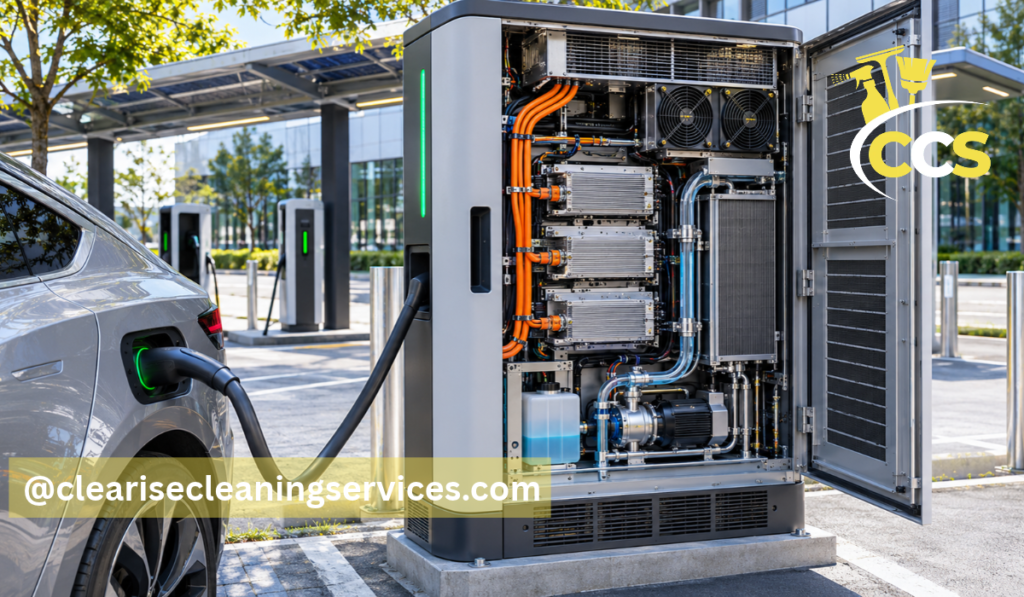
Drivers may expect an ultra-fast session to take only minutes, but the actual charging curve is controlled in part by the vehicle battery. For EV ultra fast charger, system interfaces shape the real outcome. Huawei FusionCharge is built around a liquid-cooled dispenser, central DC charging power equipment, and power-sharing logic. Its website provides conditional figures for charging current and acoustic performance, and it outlines reserved DC interfaces for later battery storage integration.
The Main Hardware Blocks
An EV ultra-fast DC charger includes rectification and power-conversion modules, a dispenser, a charging connector, safety devices, and communications with the vehicle. The complete installation also depends on utility distribution and site controls.
Output power is the product of voltage and current, but the vehicle requests the operating point within supported limits. Different battery packs can therefore draw different power from the same dispenser.
Cooling and Charging Continuity
Circulating liquid removes heat from high-current paths in the charging dispenser. Huawei describes an 800 A liquid-cooled output under defined conditions; continuous-use assumptions need validation from applicable equipment documents.
Current-induced heating increases strongly at higher current. Cable cooling and temperature sensing help keep the connector system within its safe operating envelope during repeated sessions.
The manufacturer also quotes low dispenser acoustic levels at a specified ambient temperature and measurement distance. Urban planners should compare such conditional data with local noise requirements.

Allocating Power Without Overloading The Site
Huawei describes a power-sharing matrix intended to direct available capacity to connected vehicles. Intelligent allocation is useful when some batteries accept high current while others are approaching full charge.
Reserved DC-bus provisions allow future coupling with a stationary battery system where the selected configuration supports it. Storage can assist with peak management, though it does not replace overall energy supply.
The commissioning process should test simultaneous sessions and different vehicle requests. Results need to be assessed against aggregate power ratings rather than idealized output from one dispenser.
One practical design document is a simultaneous-session model: it lists vehicle arrival windows, likely battery acceptance, available DC modules, and the grid import ceiling. This is a better basis for sizing than adding together every dispenser label.
Deployment and Operating Metrics
Charging-site plans should address accessible parking, cable reach, weather exposure, emergency equipment, and safe routes for maintenance staff. Mechanical layout affects how efficiently the hardware can be used.
Operators can compare charge-start success, energy per session, derating time, and faults by hardware component. This distinguishes software or communication issues from physical power limitations.
Evaluating an EV ultra-fast charger requires a system view of conversion, liquid cooling, vehicle communication, and dynamic power allocation. Realistic expectations come from measured session performance and site conditions rather than assuming every car will sustain the rated peak. For EV ultra fast charger, The equipment datasheet, integration drawings, and acceptance tests should all describe the same operating limits.
Thanks for visiting Clearise Cleaning Services! Discover more helpful tips and expert cleaning insights by exploring our related categories.