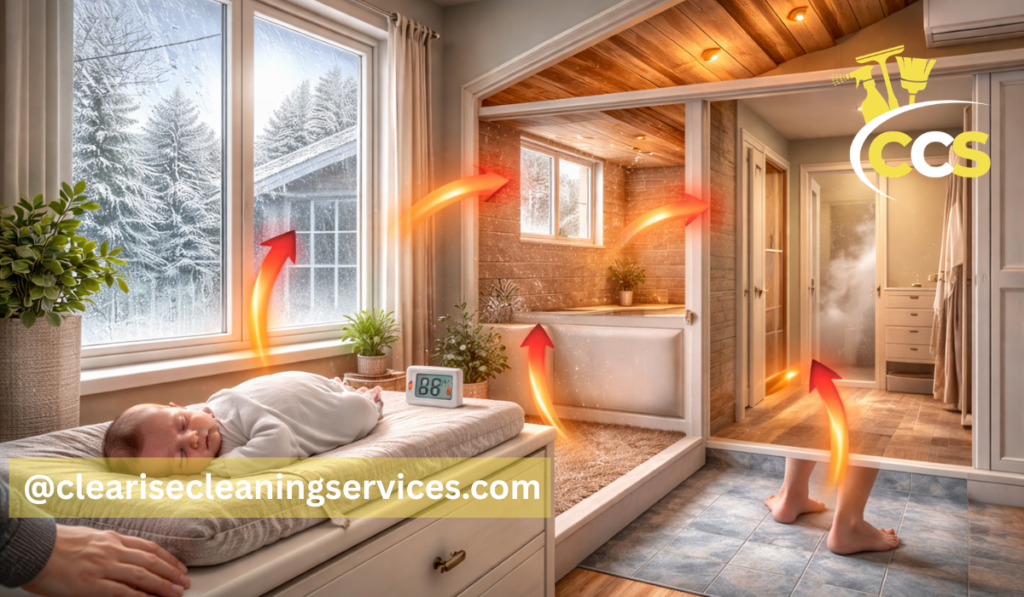
Conduction in house means heat moving through solid materials or by direct contact. For example, when you walk barefoot on a cold tile floor and your feet feel cold, heat is transferring from your body into the floor. The same process happens when warmth inside your home moves through walls, windows, ceilings, or doors toward the colder outdoors.
This matters more than most people realize. Conduction affects comfort, energy bills, and even moisture problems. Cold surfaces can make a room feel chilly, increase heating costs, and create condensation that may lead to mold. For new parents, it is especially important, because babies lose heat quickly when placed on cold surfaces. Understanding how conduction works in a house helps you create a safer, more comfortable home.
Heat Transfer Basics (So the Rest Makes Sense)
Before going deeper into conduction in house, it helps to understand the basic ways heat moves. Once you know these simple principles, many common home comfort problems start to make sense.
The 3 Types of Heat Transfer (Core Trio)
There are three main types of heat transfer:
- Conduction
Conduction is heat moving through solid materials or by direct contact. In a house, this happens when warmth travels through walls, floors, ceilings, windows, or doors. It also happens when your skin touches a cold surface. - Convection
Convection is heat carried by moving air or water. Inside a home, this often means warm air rising, cool air sinking, or drafts around windows and doors. Heating and cooling systems rely heavily on convection to move air through rooms. - Radiation
Radiation is heat transfer through electromagnetic waves. It does not require direct contact or moving air. For example, sunlight warming a room through a window is radiant heat. You can feel it even if the air itself is cool.
Understanding these three forms helps you identify whether a comfort issue is caused by cold surfaces (conduction), air movement (convection), or radiant heat gain or loss (radiation).
The “4 Methods of Heat Transfer” (Home + Baby Version)
In practical terms—especially when discussing home comfort and newborn safety—we often talk about four methods of heat transfer:
- Conduction
- Convection
- Radiation
- Evaporation
Evaporation becomes important when moisture turns into vapor and carries heat away. For adults, this happens when sweat dries on the skin. For babies, it can happen quickly after a bath or if their skin or hair remains damp. Evaporation can cool the body faster than many parents expect.
In a home environment, all four methods can work together at the same time.
Types of Heat Transfer Examples (Everyday Situations)
Here are simple, real-life examples:
- Conduction: Walking barefoot on cold tile. Heat moves from your feet into the cooler floor.
- Convection: A drafty window allows cold air to circulate, making the room feel colder even if the thermostat setting has not changed.
- Radiation: Sitting near a sunny window feels warm because radiant energy from the sun directly heats your body, even if the air temperature remains cool.
When you understand these basics, it becomes much easier to recognize how conduction in house affects comfort, energy use, and safety.
What Conduction Looks Like Inside a House (Real-Life Scenarios)
To truly understand conduction in house, it helps to picture where it actually happens. Heat does not disappear randomly—it moves through specific parts of your home structure.
Heat Transfer Conduction in House Through the “Building Envelope”
The building envelope is the physical barrier between indoor and outdoor environments. It includes the walls, roof, floors, windows, and doors. This is where most conduction occurs.
Common areas where heat transfer conduction in house is strongest include:
- Exterior walls, roof/ceiling, and floors
- Windows, window frames, and doors
- Slab edges and foundations
The key idea is simple: heat always flows from warm to cold when there is a temperature difference. In winter, indoor heat moves outward through solid materials. In summer, outdoor heat can move inward the same way. The greater the temperature difference, the stronger the heat flow.
If insulation is weak or materials conduct heat easily, energy loss increases.
The Hidden Culprit: Thermal Bridging (Cold Spots That Leak Heat)
Even well-insulated homes can have cold areas. One common reason is thermal bridging.
A thermal bridge is a more conductive path that allows heat to bypass insulation. This often happens through:
- Metal components
- Concrete sections
- Uninsulated wood framing
- Structural beams or studs
Because these materials conduct heat more easily than insulation, they create “shortcuts” for heat to escape.
Why this matters:
- You may notice cold corners or strips along walls.
- Certain rooms feel colder even with proper heating.
- Condensation forms on cold surfaces, increasing mold risk.
Many homeowners are surprised to learn that studs inside walls can create subtle vertical cold lines. It is not always poor insulation—sometimes it is simply physics.
Common Conduction Hotspots You Can Actually Check
You do not need advanced tools to spot potential conduction problems. Here are areas worth checking:
Floors
- Tile or stone directly over a concrete slab
- Rooms above uninsulated crawlspaces
Windows
- Glass edges
- Metal or aluminum window frames
- Older double-glazed units with conductive spacers
Walls
- Stud locations
- Headers above doors and windows
- Rim joists (where the floor meets exterior walls)
Other overlooked spots
- Attic hatches
- Recessed ceiling lights
- Fireplace surrounds
If these areas feel noticeably colder than surrounding surfaces, conduction is likely involved.
Materials That Conduct Heat Fast vs Slow (And Why It Changes Comfort)
The materials used in your home make a major difference in how comfortable it feels.
Thermal Conductivity Explained Without Equations
Thermal conductivity simply describes how easily heat moves through a material.
- High conductivity = heat moves quickly
Examples: metal, stone, concrete - Low conductivity = heat moves slowly
Examples: foam insulation, fiberglass, wood
Materials with low conductivity slow down heat flow. That is why insulation works. Metal, on the other hand, transfers heat rapidly, which is why metal window frames often feel cold in winter.
Why Tile Feels Colder Than Carpet at the Same Room Temperature
This is a common question.
Tile does not have to be colder than carpet in actual temperature. It simply pulls heat from your skin faster because it conducts heat more efficiently. Carpet contains air pockets and fibers that slow down heat transfer, so it feels warmer underfoot.
The difference is about rate of heat transfer, not just temperature.
Quick Parent-Friendly Tip Box (Comfort Upgrades)
If you have young children or a newborn, reducing conductive heat loss can improve comfort quickly—even without major renovations.
Simple upgrades include:
- Placing rugs or foam play mats on cold floors
- Using soft slippers or socks indoors
- Adding insulated or thermal curtains over large windows
- Installing draft stoppers at door bottoms
These changes do not eliminate conduction entirely, but they reduce how quickly heat moves through contact surfaces—making your home feel warmer and safer for little ones.
Convection vs Conduction vs Radiation in a Home (So You Don’t Fix the Wrong Thing)
Many homeowners spend money solving the wrong problem. Before upgrading insulation or replacing windows, it helps to identify whether the issue is conduction, convection, or radiation. Each one feels slightly different.
When the Problem Is Conduction (Not Drafts)
Conduction is often mistaken for poor heating.
Signs it may be conduction:
- Rooms feel cold even when there is no noticeable airflow.
- Walls feel cool to the touch.
- Floors, especially tile or concrete, feel cold underfoot.
- Window glass feels chilly even when fully closed.
In this case, heat is moving through solid materials. The thermostat may show a normal temperature, but cold surfaces are drawing heat away from your body.
When the Problem Is Convection (Air Movement)
Convection involves moving air.
Common signs:
- You feel a draft near doors or windows.
- Curtains move slightly on windy days.
- Room temperature changes when wind hits one side of the house.
- Certain spots feel colder because air is circulating unevenly.
Here, the solution is usually air sealing rather than insulation alone.
When the Problem Is Radiation (Surface-to-Body Heat Exchange)
Radiation can be subtle but noticeable.
Example:
- You feel chilled sitting near a large cold window, even though the thermostat reads “comfortable.”
Your body is radiating heat toward the colder surface. It is not air movement—it is radiant heat loss.
How to Prioritize Fixes (Simple Decision Guide)
If you are unsure where to start, follow this order:
- Seal air leaks first – This improves comfort and reduces moisture problems.
- Add or upgrade insulation – This reduces conductive heat loss.
- Address windows and thermal bridges – Improve glass performance or reduce cold structural paths.
This step-by-step approach prevents wasted upgrades and improves overall efficiency.
Conduction HVAC Definition (In Plain English)
When professionals talk about conduction in HVAC systems, they mean heat moving through solid parts of equipment or building materials.
What “Conduction” Means in HVAC Work
HVAC technicians use the term conduction when referring to heat moving through:
- Copper refrigerant line walls
- Metal ductwork
- Heat exchanger surfaces
- Building materials that influence heating and cooling loads
For example, metal ductwork running through a cold attic can lose heat through conduction before warm air even reaches your room.
Why HVAC Efficiency Depends on the Building (Not Just the Unit)
Many people upgrade their heating system but overlook the house itself.
If your home loses heat quickly through conduction—poor insulation, cold windows, or thermal bridges—even the most efficient heater will:
- Run longer
- Use more energy
- Increase utility costs
A high-quality HVAC system works best when the building envelope slows heat loss.
New Parents Section — Convection, Conduction, Radiation and Evaporation in Newborns
For families with babies, understanding heat transfer inside the home becomes even more important.
Why Newborns Lose Heat Quickly (Practical Explanation)
Newborns have limited ability to regulate body temperature. Their skin surface area is relatively large compared to their body weight, and they cannot adjust as efficiently as adults.
They can lose heat rapidly through multiple pathways—especially after bathing or during diaper changes.
The 4 Heat-Loss Methods in Newborns (What It Looks Like at Home)
Conduction
A baby’s skin touching a cold changing table, mattress, or floor can transfer heat away quickly.
Convection
Air from a fan, air conditioner vent, or open window blowing over the baby can increase heat loss.
Radiation
If a crib is placed near a cold window or exterior wall, the baby’s body can radiate heat toward that cooler surface.
Evaporation
Wet skin after a bath, spit-up, sweat, or damp hair can cool the body quickly as moisture evaporates.
All four methods can occur at the same time.
Room-by-Room Newborn Safety Checklist
Nursery / Changing Area
- Use a soft cover on the changing pad.
- Briefly warm a blanket and remove it before placing baby down (for safety, do not leave loose blankets).
- Avoid placing the changing station against a cold exterior wall or window.
Bathroom (Bath Time)
- Dry the baby immediately and thoroughly.
- Have towels ready before removing baby from the water.
- Close doors and reduce drafts during bath time.
Living Room
- Keep baby away from direct airflow from vents or fans.
- Use a rug or play mat on cold floors to reduce conductive heat loss.
Personal-Experience Style Tips (Non-Medical)
One practical trick many parents use is the “touch test.” If a surface feels cold to your forearm, it will draw heat from your baby even faster.
During diaper changes, keep wipes slightly warm (never hot) and place a soft layer between your baby and any hard surface.
Small adjustments like these make a noticeable difference in comfort.
Note: Always follow your pediatrician’s safe sleep guidance. Avoid loose blankets or soft bedding inside the crib.
Methods of Heat Transfer With Examples (Home + Human Body)
To fully understand conduction in house, it helps to remember that the same physics affecting your walls and floors also affects your body. Heat always moves from warm to cold—whether it is inside a building or inside you.
Radiation, Conduction, Convection, Evaporation — Human Body Connection
Your body gains and loses heat through all four methods:
- Conduction: When you sit on a cold bench or walk on a cool floor, heat leaves your body through direct contact.
- Convection: Wind or moving indoor air carries heat away from your skin.
- Radiation: Your body radiates heat toward colder objects around you.
- Evaporation: Sweat or moisture on your skin removes heat as it dries.
The physics is the same as in a house. The difference is speed. Skin is sensitive, so even small temperature differences feel noticeable. This is why cold surfaces inside a home can make people feel uncomfortable even when the thermostat looks normal.
How Is Heat Transferred by Radiation? (Without Jargon)
Radiation does not require touch or moving air.
You feel radiant heat when:
- Sunlight warms your face through a window.
- You stand near a heater and feel warmth on your skin.
The opposite also happens. If you sit near a large cold window in winter, your body radiates heat toward that cooler surface. Even if the air temperature is fine, you may feel chilled. This is radiant heat loss, and it often gets confused with drafts.
Understanding this helps explain why improving window performance can increase comfort—even if insulation levels stay the same.
Practical Fixes to Reduce Conduction Heat Loss in a House (Actionable Steps)
If conduction is increasing your energy use or reducing comfort, there are practical steps you can take. Some are simple and affordable. Others involve larger upgrades for long-term performance.
Low-Cost Fixes (Fast Wins)
These improvements can make a noticeable difference quickly:
- Thick rugs or play mats on cold floors
Especially helpful for crawling babies or tile-over-slab homes. They slow down heat transfer through contact. - Insulated curtains or thermal liners
Large glass areas lose heat through conduction. Thermal curtains reduce heat flow and improve comfort near windows. - Pipe insulation on hot water lines
Insulating exposed hot water pipes reduces unwanted heat loss and improves system efficiency.
These upgrades are affordable and often deliver immediate comfort benefits.
Medium-Cost Fixes (Best Value for Most Homes)
For stronger long-term results:
- Attic insulation improvements
Heat rises, and ceilings often represent the largest surface area for heat loss. Upgrading attic insulation is usually one of the best investments. - Rim joist and crawlspace insulation
These areas are major conduction pathways. Proper sealing and insulation reduce cold floors and drafts. - Window sealing and targeted upgrades
Adding storm windows or improving glazing performance can significantly reduce conductive heat loss without full replacement.
These changes often improve both comfort and energy efficiency.
Advanced Fixes (Long-Term Performance Upgrades)
If you are renovating or building, consider deeper solutions:
- Continuous exterior insulation
This reduces thermal bridging by covering framing elements that normally conduct heat. - High-performance windows and insulated frames
Modern designs reduce both conductive heat loss and cold radiant surfaces. - Foundation or slab-edge insulation
Particularly important in colder climates where floor conduction is a major factor.
While these upgrades require higher investment, they deliver lasting improvements in energy performance and indoor comfort.
By addressing conduction in house thoughtfully—starting with simple steps and moving toward structural improvements—you can create a more efficient, comfortable, and safer living environment for your family.
Quick DIY Checks (No Special Tools Needed)
You do not always need professional equipment to identify conduction problems. A few simple checks can reveal where heat is escaping.
The “Hand + Flashlight” Audit for Conduction Clues
Start with your senses.
- Touch walls, floors, and window edges during cold weather.
- Notice if certain corners feel significantly colder than the center of the wall.
- Check areas near exterior walls, especially behind furniture.
If a surface feels noticeably colder than surrounding areas, conduction is likely happening there.
Also look for condensation patterns in winter. Water droplets on window edges, damp wall corners, or recurring moisture near framing lines often indicate cold surfaces caused by thermal bridging or poor insulation.
A small flashlight helps you spot subtle moisture lines or uneven surface textures that suggest cold spots.
Optional: IR Thermometer or Thermal Camera (If You Want to Level Up)
If you want more precise information, an infrared (IR) thermometer or thermal camera can help.
Here is what to look for:
- Clear surface temperature differences between wall sections.
- Cold vertical or horizontal streaks (often framing members conducting heat).
- Cooler window edges compared to the center of the glass.
These tools do not fix the problem, but they make it easier to confirm where conduction in house is strongest.
Conclusion
Understanding conduction in house helps explain why certain rooms feel colder, why heating systems run longer, and why some surfaces collect condensation. At its core, conduction is simply heat moving through materials and by direct contact.
Improving comfort and efficiency comes from addressing the full picture: reducing cold surfaces with proper insulation and limiting thermal bridges, sealing air leaks to control convection, improving window performance to reduce radiant heat loss, and using newborn-safe routines to prevent rapid cooling—especially through evaporation.
When you understand how heat truly moves inside your home, you can make smarter decisions that improve comfort, energy use, and safety for everyone in the household.
FAQs
What Is Conduction In House In Simple Words?
Conduction in house means heat moving through solid materials or by direct contact. For example, indoor warmth can travel through walls and windows toward the colder outdoors. It also happens when your feet touch a cold floor and lose heat to it.
Heat always flows from warmer areas to cooler areas when there is a temperature difference.
What Are The 3 Types Of Heat Transfer Definition?
The three main types of heat transfer are:
- Conduction: Heat moving through solids or by direct contact.
- Convection: Heat carried by moving air or water.
- Radiation: Heat transferred through electromagnetic waves without contact.
Together, these explain most comfort issues inside homes.
What Are 3 Types of Heat Transfer Examples in Daily Life?
Here are simple examples:
- Conduction: Holding a cold metal spoon and feeling it chill your hand.
- Convection: A fan blowing cool air across your skin.
- Radiation: Feeling warmth from sunlight through a window.
Each method works differently, but all involve heat moving from warm to cold.
What Are the 4 Methods of Heat Transfer With Examples?
The four methods are:
- Conduction: Bare feet on cold tile.
- Convection: Drafty air around a window.
- Radiation: Heat from the sun warming your face.
- Evaporation: Sweat drying on skin and cooling you down.
In homes and human bodies, these processes often happen at the same time.
What Is the Conduction HVAC Definition?
In HVAC terms, conduction refers to heat moving through solid components. This includes metal ductwork, refrigerant lines, heat exchangers, and building materials that influence heating and cooling performance.
If these components lose or gain heat through conduction, system efficiency can decrease.
How Do Newborns Lose Heat by Convection, Conduction, Radiation and Evaporation?
Newborns lose heat in four main ways:
- Conduction: Direct contact with a cold surface, such as a changing table.
- Convection: Air moving over their skin from a fan or vent.
- Radiation: Heat radiating toward a colder window or wall.
- Evaporation: Moisture drying from their skin after a bath.
Because babies cannot regulate temperature as efficiently as adults, managing these four pathways is important for comfort and safety.
Disclaimer: This article is for general informational and educational purposes only. While we aim to provide accurate and practical guidance about conduction in house and heat transfer, the content should not replace professional advice from licensed HVAC technicians, building inspectors, energy auditors, or healthcare providers. Home performance conditions vary by structure, climate, and construction type. For newborn care and temperature safety, always follow guidance from your pediatrician or qualified medical professional.
Thanks for visiting Clearise Cleaning Services! Discover more helpful tips and expert cleaning insights by exploring our related categories.