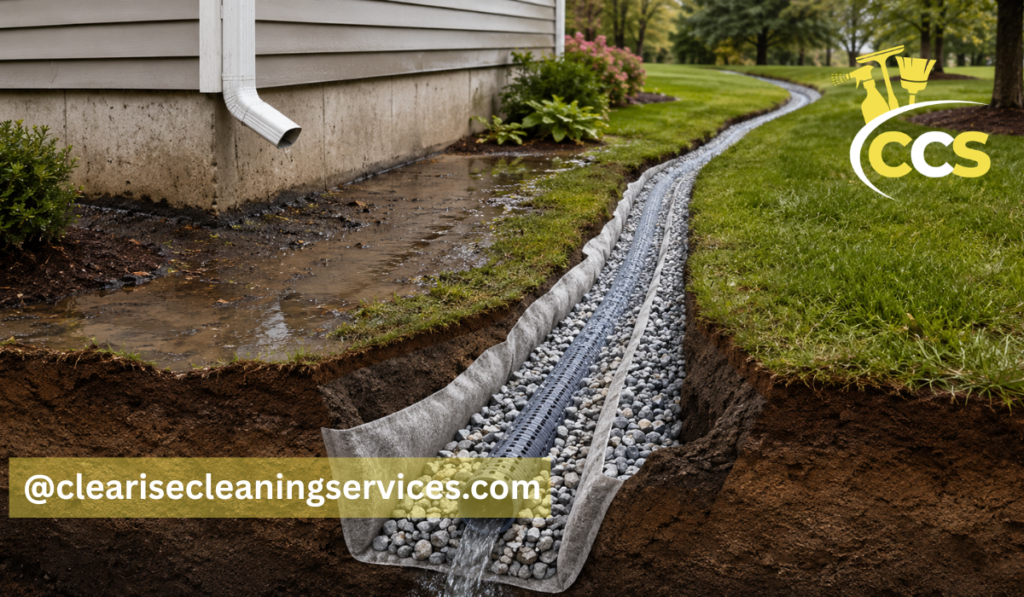
What is a French drain? A French drain is a simple but powerful drainage system that uses a sloped trench, gravel, and often a perforated pipe to collect surface water or groundwater and move it away from places where it can cause damage.
Homeowners usually start searching for a French drain system when they notice standing water, a soggy yard, basement seepage, water pooling near the foundation, or moisture problems after heavy rain. In simple words, a French drain gives water an easier path to follow, so it does not sit around your lawn, basement, driveway, retaining wall, or home foundation.
A French drain can be used for yard drainage, foundation protection, basement flooding prevention, and stormwater management. But it must be designed correctly. If the slope, gravel, pipe, filter fabric, or discharge point is wrong, the system may clog, fail, or even make the drainage problem worse.
Quick Answer: What Does a French Drain Do?
The main purpose of a French drain is to redirect water away from your home or yard. It collects excess water through a gravel-filled trench and sends it to a safer discharge point, such as a dry well, rain garden, soakaway, drainage ditch, or approved storm drain.
A French drain is especially useful when water naturally moves toward your house instead of away from it. Water follows the path of least resistance, and a French drain creates that path using gravity and a downward slope.
A French drain can help with:
| Problem | How a French drain helps |
| Standing water in yard | Moves water away from low spots |
| Basement seepage | Reduces water pressure near foundation walls |
| Waterlogged soil | Improves drainage below the surface |
| Retaining wall pressure | Relieves trapped groundwater |
| Foundation moisture | Redirects water before it causes damage |
A typical French drain is described as a trench filled with gravel and a perforated pipe that collects rainwater or groundwater and directs it away from the home to help prevent leaks, erosion, and foundation problems.
How Does a French Drain Work?
A French drain works by giving water a controlled underground route. Instead of allowing water to collect on the surface or push against your foundation, the drain captures it and moves it to a better location.
First, water enters the gravel-filled trench. Gravel has open spaces between the stones, so water can move through it more easily than compacted soil. This is why clean gravel, coarse gravel, or washed stone is commonly used.
Second, the water reaches the perforated drainage pipe. A perforated pipe has small holes that allow water to enter. Once inside the pipe, the water flows along the pipe because the trench has been installed with a downward slope.
Third, the pipe carries water toward the discharge point. This could be a lower part of the property, a dry well, a rain garden, a soakaway, or another approved drainage location.
Many residential systems use a slope such as 1:50, while some drainage references discuss slopes like 1 in 100 or 1 in 200, depending on site conditions, soil, and drainage design. Homebuilding guidance notes that a slope of at least 1:50 is commonly recommended for proper drainage in residential garden applications.
The key idea is simple: water enters the trench, flows into the pipe, and exits somewhere safe.
Main Parts of a French Drain System
A good French drain system is more than just a hole filled with rocks. Each part has a job.
Gravel-filled trench
The trench is the channel that holds the drainage materials. It is usually dug along the problem area, such as beside a foundation wall, across a soggy lawn, behind a retaining wall, or near a driveway.
The trench is filled with gravel, stone, or another aggregate material that lets water pass through easily.
Perforated pipe
The perforated pipe collects water inside the trench and carries it away. Some older systems used clay pipe, terracotta tile, or drain tile, while modern systems often use plastic pipe, PVC pipe, or corrugated pipe.
Geotextile fabric
Geotextile fabric, also called filter fabric, water-permeable fabric, or landscaping textile, helps stop soil, sediment, and fine particles from entering the gravel and clogging the pipe.
This is important because clogging is one of the most common reasons a French drain stops working.
Discharge point
The discharge point is where the water exits. This may be a dry well, rain garden, soakaway, storm drain, or safe lower area. The drain should never send water toward a neighbor’s property, public sidewalk, or restricted drainage system without checking local rules.
Why Is It Called a French Drain?
The name French drain does not come from France. It is commonly linked to Henry Flagg French, a 19th-century farmer, judge, and writer from Concord, Massachusetts. He helped popularize this type of drainage system in his 1859 book about farm drainage.
That history matters because the original idea was practical: move excess water away from land so the soil becomes more usable. Today, the same basic concept is used around homes, basements, yards, gardens, retaining walls, and even fields.
When Do You Need a French Drain?
You may need a French drain if water repeatedly collects where it should not. One small puddle after a storm is not always a major issue, but repeated water problems can lead to foundation damage, mold growth, soil erosion, and expensive repairs.
Standing water in your yard
If your yard stays wet long after rain, the soil may be compacted, poorly graded, or naturally slow-draining. A French drain for standing water in yard can collect water from the low spot and move it away.
This is common in yards with clay soil drainage problems, low-lying garden areas, or flat landscapes.
Water near your foundation
Water pooling near the foundation is a serious warning sign. Over time, water can increase hydrostatic pressure against the foundation wall. That pressure may push moisture through cracks, joints, or weak spots.
A French drain around foundation can help redirect water before it creates bigger structural problems.
Basement seepage or damp walls
If your basement smells musty after rain, has damp walls, or shows water near the wall-floor joint, groundwater may be pressing against the foundation. An interior French drain or exterior French drain may be considered depending on the source of the water.
Retaining wall pressure
A French drain behind retaining wall helps relieve groundwater pressure. Without drainage, trapped water can push against the wall and cause leaning, cracking, or failure.
Soil erosion on slopes
If water runs across your yard and washes away soil, a French drain may help control surface water runoff and reduce erosion.
Where Should a French Drain Be Installed?
The best place for a French drain depends on where the water is coming from and where it needs to go.
Common installation areas include:
| Location | Why it helps |
| Around foundation | Protects basement and foundation walls |
| Across soggy lawn | Removes water from low areas |
| Behind retaining wall | Reduces hydrostatic pressure |
| Along driveway or patio | Controls water pooling near hard surfaces |
| Bottom of a slope | Catches runoff before it spreads |
A French drain should not be placed randomly. It needs the right route, slope, and outlet. If your yard has a negative slope toward the house, poor gutter drainage, or roof water dumping near the foundation, you may also need downspout extensions, grading improvements, or a separate solid drain pipe.
Interior vs Exterior French Drain
There are two common types of foundation-related French drains: interior French drains and exterior French drains.
An interior French drain is installed inside the basement, usually along the perimeter of the basement floor. It collects water that enters near the wall-floor joint and sends it to a sump pump basin or sump pit. This option is often used when exterior excavation is difficult.
An exterior French drain is installed outside the house near the foundation wall or footing. It intercepts groundwater before it enters the basement. Exterior systems can be effective, but they may require more excavation, landscape repair, and waterproofing work.
| Type | Best for | Main drawback |
| Interior French drain | Basement seepage already entering inside | May require cutting concrete |
| Exterior French drain | Stopping water before it reaches foundation | More excavation and higher labor cost |
For serious basement water problems, a contractor may also recommend a foundation footing drain, footer drain, waterproofing membrane, or sump pump system.
How Deep and Wide Should a French Drain Be?
The correct French drain width and depth depends on the water problem, soil type, rainfall, slope, and location. A shallow yard drain may be much smaller than a foundation drainage system.
Some common residential garden dimensions include around 200mm wide and 450–600mm deep, with a 100mm perforated pipe often used in UK-style residential drainage guidance.
Other homeowner guides mention trenches around 12 inches wide and 18 inches deep for simpler yard drainage projects, though deeper systems may be needed near foundations or in heavy-water areas.
The important thing is not just depth. A French drain must have:
proper slope, enough gravel, filter fabric, the right pipe, and a safe discharge point.
If the drain is too shallow, too flat, or too narrow for the water volume, it may not work well.
French Drain Installation: Basic Process
A full French drain installation should be planned carefully. Small yard drains may be DIY-friendly, but complex systems near foundations, basements, utilities, or retaining walls often require professional help.
The basic process looks like this:
- Plan the route from the wet area to a safe outlet.
- Check for underground utilities before digging.
- Dig a sloped trench with enough fall for water movement.
- Line the trench with geotextile fabric to reduce soil migration.
- Add gravel to create a drainage bed.
- Place the perforated pipe in the trench.
- Cover the pipe with more gravel.
- Wrap or cover with fabric to help prevent sediment clogging.
- Backfill with soil or decorative stone.
- Test water flow before considering the job complete.
For safety, homeowners in the United States should contact 811 before digging. 811 is the national call-before-you-dig number, and it helps arrange marking of buried utility lines before excavation.
This is not a small detail. French drain work often involves long trenches, and hitting a gas line, electrical line, water line, or communication cable can be dangerous and expensive.
How Much Does a French Drain Cost?
French drain cost depends on the length of the drain, soil conditions, excavation difficulty, materials, labor rates, and whether the system is inside or outside.
Recent cost guides commonly place outdoor French drain installation around $10 to $65 per linear foot, with many full outdoor projects ranging from about $1,000 to $6,500 for a 100-foot drain. More complex systems with sump pumps, indoor drainage, foundation work, or landscape repair can cost much more.
Another 2026 cost guide estimates exterior yard drains around $10 to $35 per linear foot and interior basement systems around $40 to $85 per linear foot, with an average project cost near $5,000.
| French drain type | Typical cost pattern |
| DIY yard drain | Lower cost, mostly materials and tools |
| Professional yard drain | Higher cost due to labor and excavation |
| Interior basement drain | More expensive because concrete may be cut |
| Exterior foundation drain | Often costly due to deep excavation and waterproofing |
A French drain contractor may also charge more if the job involves tree roots, hardscape removal, poor access, deep trenching, permits, or connection to a dry well or sump system.
Pros and Cons of French Drains
A French drain can be an excellent drainage solution, but it is not perfect for every situation.
| Pros | Cons |
| Helps remove standing water | Can clog if installed poorly |
| Protects foundation and basement | Requires digging and planning |
| Can reduce hydrostatic pressure | Needs a proper outlet |
| Works underground and can be hidden | May not solve grading or roof runoff alone |
| Can support long-term yard drainage | Professional installation can be expensive |
A French drain is worth considering when water is moving through the soil or collecting in predictable areas. But if your main issue is roof runoff, broken gutters, poor grading, or a flat property with no discharge option, you may need another solution along with or instead of a French drain.
Common French Drain Mistakes to Avoid
Many French drain failures come from poor design, not from the concept itself.
One common mistake is not enough slope. If water cannot move downhill, it may sit inside the pipe or gravel. Another mistake is using the wrong gravel. Fine gravel, dirty stone, or soil mixed into the trench can reduce water flow.
Skipping geotextile fabric is also risky because sediment and fine particles can migrate into the gravel and clog the system. A poor discharge point is another major issue. If the outlet is blocked, too high, or aimed toward a bad location, the drain will not perform correctly.
Homeowners also ask: French drain pipe holes up or down? The answer depends on the pipe type and system design, so it is best to follow the pipe manufacturer’s instructions or a drainage professional’s guidance. The bigger point is that water must be able to enter the pipe and flow out without obstruction.
Other mistakes include connecting too much roof runoff into a perforated system, failing to add cleanout access, placing the drain too close or too far from the problem area, and ignoring local drainage rules.
French Drain Maintenance
A French drain is low-maintenance, but it is not maintenance-free.
Check the outlet regularly to make sure it is not blocked by leaves, mud, grass, or debris. After heavy storms, look for slow drainage, new puddles, or water backing up around the trench.
Basic maintenance includes keeping the outlet clear, removing debris, checking for erosion near the discharge area, and watching for signs of clogging. If the drain has a cleanout, it may be flushed when needed.
Common signs of a clogged French drain include:
- water pooling where it used to drain,
- soggy soil returning after rain,
- water backing up near the outlet,
- sediment collecting at the end of the pipe,
- basement seepage returning.
Good installation with clean gravel, filter fabric, and a visible outlet makes maintenance much easier.
French Drain vs Other Drainage Solutions
A French drain is useful, but sometimes another drainage solution is better.
| Solution | Best for |
| French drain | Subsurface water, soggy soil, foundation drainage |
| Trench drain / channel drain | Surface water across driveways, patios, garages |
| Sump pump | Pumping basement water out when gravity drainage is not enough |
| Dry well | Holding and slowly dispersing collected water |
| Swale | Moving surface runoff across a landscape |
| Regrading | Fixing land that slopes toward the house |
| Dry creek bed | Decorative surface drainage |
A French drain vs sump pump comparison is especially important for basements. A French drain collects water, while a sump pump actively pumps water out. In many wet basements, both systems may work together.
A French drain vs trench drain comparison is also useful. A trench drain catches water at the surface, while a French drain mainly manages water below the surface.
Where Should French Drain Water Go?
French drain water should go to a safe and legal drainage location. Possible outlets include a dry well, rain garden, soakaway, drainage ditch, approved storm drain, or lower area that can handle water without causing damage.
Never assume you can send water into the street, a neighbor’s yard, or a municipal system. Some locations have property line drainage laws, storm drain regulations, local building code requirements, or permit rules.
A good discharge point should be:
lower than the drain, clear of debris, away from the foundation, safe from erosion, and legal for your area.
For outlet protection, some systems use stone, riprap, a pop-up emitter, or another method to slow water and prevent soil washout.
Final Thoughts: Is a French Drain Right for Your Home?
A French drain system is a smart solution when excess water is collecting in your yard, pressing against your foundation, entering your basement, or damaging your landscape. It works by using a gravel-filled trench, perforated pipe, geotextile fabric, and gravity to move water toward a safe discharge point.
The best French drains are not guessed into place. They are planned around soil conditions, water flow, slope, foundation protection, and local drainage rules.
A French drain may be right for your home if you deal with standing water, waterlogged soil, basement seepage, retaining wall pressure, or repeated moisture problems after storms. For simple yard drainage, a DIY project may work. For serious foundation or basement water issues, a qualified French drain contractor or drainage professional is usually the better choice.
FAQs
What Is The Main Purpose Of A French Drain?
The main purpose is to collect and redirect surface water or groundwater away from problem areas like a foundation, basement, yard, or retaining wall.
Does A French Drain Need A Pipe?
Some older or simple French drains may use only gravel, but most modern systems use a perforated pipe because it moves water more efficiently.
Can A French Drain Stop Basement Flooding?
A French drain can help with basement seepage and water pressure near the foundation, but severe flooding may also require waterproofing, grading, gutter repairs, or a sump pump.
Can A French Drain Fix Standing Water In A Yard?
Yes, a French drain for standing water can help if the water has a proper place to go and the drain is installed with the right slope.
What Is The Best Gravel For A French Drain?
Clean, washed, coarse gravel or stone is usually preferred because it allows water to flow and reduces sediment problems.
Do French Drains Clog?
Yes, French drains can clog if soil, roots, sediment, or debris enter the system. Filter fabric, clean gravel, and proper maintenance reduce the risk.
How Long Does A French Drain Last?
A well-installed French drain can last many years, but lifespan depends on soil conditions, materials, fabric quality, root intrusion, clogging, and maintenance.
Can I Install A French Drain Myself?
You may be able to install a small yard French drain yourself if you understand slope, utilities, soil, and discharge rules. For foundation, basement, retaining wall, or major drainage problems, professional help is safer.
Disclaimer: This content is for general informational purposes only and is not professional drainage, plumbing, engineering, or legal advice. French drain needs vary by property, soil, slope, and local regulations. Always check local codes, confirm a safe discharge point, and contact utility-marking services before digging. For serious water, basement, or foundation issues, consult a qualified professional.
Thanks for visiting Clearise Cleaning Services! Discover more helpful tips and expert cleaning insights by exploring our related categories.