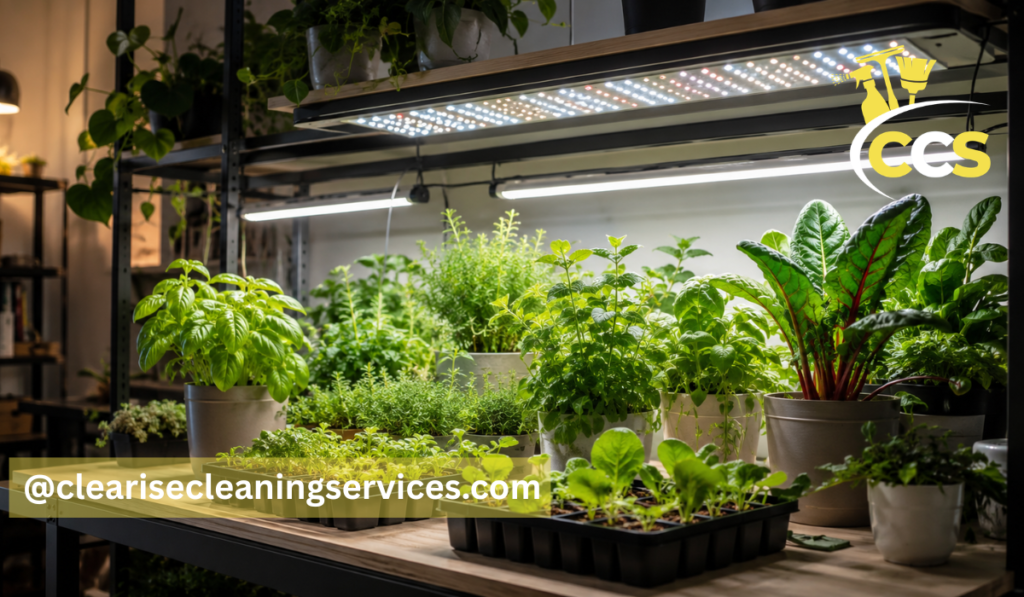
Using LEDs as grow lights is one of the simplest ways to help indoor plants receive steady, useful light when sunlight is weak, limited, or unavailable. An LED grow light converts electricity into light that plants can use for photosynthesis. Unlike ordinary room lighting, a grow light is designed to provide enough intensity and a suitable mix of light wavelengths across the plant canopy.
LED technology has become common in homes, seed-starting areas, grow tents, and controlled farms because it can deliver useful plant light with less wasted energy and less radiant heat than many older lamp types. LEDs are also available in many shapes, from small screw-in bulbs to large panels and bar systems. Quality white LED products may operate for roughly 30,000 to 50,000 hours or longer, although their output normally falls gradually instead of stopping suddenly.
This guide explains how LEDs help plants, what full spectrum means, how to understand PAR and PPFD information, and how to choose the correct coverage, hanging height, and daily lighting time. It also covers basic DIY safety and the claims shoppers should check before buying a grow light.
Quick Guide to LEDs as Grow Lights
| LED grow light type | Best for | Main advantage | Important consideration |
| Screw-in LED bulb | One or two houseplants | Affordable and easy to install | Usually covers only a small area |
| Clip-on grow light | Small plants and compact spaces | Flexible positioning | May not be strong enough for demanding plants |
| LED panel | Grow tents and wider plant areas | Strong, concentrated output | Center may receive more light than the edges |
| LED light bars | Shelves and vertical gardens | Even light distribution | Several bars may be needed for full coverage |
| Full-spectrum LED | Seedlings, herbs, and mixed indoor plants | Supports multiple growth stages | Check actual power draw and PPFD data |
| Red-and-blue LED | Controlled growing setups | Allows spectrum adjustment | Colored light can make plant inspection difficult |
Key Points to Remember
- Choose the light according to the plant’s needs and growing area.
- Check actual power draw instead of relying on advertised replacement wattage.
- Look for clear PPFD maps and recommended hanging heights.
- Use a timer to provide a regular light and dark schedule.
- Watch plants for stretching, bleaching, curling, or slow growth.
- Select certified fixtures that are suitable for indoor growing conditions.
How LEDs Help Plants Grow
Plants use light energy to combine water and carbon dioxide into sugars during photosynthesis. Those sugars support the development of leaves, roots, stems, flowers, and fruit. Light is therefore not simply something that makes a plant look brighter. It is an essential part of the plant’s food-making process.
An ordinary household LED can support a low-light houseplant when placed close enough, especially when the bulb produces a broad white spectrum. However, a normal bulb is mainly designed to light a room for people. Its shape may send light in several directions, and its output may be too low for seedlings, herbs, or fruiting plants.
A purpose-built grow light normally directs more light toward the growing area and provides clearer information about plant-light output. Some grow lights also include additional red or blue wavelengths to support different plant responses.
Visible brightness can be misleading. Human eyes are more sensitive to certain colors, so a lamp that looks very bright may not deliver the amount or distribution of light a plant needs. Plant lighting is better judged by its spectrum, intensity at leaf level, coverage, and the number of hours it operates each day.
Main Benefits of Using LEDs as Grow Lights
The main advantage of LEDs is energy efficiency. They can produce a useful amount of light while drawing less electricity than many older lighting technologies. The exact energy saving depends on the fixture being replaced, its efficiency, the growing area, and how many hours it runs.
General LED lighting can be far more efficient than incandescent lighting. However, horticultural lights should be compared using measured plant-light output rather than broad claims about energy savings or replacement wattage.
LED fixtures also release less radiant heat toward plants than many high-intensity lamps. They still produce heat at the diodes and electrical driver, which is why quality fixtures use metal bodies, heat sinks, or fans to move heat away.
Lower radiant heat can make it easier to place LEDs near plants. However, leaves can still become damaged when a powerful light is placed too close. Light intensity, leaf temperature, airflow, and growing-room temperature must all be considered.
Long operating life is another advantage. Fewer replacements may reduce expense and disruption, particularly when lights operate for many hours every day. LEDs also allow manufacturers to combine blue, green, red, and sometimes far-red diodes in a single fixture. This makes it possible to create broad white light or a spectrum designed for a particular crop or growth stage.
Understanding the LED Light Spectrum
Light spectrum describes the colors, or wavelengths, produced by a fixture. Different wavelengths can influence plant growth, shape, color, and flowering responses.
Blue light is commonly associated with compact growth, leaf development, and control of stem stretching. Research from Michigan State University notes that blue light can reduce extension growth, especially in indoor or low-light environments. However, the response depends on the plant species, light intensity, and the other wavelengths present.
Red light is highly useful for photosynthesis and can influence flowering and other developmental responses. However, red light alone is not automatically better. Plants grown under only one narrow color may develop unusual leaf shapes, weak pigmentation, or excessive stretching.
Flowering and seed-germination responses also vary between species. A red-heavy setting should therefore not be treated as a universal switch that makes every plant flower or germinate faster.
Green light is not wasted. Although leaves reflect some green wavelengths, green light can travel deeper into a dense plant canopy and reach tissues shaded by upper leaves.
Far-red light sits just beyond the traditional PAR range of 400 to 700 nanometres. It can influence plant shape, leaf expansion, stem growth, and flowering signals. Research into far-red lighting continues, so it is better viewed as a useful supporting wavelength rather than a required feature for every indoor plant.
For most home growers, a balanced spectrum is easier to manage than separate red and blue controls. Intensity, distance, and daily exposure often matter just as much as small differences in color.
Full-Spectrum LED Grow Lights Explained
“Full spectrum” usually means that a grow light produces a broad band of visible light instead of only narrow red and blue peaks. However, there is no single spectrum recipe that every manufacturer must follow. Two products carrying the same full-spectrum label may produce noticeably different light.
Many full-spectrum fixtures use white LEDs combined with extra red diodes. The resulting light looks more natural, makes it easier to inspect leaf color, and can support seedlings, leafy growth, flowering, and fruit development without changing fixtures.
Full-spectrum LED grow lights for indoor plants are especially practical for mixed collections. The same fixture may be used for foliage plants, herbs, seedlings, and small flowering plants, provided its intensity and coverage are suitable.
A broad-spectrum fixture does not need to reproduce sunlight perfectly to work well. Natural sunlight changes according to the time of day, weather, season, and location. Indoor plants mainly need a useful mix of wavelengths delivered at the correct strength for enough hours each day.
For a simple home setup, one full-cycle fixture is normally easier to use than separate vegetative and flowering lights. Full-spectrum white light is also more comfortable for rooms where people regularly spend time.
Common Types of LED Grow Lights
Panel lights are flat fixtures containing many LEDs across a board. They suit grow tents, tables, and wider growing areas because they can provide strong light from one compact unit.
Coverage from a panel is usually strongest directly below its center. A PPFD map can help a buyer understand how quickly the intensity decreases near the edges of the recommended growing area.
Light bars spread LEDs along long, narrow strips. They work well on shelves, propagation racks, and vertical gardens because several bars can be placed evenly across the canopy. This arrangement may create more uniform coverage and fewer strong hot spots than one powerful fixture in the center.
Screw-in LED grow bulbs fit common lamp holders and are useful for one or two houseplants. They are easy to install, but the socket must have a suitable electrical rating. An open shade or reflector can help direct more light toward the plant instead of allowing it to spread around the room.
Clip-on and flexible fixtures offer similar convenience for small plant collections. However, their small lighting heads often provide limited intensity and coverage. They may help low-light houseplants but are not always strong enough for large seedlings, herbs, or fruiting crops.
The most suitable style depends on the growing area rather than the product name. A single bulb may be enough for a pothos or small herb pot, while a shelf of seedlings may require two or more bars. A large flowering or fruiting plant will normally need a stronger panel or a well-spaced bar system.
Best Grow Lights for Different Indoor Plants
The best grow lights for indoor plants match the natural light requirements of the species. Shade-tolerant foliage plants such as snake plants, pothos, and some philodendrons can often remain healthy under modest light. They may only need supplemental lighting near a window rather than a powerful grow-tent fixture.
Herbs, young seedlings, and leafy vegetables normally need brighter and more evenly distributed light. Weak lighting commonly causes seedlings to stretch, lean toward the fixture, and develop thin stems.
University guidance for starting seedlings often recommends a long daily lighting period and keeping the fixture close enough to prevent stretching. The distance should be adjusted as the seedlings grow so that the leaves do not touch the fixture or become overheated.
Flowering and fruiting plants generally require more total light than foliage plants. Tomatoes, peppers, strawberries, and many flowering crops may survive under weak lighting but produce few flowers, limited fruit, or slow growth.
Their exact needs depend on the species, variety, plant size, temperature, growth stage, and amount of sunlight already available.
When comparing the best LEDs as grow lights, begin with the plant rather than the advertised wattage. Count the plants, measure the final canopy, consider their natural light requirements, and decide whether the fixture will supplement a window or provide all their light.
PAR, PPFD, and Actual Power Draw
PAR means photosynthetically active radiation. It traditionally refers to light between 400 and 700 nanometres, the range commonly measured when discussing photosynthesis. PAR describes a range of wavelengths. It does not measure how much light actually reaches a plant.
PPFD means photosynthetic photon flux density. It measures the number of PAR photons landing on one square metre every second. It is normally shown as micromoles per square metre per second.
A PPFD reading or map helps show how intense a grow light is at canopy level. It can also reveal whether the corners and edges receive much less light than the center.
Current controlled-environment research continues to use PPFD as a main way to describe plant-light intensity. Researchers also recognize that wavelengths outside the traditional 400–700 nanometre range, particularly far-red, can affect plant growth and form.
Lumens measure visible brightness according to human vision. They are therefore not the best main measurement for a grow light. Lumens may help compare similar white household bulbs, but they do not explain spectrum quality or how evenly the light reaches plants.
Actual power draw is the amount of electricity a fixture pulls from the wall. It affects running cost but does not prove how much useful light reaches the plants.
Two 100-watt fixtures can perform differently because of differences in diode efficiency, optics, heat control, fixture shape, and spacing. Actual wattage should be considered together with PPF or PPFD information, coverage area, and tested efficiency.
Choosing the Correct Coverage Area and Output
Measure the growing area before shopping. Record its length and width, then consider the plants’ final canopy size rather than only measuring their pots. Leaves may spread far beyond the containers, and tall plants may shade lower growth.
Manufacturer coverage claims require context. A fixture may cover a large space when used for low-light foliage plants but a much smaller space when used for seedlings, flowering plants, or fruiting crops.
Check the hanging height used for the advertised coverage and look for a PPFD map showing readings across the entire area. A single reading from the center does not explain how well the fixture lights the edges.
Even distribution is often more useful than one extremely bright spot. If the center leaves bleach or curl while plants near the edges stretch, the light may be distributed unevenly.
Raising the fixture may widen its coverage, but it also reduces the intensity reaching the leaves. Adding a second fixture or using several light bars can improve uniformity without exposing the center plants to excessive light.
Reflective grow-tent walls can reduce some light loss, but they cannot turn a weak fixture into a powerful one. Select enough output for the plants first, and then use reflective surfaces to improve distribution.
Proper Hanging Height and Daily Lighting Time
Always begin with the manufacturer’s recommended hanging distance because fixtures vary greatly in size and power. A small screw-in bulb may need to sit close to a plant, while a high-output panel may require much more space.
After installation, watch the newest leaves and stems instead of assuming one distance will work throughout the plant’s life.
A light that is too far away may cause leaning, long spaces between leaves, pale growth, or slow development. A fixture that is too close or too intense may cause bleaching, dry patches, upward-curling leaf edges, or unusually tight growth.
Leaf temperature should also be checked, even when LEDs are being used. LEDs usually produce less radiant heat than many traditional grow lights, but powerful fixtures can still warm the canopy and the surrounding room.
Many indoor plants and hydroponic crops are grown with approximately 12 to 16 hours of artificial light per day. Seedlings are commonly given around 14 to 16 hours. The correct schedule depends on the plant, light intensity, growth stage, and amount of daylight it already receives.
More hours are not always better. Plants use light and darkness as biological signals, and the flowering of some species depends partly on the length of the dark period.
A timer provides a reliable schedule and prevents accidental around-the-clock lighting. Research into continuous lighting is crop-specific, so home growers should not assume that results from one controlled crop apply to every houseplant or vegetable.
Using LEDs Through Different Growth Stages
Newly germinated seedlings need enough light to prevent stretching, but a powerful fixture should be introduced carefully. Start at the recommended distance or use a lower dimmer setting. The intensity can then be increased as seedlings develop true leaves and stronger root systems.
During vegetative growth, a balanced spectrum containing enough blue light can help produce compact stems and healthy leaves. However, total light remains important. A perfect spectrum delivered at very low intensity will not support strong growth.
Flowering and fruiting plants often benefit from higher total light and a spectrum containing plenty of red. This does not mean that all blue light should be removed. A mixed spectrum supports photosynthesis and balanced plant development throughout the growth cycle.
Plants also become taller and wider as they mature. Raise or reposition the light to maintain an even canopy and prevent the tallest leaves from receiving excessive intensity.
Dimming is useful when plants are young, while movable bars may help reduce shaded areas later. Make lighting changes gradually and observe the plants for several days before making another major adjustment. Light response can vary according to species, temperature, nutrition, and water availability.
DIY LEDs as Grow Lights
A DIY grow-light setup can be suitable for a small seed shelf, propagation station, or houseplant corner when the builder understands basic electrical safety.
A simple project may use rated LED bars or boards mounted to a stable frame and connected to a timer. More advanced projects require correctly matched drivers, wiring, connectors, and heat-management parts.
Do not choose components only by their diode count or color. The electrical driver must match the voltage and current requirements of the LED board. Heat must also be moved away from the diodes. Poor heat control can reduce performance, shorten the fixture’s life, and create a safety risk.
Keep electrical connections away from watering areas, provide proper strain relief, and avoid overloading sockets, power strips, or extension leads. Cables should be secured so they cannot fall into water or be damaged when the fixture is raised and lowered.
Moisture is a major concern around indoor plants. Horticultural lighting creates safety issues that ordinary room fixtures may not fully address, including damp conditions, movable wiring, close exposure, and eye or skin safety.
UL 8800 was developed specifically for horticultural lighting equipment and systems. Recognized safety certification and appropriate damp-location ratings are therefore valuable when selecting parts or finished fixtures.
For most beginners researching DIY LEDs as grow lights, a ready-made certified fixture is safer and often more dependable than building a high-powered lamp from separate electronic parts.
Buying Full-Spectrum LED Grow Lights Wisely
Grow-light product names can be confusing. A listing described as “full spectrum LED grow lights 1000W” may not draw 1,000 watts from the electrical outlet.
The number may be a model name or an estimated replacement rating for an older lamp. Always find the actual power consumption in the technical details and compare it with measured plant-light output.
A useful product listing should provide a spectrum chart, actual wattage, recommended hanging heights, and PPFD maps for the stated coverage areas.
More detailed information may include total PPF, photon efficiency, dimming range, driver specifications, and the conditions under which the fixture was tested. Independent performance certification can provide greater confidence that the advertised output was measured rather than estimated.
Check the warranty terms, return policy, cooling design, electrical certification, and whether the light is suitable for the humidity of the growing space.
Fanless fixtures are usually quieter and contain fewer moving parts. Fan-cooled lights may remove heat effectively, but their fans can collect dust, create noise, and eventually require cleaning or replacement.
When comparing full-spectrum LED grow lights on Amazon or another online marketplace, do not rely only on star ratings, promotional images, or customer photos. Reviews may reveal noise, early failures, and customer-service problems, but they do not replace reliable technical data.
Be cautious when a seller hides actual power draw, provides no PPFD map, or advertises the same large coverage area for seedlings and heavy flowering. A trustworthy grow light should explain how its output changes with hanging height and growing purpose.
Conclusion: Creating a Reliable LED Growing Setup
Using LEDs as grow lights can make indoor growing more reliable, but the fixture should be selected around the plant rather than a dramatic wattage claim.
A dependable setup matches the light spectrum, intensity, coverage, and daily operating time to the plant’s needs and the size of its canopy.
For most houseplants, seedlings, and herbs, a broad white or full-spectrum fixture is a practical starting point. Position it according to the manufacturer’s guidance, control it with a timer, and watch for signs such as stretching, bleaching, curling, or uneven growth.
Flowering and fruiting plants normally require greater attention to PPFD, total coverage, and the amount of light received throughout the day.
The most useful buying information includes actual power draw, spectrum data, PPFD maps, tested efficiency, safety certification, and clear warranty terms. With accurate information and careful placement, LEDs can support healthier indoor plants while keeping energy use, heat, and maintenance manageable.
Frequently Asked Questions
Can ordinary household LEDs Be Used As Grow Lights?
Yes, they may help low-light houseplants when placed close enough, but purpose-built grow lights usually provide better intensity, coverage, and spectrum information.
How many Hours should LED Grow Lights Stay On?
Most indoor plants do well with about 12 to 16 hours of light daily, although the ideal schedule depends on species, growth stage, and available sunlight.
Are Full-spectrum LEDs Better For Indoor Plants?
Full-spectrum LEDs are practical for most indoor setups because they provide a balanced range of wavelengths suitable for seedlings, leafy growth, flowering, and general plant care.
What Does 1000w Mean On An LED Grow light?
It may be a model name or replacement claim rather than actual consumption. Always check the real wall power, PPFD map, coverage area, and efficiency.
How close should LEDs Be To Plants?
Follow the manufacturer’s recommended distance and watch the leaves. Stretching can indicate weak or distant light, while bleaching, curling, or dry patches may signal excessive intensity.
Disclaimer: This article is provided for general educational purposes only. Plant lighting needs can vary according to species, growth stage, room conditions, and fixture design. Always follow the grow-light manufacturer’s installation, electrical-safety, distance, and operating instructions. Product performance and specifications may change, so verify current details before purchasing or installing any lighting equipment.
Thanks for visiting Clearise Cleaning Services! Discover more helpful tips and expert cleaning insights by exploring our related categories.