Clients ask about this constantly, and it’s a fair question. Consumer upholstery cleaning equipment has gotten much better over the last several years. The Bissell and Hoover portable machines in the current generation are legitimately more capable than what existed a decade ago. Rental equipment at most home improvement stores now comes with decent upholstery attachments. So when someone says “I cleaned it myself last month” before we arrive, it’s not necessarily because they didn’t try — it’s because there’s a real gap between what the equipment can do, and that gap shows up in what comes out of the fabric when we use ours.
Understanding the difference isn’t complicated once you know what each type of machine is actually doing inside the fiber. The confusion comes from marketing language that treats all “steam cleaning” and “hot water extraction” as if they’re the same thing when they operate at completely different parameters.
What “Steam Cleaning” Actually Means — And What It Doesn’t
True steam cleaning uses dry steam — water heated to the point where it becomes a vapor with very low moisture content. It sanitizes surfaces and works well on hard surfaces like tile grout, bathroom fixtures, and sealed hardwood. On upholstered fabric, dry steam does a reasonable job of killing surface bacteria and dust mites, but it doesn’t extract what it loosens. The steam loosens particulate matter from the surface fibers; that material then settles back into the fabric when the vapor dissipates. You’ve sanitized what was on the surface, but the embedded load in the base of the fiber hasn’t moved.
Most consumer “steam cleaners” sold for upholstery aren’t true dry steam units. They inject hot water mist into the fabric and then use a low-power vacuum to pull it back out. This is actually closer to hot water extraction than steam cleaning, but at parameters — water temperature, injection pressure, vacuum extraction pressure — well below what professional equipment operates at. The machine can cool the water significantly between the heating element and the fabric surface, particularly when the tank runs below half capacity.
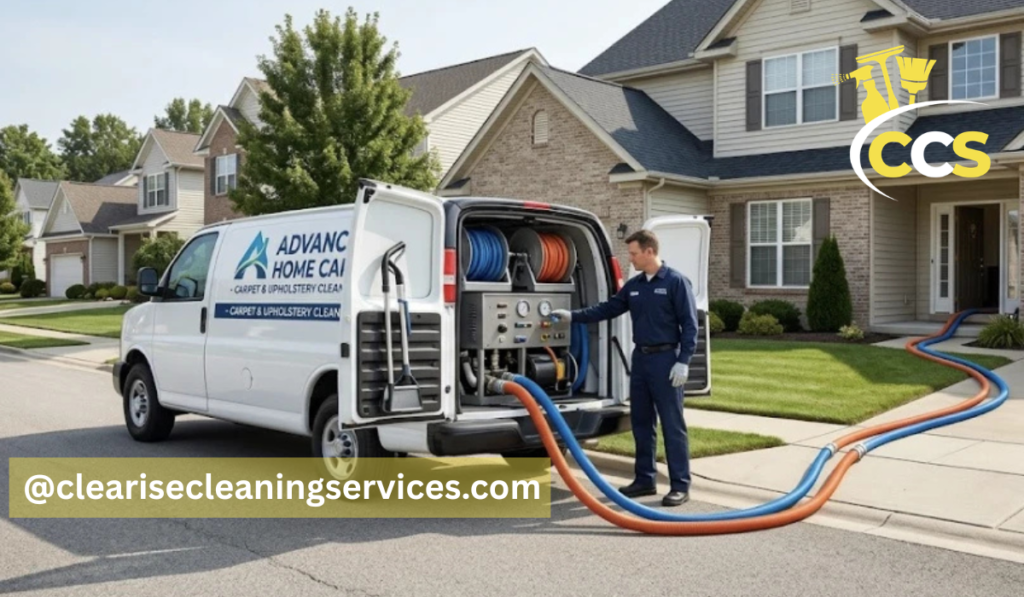
Hot water extraction — what professional cleaning equipment actually does — injects water at controlled high temperature under pressure, allows a short dwell time, and then extracts with high-vacuum pressure before the water has time to fully saturate the fiber backing. The distinction matters because the fiber base is where the accumulated particulate load lives after the first year or two of use. Surface cleaning reaches the pile. Professional extraction reaches the base.
The Numbers That Actually Separate the Equipment
Truck-mounted hot water extraction units operate at water temperatures between 180°F and 212°F at the spray head — the actual point of contact with the fabric. Portable consumer machines typically deliver water between 110°F and 140°F. The temperature difference isn’t incidental; water temperature is what determines whether the enzyme-based pretreatment solutions that break down protein-based soiling (pet urine compounds, body oils, food residue) can activate fully. Most enzymatic cleaners require sustained contact at temperatures above 150°F to complete the chemical reaction that breaks down the molecules causing odor and staining.
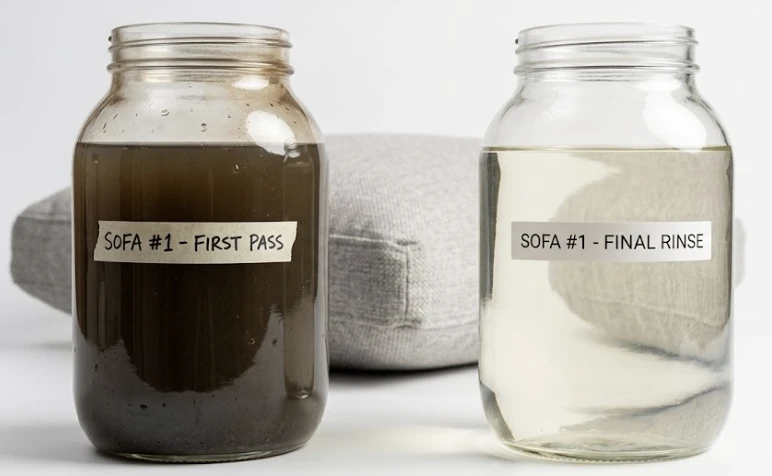
Vacuum extraction pressure is the other variable that separates the categories. Truck-mounted units produce vacuum lift in the range of 200–300 inches of water lift, which translates to enough extraction force to pull moisture and dissolved soiling from the fiber base before it re-deposits. Portable machines typically produce 60–100 inches of water lift — sufficient to pull from the surface pile, not from the base. This is why upholstery cleaned with portable equipment often dries with a slight residue that re-attracts dirt faster than before the cleaning: the machine introduced water and cleaning solution but couldn’t fully extract what it mobilized.
Drying time reflects the extraction efficiency directly. After professional truck-mounted cleaning, most fabric upholstery is dry to the touch within two to four hours under normal conditions, and fully dry through the cushion within six to eight hours. After portable machine cleaning, fabric surfaces take four to eight hours to feel dry on the surface, with full cushion drying often extending to twelve to twenty-four hours — because the machine left significantly more residual moisture in the fiber that has to evaporate rather than being extracted.
What Rental Equipment Actually Is
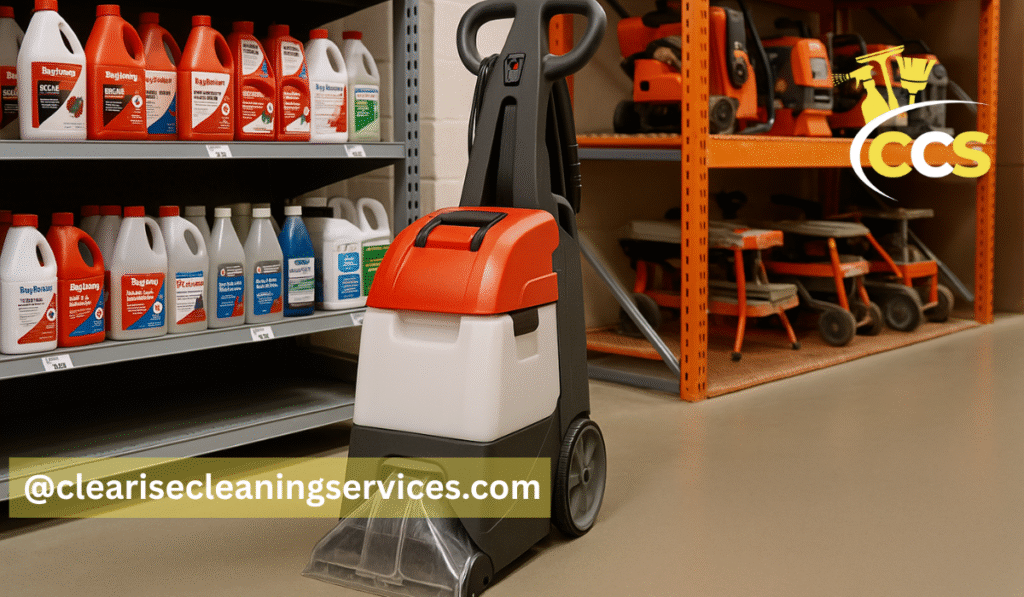
The portable extraction machines available at home improvement stores for weekend rental are generally the same units sold to consumers at the $200–$400 retail price point, sometimes with slightly larger tanks. They’re designed for residential use at residential operating parameters. They work reasonably well for maintenance cleaning — light surface soil removal on furniture that’s been professionally cleaned within the last year, or addressing a fresh spill before it sets.
Where rental equipment runs into its limits is anywhere the soil load has built up beyond the surface pile — typically any upholstered piece that hasn’t been professionally cleaned in two or more years, any household with pets, and any situation where the problem is odor rather than just visible dirt. Odor in upholstery comes from compounds embedded at the fiber base level. A rental machine running at 130°F water temperature with 80 inches of vacuum lift isn’t going to reach those compounds in any meaningful way. You’ll notice an improvement in surface appearance immediately after cleaning and the odor will return within days to a week, because the source of the odor wasn’t addressed — it was briefly masked by the cleaning solution and then the moisture re-activated it as everything dried.
This isn’t a criticism of the equipment category. Rental machines do what they’re designed to do. The issue is using the wrong tool for the scope of the problem, which wastes time, costs money in rental fees and cleaning solution, and in some cases makes the situation worse by introducing moisture that encourages bacterial growth in already-saturated fabric.
When Consumer Equipment Is the Right Call
There are genuine situations where a consumer portable cleaner is the appropriate tool. Fresh spills — wine, coffee, juice — addressed within the first thirty minutes respond well to portable machine extraction because the liquid hasn’t had time to wick down to the fiber base and bond. Pet accidents caught immediately can often be adequately addressed with a portable machine and an enzyme solution if the dwell time is sufficient and the area is small. Lightly soiled surfaces that had professional cleaning within six months and just need a refresh between scheduled professional visits benefit from portable spot treatment.
The cost-effective approach for most households is professional cleaning on an annual or biannual schedule for full upholstered pieces, with a consumer portable unit for interim spot treatment between those appointments. The professional cleaning resets the baseline by extracting what’s accumulated in the fiber base; the consumer unit handles incidental soiling between resets. Trying to replace professional cleaning with more frequent consumer machine use doesn’t produce the same result — it adds moisture cycles to already-embedded soiling and can compress what’s in the fiber base rather than extracting it.
The Pretreatment Variable Most Comparisons Miss
Equipment alone doesn’t explain the full gap between professional and consumer cleaning results. Professional upholstery cleaning involves an application of appropriate pretreatment solution — enzyme-based for biological soiling, solvent-based for oil or grease compounds, oxidizing agents for specific stain types — followed by a dwell period before extraction. The pretreatment chemistry at professional concentration levels, applied at the right dilution and allowed the correct contact time, does much of the actual work before the extraction equipment runs.
Consumer cleaning solutions sold in retail formats are formulated at concentrations safe for untrained use, which generally means lower active ingredient percentages and faster action requirements (because consumers don’t allow the dwell time that professional protocols specify). The consumer machine then runs while active chemistry is still working, which reduces extraction efficiency because the solution is still doing its job rather than having completed it.
A professional upholstery steam cleaner in a trained technician’s hands is as much about chemistry timing and fabric knowledge as it is about the equipment specifications. Knowing which pretreatment works on which fiber type, what dwell time the chemistry needs to complete its reaction, and how to adjust extraction speed for different fabric weights — these are variables that the equipment alone doesn’t control. The truck-mounted unit provides the temperature and vacuum pressure to make the chemistry work; the technician’s training determines whether those capabilities are applied correctly for what the specific fabric and soil type require.
Fabric Type Changes the Calculation
The performance gap between professional and consumer equipment is most visible on fabric types that are common in upholstered furniture but don’t tolerate consumer machine misuse well. Velvet, chenille, and other pile fabrics can develop permanent pile crushing or tracking marks if cleaning is done with incorrect moisture levels or extraction technique. Linen and cotton-blend upholstery shrinks or develops water rings with imprecise moisture control. Microfiber — ubiquitous in mass-market upholstered furniture over the last fifteen years — develops a stiff, crunchy texture when cleaned with high-mineral-content water and insufficient extraction, which is exactly what a portable machine using tap water produces in most parts of the country.
Performance fabrics like Crypton, Sunbrella indoor lines, and solution-dyed polyester weaves tolerate more cleaning variation and are where consumer machines produce their most acceptable results. The fiber construction of performance fabrics resists particulate penetration and permits wet cleaning with a wider range of temperature and pressure parameters. If your upholstery is a tight-weave performance fabric, a quality consumer machine will get you meaningfully closer to a professional result than it would on a velvet or linen piece. If it’s natural fiber, pile construction, or anything with a sensitive finish, professional cleaning is the lower-risk option in every scenario.
The bottom line after seeing both approaches up close across thousands of upholstered pieces: consumer machines are maintenance tools. Professional equipment is restoration and deep cleaning. They serve different purposes, and understanding which situation calls for which saves both time and money — and prevents the kind of damage that turns a cleaning problem into a replacement decision.
Thanks for visiting Clearise Cleaning Services! Discover more helpful tips and expert cleaning insights by exploring our related categories.