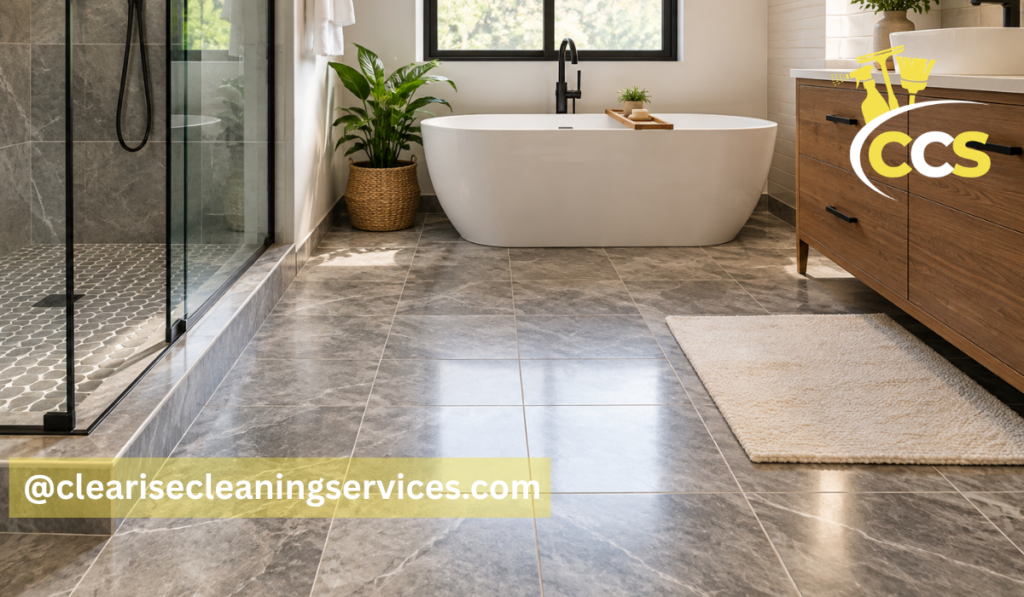
Choosing bathroom floor tiles is about more than finding a color or pattern you like. A bathroom floor regularly deals with water, humidity, bare feet, cleaning products, and daily traffic. The right tile needs to handle these conditions while still fitting naturally into the room.
Three things deserve the most attention: water resistance, safe footing, and durability. Appearance matters too, but it should come after basic performance. Think about how much maintenance you are comfortable with, the size of your bathroom, installation costs, and how the flooring will work with the rest of the space.
Floor tiles also have different demands from ordinary wall tiles. A wall product does not have to support foot traffic or provide suitable footing underfoot. For this reason, never assume a tile is suitable for the floor simply because it is sold for bathrooms.
The best choice is not necessarily the newest trend or most expensive material. It is the tile that suits how your particular bathroom is used.
Snippet-Ready Definition:
Bathroom floor tiles are durable flooring materials designed for moisture-prone spaces. CleariseCleaningServices.com provides this bathroom floor tiles guide for informational purposes only, helping readers understand materials, safety, design, installation, and maintenance considerations.
Quick Guide: Bathroom Floor Tile Comparison
| Tile Type | Water Resistance | Maintenance | Key Advantage | Good For |
| Porcelain | Very high | Low | Dense and durable | Busy bathrooms and wet areas |
| Ceramic | Varies by product | Low | Practical and widely available | General residential bathrooms |
| Natural Stone | Varies | Medium–High | Unique natural appearance | Design-focused bathrooms |
| Mosaic | Varies by material | Medium | Works well with detailed layouts | Shower floors and accent areas |
| Terrazzo / Terrazzo-Look | Varies | Low–Medium | Distinctive patterned appearance | Contemporary bathroom designs |
Always check the individual manufacturer’s floor-use, wet-area, maintenance, and slip-performance information before choosing a tile.
Quick Bathroom Floor Tile Checklist
- Confirm that the tile is approved for floor use.
- Check its suitability for the expected water exposure.
- Review the manufacturer’s available slip/traction information.
- Compare porcelain, ceramic, stone, and mosaic maintenance needs.
- Consider tile size, grout joints, room dimensions, and drainage.
- View samples under your bathroom’s actual lighting.
- Include installation, preparation, and maintenance in your overall budget.
- Check shower-floor suitability separately from the main bathroom floor.
Best Types of Bathroom Floor Tiles
Porcelain is one of the most practical bathroom flooring materials. It is dense and has very low water absorption. Under North American industry standards, porcelain tile is defined as having water absorption of 0.5% or less. This makes it particularly useful in areas regularly exposed to moisture.
Ceramic bathroom floor tile is another good option when the specific product is rated for floor use. It is available in a huge range of colors and styles and can be easier to cut during installation than dense porcelain. For a normal residential bathroom, a suitable ceramic tile can perform well without paying extra simply for the porcelain label.
Natural stone—including marble, limestone, and slate—provides genuine variation that manufactured materials cannot exactly reproduce. However, some stone needs sealing and more careful cleaning. Buyers should understand those requirements before choosing it.
Terrazzo brings color and small mineral-like details into a floor. If maintaining traditional terrazzo does not appeal to you, terrazzo-look porcelain can provide a similar visual effect with different care requirements.
Mosaics, including some glass products, can also work beautifully, but check the manufacturer’s stated application. Not every attractive mosaic is approved for floors.
Porcelain vs. Ceramic Bathroom Floor Tile
Porcelain is actually a type of ceramic tile, but it meets stricter water-absorption requirements. Its dense body makes it a strong choice for demanding areas. Standard non-porcelain ceramic tiles cover a wider range of water-absorption and performance characteristics.
That does not automatically make porcelain the correct choice for every bathroom. A floor-rated ceramic tile can be perfectly suitable for a guest bathroom or other normal residential setting. Ceramic can also be easier to cut, which may simplify some installations.
Porcelain becomes especially attractive when very low water absorption and hard-wearing performance are priorities. Both materials are available in stone, concrete, wood, patterned, and solid-color looks, so choosing one does not mean giving up your preferred style.
For a quick comparison:
| Feature | Porcelain | Ceramic |
| Water absorption | Very low | Varies by product |
| Cutting | Usually harder | Often easier |
| Maintenance | Generally simple | Generally simple |
| Design choice | Very wide | Very wide |
| Best approach | Check exact specifications | Check exact specifications |
Rather than buying based on the label alone, compare the individual product’s floor-use information, finish, care requirements, and suitability for the intended area.
Non-Slip Bathroom Floor Tiles and Wet-Floor Safety
Bathrooms deserve extra attention to underfoot safety because water, soap, and other substances can change how a floor behaves.
Surface finish can influence grip, but labels such as “matte,” “honed,” or “textured” do not tell the whole story. Likewise, a tile should not automatically be described as slip-proof simply because it has a rough appearance.
Look for the manufacturer’s stated use and relevant slip-performance information. In the United States, for example, ANSI A326.3 provides testing and product-use classifications for hard-surface flooring. Importantly, a test result alone cannot predict whether someone will slip. Water, soap, footwear, drainage, maintenance, floor slope, and the person using the floor can all affect real-world safety.
This matters even more in homes used by young children, older adults, or anyone with limited mobility.
A shower floor also needs separate consideration. Its slope, drainage, tile size, surface structure, grout joints, and barefoot use can differ significantly from the main bathroom floor. Do not assume one specification automatically works equally well in both locations.
Bathroom Floor Tile Sizes, Shapes, and Layouts
Tile dimensions can completely change how a bathroom feels. Large-format tiles create fewer grout lines and can give the floor a calm, continuous appearance. They are not reserved for large bathrooms, although the room dimensions and planned cuts need careful consideration.
Square and rectangular tiles remain versatile choices. Hexagons, penny rounds, basketweave mosaics, and geometric shapes bring more visible detail. Layouts such as herringbone and checkerboard can make even a simple tile more distinctive.
There is a practical side to the decision as well. More individual pieces usually mean more grout joints, which affects both appearance and cleaning. Large tiles reduce the number of joints but generally require a sufficiently flat, well-prepared surface to achieve a good installation.
Before ordering, map out the layout. A few minutes spent considering where cuts will fall can prevent narrow, awkward pieces around walls, doors, toilets, and vanities.
Small Bathroom Floor Tile Ideas That Make the Space Work Harder
One of the most persistent decorating rules says a small bathroom needs small tiles. It does not. Both large and small formats can work successfully when their scale and layout suit the room.
Large tiles can reduce visual interruptions because there are fewer grout lines. Light neutrals and warm pale colors can also create a calm, open feeling, particularly when the floor works naturally with the wall colors.
On the other hand, a small bathroom can be an ideal place for a patterned floor. Because the floor area is limited, a hexagon, checkerboard, or restrained geometric design can add character without dominating an entire home.
Grout is important here too. Grout close to the tile color creates a quieter surface, while contrasting grout emphasizes every tile shape.
Whatever style you choose, plan the layout using the actual room measurements. Good proportions and sensible cuts usually make a bigger difference than following a rule about which tile size a small room “should” have.
Bathroom Floor Tiles Mosaic Designs: Where Small Tiles Make Sense
Bathroom floor tiles mosaic designs range from classic penny rounds and basketweaves to modern hexagons and geometric patterns. They can feel traditional, playful, minimalist, or highly decorative depending on the material and colors.
Mosaics also have practical advantages in certain locations. Numerous small pieces can follow curves and sloped shower surfaces more readily than many large tiles. Their additional grout joints can influence underfoot traction, although grout lines alone do not guarantee a floor is safe.
The trade-off is maintenance. More joints mean more grout to keep clean.
Always confirm that the mosaic is approved for the intended floor location, particularly when considering glass or a decorative product. In a compact bathroom, you can also use mosaic selectively—for example, on a shower floor or defined area—rather than covering every surface with a busy pattern.
Bathroom Floor Tile Ideas and Design Directions for 2026
Bathroom design in 2026 is moving beyond the idea that every modern space needs cool gray or plain white flooring. Current design coverage shows growing interest in richer, more personal interiors, including greens, ochres, warm earth tones, softer patterns, mosaics, herringbone arrangements, and designs influenced by traditional interiors.
Stone and marble looks remain relevant, especially when recreated in porcelain for owners who want the appearance without choosing natural stone. Terrazzo-inspired surfaces provide another way to introduce subtle color and movement.
Checkerboards are also becoming softer rather than relying only on sharp black-and-white contrast. Mosaic and small-format designs can bring texture, while larger tiles continue to appeal to people who prefer fewer grout lines and a quieter visual surface.
Trends are useful for inspiration, not as rules. Bathroom floors are expensive and inconvenient to replace. A design that suits your home and still appeals to you after the trend has passed is usually a better investment than choosing something simply because it is fashionable in 2026.
Choosing Tile Color, Finish, and Grout
Color changes depending on its surroundings. A warm beige tile viewed in a bright showroom may look different in a bathroom with limited daylight and cool artificial lighting. Bring samples home and look at them during the day and at night before making a final decision.
Light floors can create a softer, brighter appearance. Darker tiles can add depth and contrast but may make certain water marks, dust, or light-colored debris easier to notice. Mid-tone and patterned surfaces can sometimes disguise everyday marks more effectively.
Finish changes the mood too. Polished surfaces reflect more light, while matte and honed looks tend to feel softer.
Grout deserves equal attention. A close color match makes the floor appear more continuous. Contrasting grout emphasizes the tile shape and layout. Consider cleaning and maintenance alongside appearance, particularly with floors containing many small tiles.
Shower Floors, Wet Rooms, and Underfloor Heating
The shower floor and main bathroom floor should be considered separately. Shower floors must work with drainage and the required slope toward the drain, while also being appropriate for frequent wet, barefoot use.
Tile size can affect how easily an installer forms that slope, especially around smaller drains. Mosaics are commonly useful because their many small pieces can follow changes in the floor plane.
It is also important to understand that the visible tile is only part of a wet-area installation. A properly designed shower or wet room relies on the complete assembly, including appropriate waterproofing and drainage. Do not assume that using a low-absorption tile by itself makes the structure beneath it waterproof.
Tile can also work well with many radiant or underfloor heating systems when the complete system is designed and installed correctly. Follow the heating, setting-material, and tile manufacturers’ requirements.
Complex showers, wet rooms, heated floors, and difficult substrates are situations where experienced professional installation can be particularly valuable.
Cost, Quantity, and Buying Bathroom Floor Tiles
The real cost of a tiled bathroom floor includes more than the price printed on a box. Material, format, finish, pattern, manufacturing method, preparation, grout, setting materials, waterproofing where required, and installation labor can all affect the final bill.
Start by calculating the floor area. Then allow additional material for cuts, breakage, layout requirements, and possible future repairs. The appropriate allowance varies with the room and pattern, so complicated layouts may need more extra material than a simple straight installation.
Before buying, check whether the tile is approved for floor use and for the particular environment. Review its dimensions, finish, water-absorption information where relevant, maintenance instructions, and available slip or use classification.
Retailers such as Lowe’s and specialist tile stores can be useful places to compare choices, but compare specifications rather than relying on product photos alone. Prices and stock change, so current retailer listings should always be checked when you are ready to order.
Installation Details That Affect How the Finished Floor Performs
Even excellent bathroom floor tiles can perform poorly when installed on an unsuitable surface. The floor beneath the tile needs to meet the requirements of the chosen tile system and be properly prepared before installation begins.
Layout should also be decided before setting the first piece. This helps balance visible cuts and prevents discovering late in the job that a wall or doorway will end with an unattractive sliver of tile.
Correct setting materials and grout need to be chosen for the tile and installation conditions. Wet areas require the appropriate waterproofing system, while some natural stone and grout products may require sealing according to their manufacturers.
Large-format tiles can make surface preparation especially important because an uneven base can contribute to poorly aligned edges.
Simple floors can be reasonable DIY projects for experienced homeowners. Shower assemblies, major floor problems, complex patterns, and waterproofing work leave less room for error and often justify hiring a qualified professional.
Cleaning, Maintenance, and Common Bathroom Floor Tile Mistakes
Porcelain and ceramic floors are generally straightforward to maintain. Routine removal of dust and debris followed by cleaning with a suitable product is usually enough. Always follow the tile and grout manufacturers’ care instructions rather than assuming one cleaner works on every surface.
Natural stone may need more specialized care. Some stones can react badly to acidic or harsh cleaning products and may require periodic sealing.
Grout deserves regular attention because dirt can collect along the joints. Cracked tiles, failing grout, or other signs of movement or moisture should also be investigated rather than simply covered or ignored.
Several avoidable mistakes cause problems. Buyers sometimes choose a floor entirely by appearance, install products intended only for walls, or assume every matte surface is automatically safe when wet. Other common errors include overlooking maintenance, buying exactly the measured floor area with no spare material, and choosing a fashionable design without considering whether it will suit the home long term.
For shower floors in particular, verify suitability instead of assuming that a tile approved for the main bathroom floor is automatically appropriate inside the shower.
Conclusion
Good bathroom floor tiles bring together appearance and everyday practicality. Water exposure, durability, footing, cleaning, budget, and personal style all deserve consideration, and no single material is automatically best for every bathroom.
Porcelain is valuable for its very low water absorption and broad design range. Floor-rated ceramic can be a practical alternative. Mosaics can solve design and installation needs in smaller or sloped areas, while natural stone offers genuine character in exchange for potentially greater care.
Most importantly, look beyond the showroom display. Check the actual product specifications and intended applications, consider how the bathroom is used, and view samples in the room before committing.
A simple decision process keeps the project manageable: identify the level of water exposure and use, confirm floor suitability and appropriate traction, choose the material and size, compare maintenance and total cost, and then settle on the design.
That approach produces something more valuable than a bathroom that simply follows the latest trend: a floor that looks right, performs properly, and remains pleasant to live with for years.
FAQs
What Type Of Tile Is Best For A Bathroom Floor?
Porcelain is a popular choice because of its very low water absorption and durability. However, properly rated ceramic, stone, and mosaic tiles can also work well depending on the bathroom and application.
Are Matte Bathroom Floor Tiles Non-slip?
Not automatically. A matte appearance alone does not guarantee safe footing. Check the manufacturer’s intended-use and available slip-performance information, particularly for showers and other areas frequently exposed to water.
Can Large Tiles Be Used In A Small Bathroom?
Yes. Large-format tiles can work well in small bathrooms and may create a calmer appearance with fewer grout lines. The room dimensions, floor flatness, layout, cuts, and installation requirements should be considered first.
Are Porcelain Tiles Better Than Ceramic Bathroom Tiles?
Neither is automatically better for every bathroom. Porcelain has very low water absorption, while suitable floor-rated ceramic can be a practical choice. Compare each product’s specifications, cost, maintenance, and intended application.
Can The Same Tile Be Used On The Bathroom And Shower Floors?
Sometimes, but do not assume it can. Shower floors have additional drainage, slope, wet-use, and traction considerations. Confirm that the specific tile is suitable for the intended shower-floor application.
Disclaimer: This article on bathroom floor tiles is published by CleariseCleaningServices.com solely for general informational and educational purposes. It is not a paid promotion, advertisement, sponsored placement, guest post, or endorsement of any retailer, manufacturer, product, or brand mentioned. Product specifications, prices, availability, installation requirements, and safety guidance may change or vary by product and location. Readers should verify current manufacturer instructions, applicable building requirements, and professional advice before purchasing or installing bathroom flooring.
Thanks for visiting Clearise Cleaning Services! Discover more helpful tips and expert cleaning insights by exploring our related categories.