Cleaning looks simple from the outside. Inside, crews work with chemicals, wet floors, sharp debris, and heavy lifting, often on evening shifts with few people around. When something goes wrong, the first few minutes matter. A slip beside a mop bucket can end a shift. A splash of the wrong product can mean a trip to the emergency room. Preparation is cheap by comparison. Windsor employers who want a plan often start by searching for Coast2Coast First Aid Training Windsor and then check what their own crews actually need.
What Hazards Do Cleaning Crews Face?
Cleaning crews face chemical exposure, slips and falls, cuts, and strain injuries every shift. Most of these look routine, which is why they catch people off guard.
- Chemical splashes: Bleach, degreasers, and drain cleaners can burn skin and eyes.
- Slips and falls: Wet floors, buckets, and stairs create constant risk.
- Cuts and punctures: Broken glass and sharp items turn up in waste bins.
- Strain injuries: Lifting, bending, and pushing equipment can hurt backs and shoulders.
- Sudden illness: Heat, long shifts, and fumes can cause dizziness or fainting.
No one plans to get hurt. A crew that knows the basics can act fast and keep a bad moment from getting worse.
What Should A Worker Do After A Chemical Splash?
Rinse the area with plenty of clean running water right away, call for help, and follow the product’s safety data sheet. Speed matters more than perfect technique.
For skin contact, remove contaminated clothing and rinse the skin for at least 15 minutes. For the eyes, flush with clean water for at least 15 minutes, keeping the eyelids open. If the person is struggling to breathe, losing consciousness, or in severe pain, call 911. If swallowing is involved, contact a poison centre and follow their direction.
A first aid course teaches these steps in practice, with an instructor to correct mistakes. Reading about them once isn’t the same as rehearsing them. Chemical handling training, such as WHMIS, is a separate course, so plan for both.
How Should Crews Handle A Cut Or A Fall?
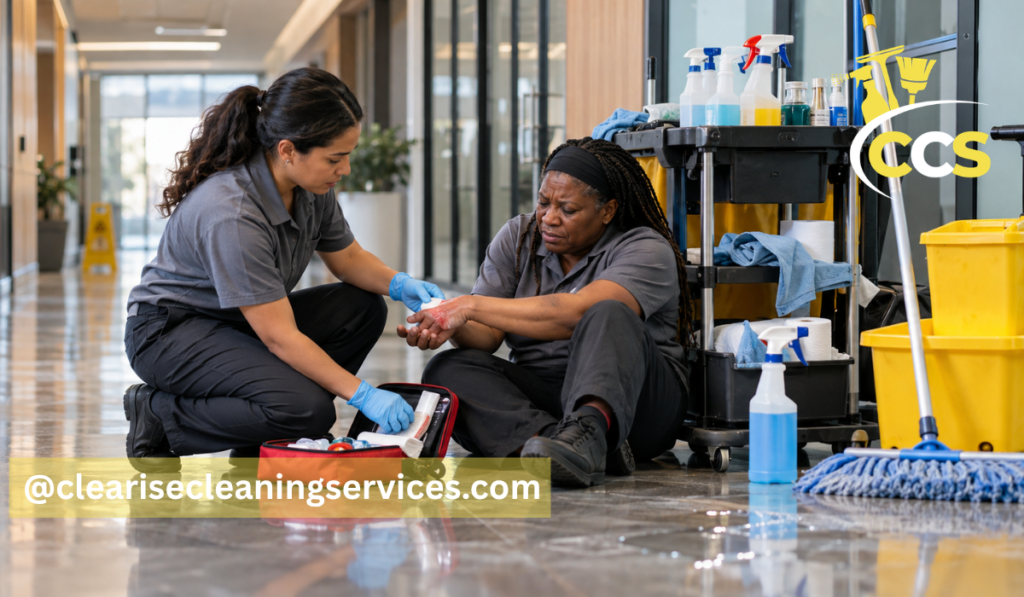
For a bleeding cut, press firmly on the wound with a clean cloth and keep pressing; for a hard fall, keep the person still and call 911 if a head, neck, or back injury is possible. Both steps are simple, and both are easy to get wrong without practice.
If blood soaks through the cloth, add another layer on top instead of lifting the first. Call 911 for heavy bleeding that won’t stop. After a fall, don’t help the person stand if they’ve hit their head or complain of neck or back pain. Stay with them and wait for paramedics.
Why Do Lone And Night Shifts Raise The Stakes?
When a worker is alone, no one is nearby to call for help or give care. That makes planning more important, not less.
Many cleaners work after hours in empty offices, clinics, or warehouses. If someone falls or feels unwell, minutes can pass before anyone notices. Employers can reduce that risk with a few habits:
- Set regular check-in times for workers on their own
- Make sure every worker has a working phone and knows the site address
- Show every worker where the first aid kit and AED are
- Train crew leads so someone on each shift can give care
Training also gives a worker the confidence to treat themselves or a coworker until help arrives.
What Does First Aid Training Cover For Cleaning Teams?
A first aid course teaches workers to recognize an emergency, call 911, and give care until paramedics arrive. Skills vary by course, but they include:
- Controlling bleeding from cuts and punctures
- First aid for poisons and chemical exposures
- Head and spinal injuries after a fall
- Bone, muscle, and joint injuries
- Medical emergencies such as fainting and chest pain
- The recovery position
- CPR and automated external defibrillator trainer practice
CPR Level C covers adults, children, and infants. Cleaners who work in schools, daycares, or medical offices may meet people of every age, so it’s a useful addition.
What Do Ontario Employers Need To Meet?
Ontario workplaces covered by WSIB must have trained first aiders, and a standalone CPR course doesn’t count. Regulation 1101 sets the level by workplace size.
- Five or fewer workers: Emergency (Basic) First Aid with CPR/AED
- More than five workers: Intermediate (Standard) First Aid with CPR/AED
Most workplaces need the intermediate level, which runs 16 hours. Employers should also think about shift coverage. If your crews work nights and weekends, make sure each shift has a trained person, not just the day team. A quick review of how many workers you employ will tell you which level applies.
How Can Cleaning Businesses Fit Training Around Contracts?
Blended learning lets crews finish the theory on their own time, then attend a short classroom skills session. Workers complete a self-paced online portion of the training first. The in-class time goes to practice with manikins and an AED trainer.
For a business with shifting contracts, that means less disruption. Certificates are issued within 48 hours, and first aid and CPR students receive a free 90-day skills practice retake. Owners who want to compare dates can find out more here and schedule training between client sites.
Where Should A Cleaning Business Start?
Start small and keep it practical:
- Walk a typical site and list the top three hazards.
- Check that first aid kits are stocked and easy to reach.
- Train a lead on each shift and each major contract.
- Post emergency addresses and phone numbers at every site.
- Practise a short drill twice a year, such as an eye flush or a call to 911.
Your clients trust you with their buildings. Your crews trust you with their safety. A trained team honours both.
If you are looking for first aid training near Howard Avenue, Tecumseh Road East, East Windsor, the Ambassador Bridge corridor, or surrounding areas, you may reach out to Coast2Coast First Aid & Aquatics in that area.
FAQS
Q: Why Do Cleaning Crews Need First Aid Training?
A: Cleaning work involves chemical exposure, slips, cuts, and strain injuries, and trained workers can give care in the first minutes before paramedics arrive.
Q: What Should You Do After A Chemical Splash In The Eyes?
A: Flush the eyes with clean running water for at least 15 minutes, keep the eyelids open, and call for medical help or 911 if symptoms are serious.
Q: Does a CPR Course Meet Ontario WSIB First aid Requirements?
A: No. WSIB Regulation 1101 requires first aid training, so a standalone CPR course does not satisfy it for covered workplaces.
Q: Which First Aid Level Do Most Workplaces Need?
A: Most workplaces need Intermediate (Standard) First Aid, which applies when a workplace has more than five workers. Emergency (Basic) First Aid applies to five or fewer.
Q: How Should Employers Protect Workers On Lone Or Night Shifts?
A: Set check-in times, make sure workers have a phone and the site address, show them where first aid supplies and the AED are, and train crew leads on each shift.
Thanks for visiting Clearise Cleaning Services! Discover more helpful tips and expert cleaning insights by exploring our related categories.