
A window air conditioner is a simple idea: a box that sits in your window, cools one room, and costs far less than a whole-house system. But the choice is confusing, with dozens of sizes, features and prices. Good AC window units are not the biggest or the most expensive ones. They are the ones that match your room, fit your window, run quietly, and keep working year after year. This guide shows you how to find good AC window units without paying for features you will never use.
What Makes Good AC Window Units?

Good AC window units are the right size for the room, cool evenly without big temperature swings, run quietly enough to sleep near, use power efficiently, and are built well enough to last for years.
Cooling power is measured in BTU per hour, and a good unit matches its BTU rating to the room it serves. An undersized unit runs all day and never quite cools the room, while an oversized unit cools the air fast but shuts off before it removes enough humidity, leaving the room cool but clammy. Efficiency matters too: look for a high CEER rating, the energy-efficiency measure for room air conditioners, and for ENERGY STAR certification, which marks units that beat the standard. Noise is measured in decibels, and a good bedroom unit is quiet enough to sleep near.
What Size Window AC Do You Need?
To size a window AC, measure the room’s floor area in square feet, then match it to the ENERGY STAR room air conditioner chart, which starts at 5,000 BTU per hour for 100 to 150 square feet and rises to 34,000 BTU per hour for 2,000 to 2,500 square feet.
The chart is a starting point, not a final answer. Measure the length and width of the room and multiply them to get the floor area, then find that area in the table below. After that, adjust for the room itself. ENERGY STAR guidance says to reduce capacity by 10 percent for a heavily shaded room, increase it by 10 percent for a very sunny room, add 600 BTU per hour for each regular occupant beyond two, and add 4,000 BTU per hour if the room is a kitchen. If your room falls outside the chart, below 100 square feet or above 2,500, do not guess from the table; get advice for that space specifically.
| Room area (sq ft) | Starting capacity (BTU/h) | Typical room |
|---|---|---|
| 100–150 | 5,000 | Small bedroom, home office |
| 150–250 | 6,000 | Bedroom, small living room |
| 250–300 | 7,000 | Medium bedroom |
| 300–350 | 8,000 | Living room, large bedroom |
| 350–400 | 9,000 | Large living room |
| 400–450 | 10,000 | Open living area |
| 450–550 | 12,000 | Large open room |
| 700–1,000 | 18,000 | Open-plan living space |
One example shows how the adjustments work. A room of 300 to 350 square feet starts at 8,000 BTU per hour. If it is very sunny, add 10 percent, which takes it to about 8,800 BTU per hour. If four people use the room regularly, add 600 BTU for each person beyond two, which is 1,200 more, taking it to 10,000 BTU per hour. Work through the same steps for your own room, and good AC window units stop being a guess and start being a number.
Window AC vs Portable AC: Which Is Better?
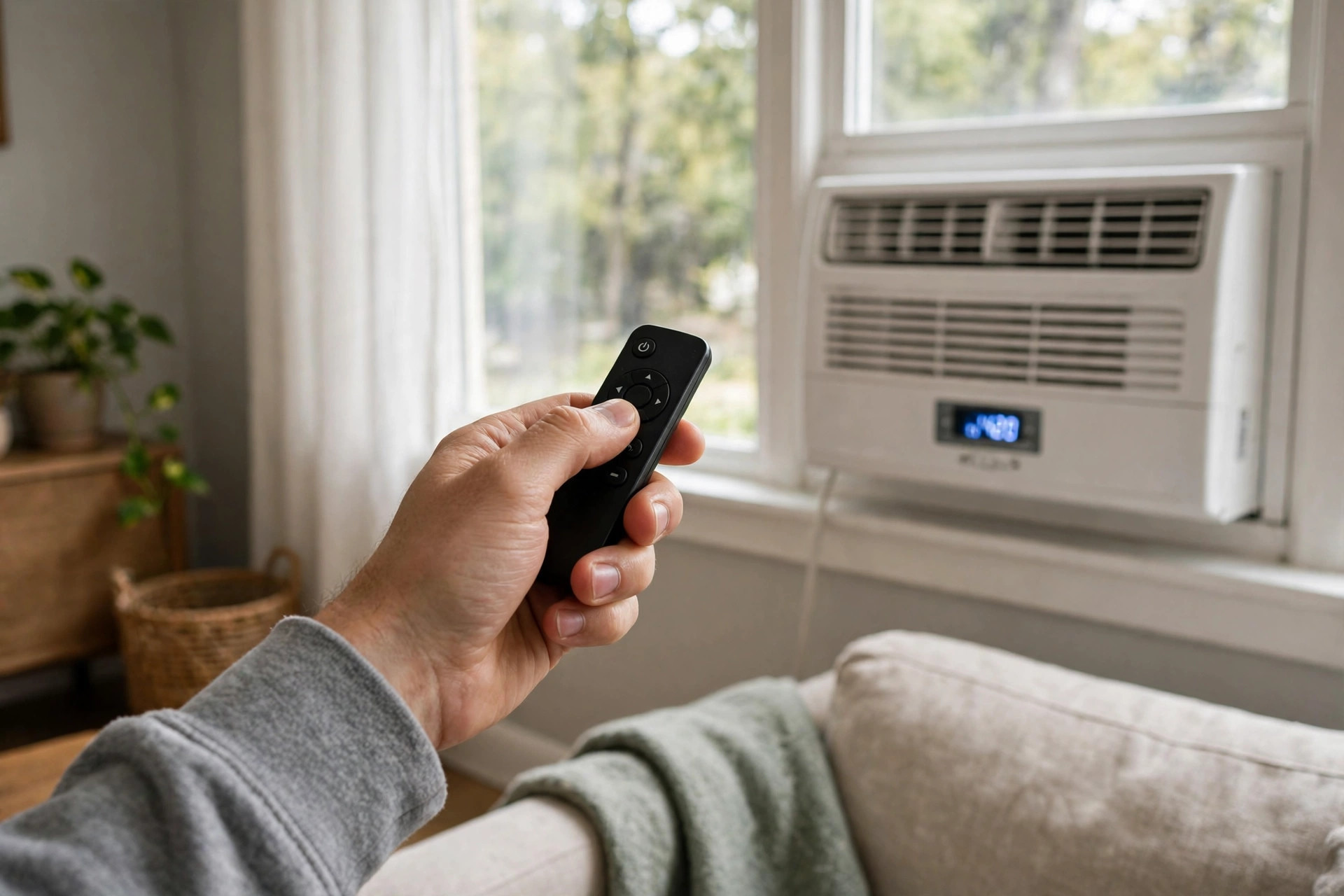
A window AC is usually better than a portable AC for cooling one room, because it is more efficient, quieter and cheaper for the same cooling power, while a portable AC wins only where a window unit cannot be fitted.
A window unit sits in the window with its hot side outside, so it pushes heat straight outdoors and seals the window around itself. A portable unit sits inside the room and pushes hot air out through a hose in the window, but the hose itself gives off heat back into the room, and the unit draws in warm air from elsewhere to replace the air it exhausts. That makes portable units less efficient for the same BTU rating, and often noisier, because the whole machine sits in the room with you.
Key Features Worth Paying For
The features worth paying for in good AC window units are an inverter compressor or variable fan speeds, a quiet sleep mode, a washable filter with a clean-filter reminder, a remote control and timer, and an energy-saver mode.
An inverter compressor, where available, changes its speed instead of switching fully on and off, which keeps the temperature steadier and the noise lower. Variable fan speeds do similar work on simpler units: low speed at night, high speed when the room is hot. A sleep mode slowly raises the set temperature overnight and dims the display, which suits bedrooms. A washable filter that slides out easily matters more than it sounds, because a clogged filter is the most common reason a unit cools badly, and a filter you cannot reach will not be cleaned. An energy-saver mode switches the fan off when the compressor stops, which saves power and stops the fan blowing damp air back into the room. Those five features are what separate good AC window units from the cheapest box on the shelf.
How Quiet Should a Window AC Be?
A good window AC for a bedroom should run at around 50 decibels or lower on its low setting, which is about the level of quiet conversation, while units above 60 decibels will be noticeable and can disturb sleep.
Decibels are measured on a logarithmic scale, so a small change in the number means a large change in loudness: a unit at 60 decibels sounds roughly twice as loud as one at 50. Makers usually quote the noise level on the lowest fan setting, so check the figure for the setting you will actually use, and look for buyer reviews that mention noise, because quoted figures are measured in ideal conditions. The quietest units use an inverter compressor, a well-balanced fan and good insulation around the casing.
Energy Efficiency: What the Ratings Mean
Window AC efficiency is shown by the CEER rating, where a higher number means more cooling per unit of electricity, and ENERGY STAR certified units beat the minimum standard for their size.
CEER stands for Combined Energy Efficiency Ratio, and it tells you how many BTU of cooling you get for each watt of electricity. A unit rated at 12 CEER gives you more cooling per watt than one rated at 10, so it costs less to run for the same cooling. The difference adds up over a summer: a unit that runs for hundreds of hours will repay a higher purchase price through lower power bills, especially in a hot climate.
Will It Fit Your Window?

A window AC fits if your window is a double-hung or sliding type with an opening at least as wide and tall as the unit, with a sill strong enough to hold its weight and a power socket nearby.
Most window units are made for double-hung windows, the type that slides up and down, and the unit sits on the sill with the sash lowered onto it. Sliding windows need a different design or an adapter, and casement windows that swing open usually cannot take a window unit at all. Measure the width and height of the opening, and compare both with the unit’s dimensions, including the side panels. Check the weight as well: small units weigh around 40 to 60 pounds, while large ones can weigh over 100 pounds. Good AC window units always list their weight and dimensions on the box, so check them before you order, not after. For help keeping windows in good shape, see our guide to how to clean window screens.
Installing a Window AC the Right Way
Installing a window AC the right way means seating it level on the sill, fixing the side panels and brackets firmly, sealing every gap against air and rain, and making sure the unit tilts slightly outward so condensation drains outside.
Start by reading the maker’s instructions, because the brackets and panels differ between models. Clean the sill and the window tracks, then lift the unit into place with a helper if it is heavy. Centre it in the opening and lower the sash onto the top of the unit. Fit the side panels so no gap is left on either side, and screw the mounting brackets into the sill and the sash as directed. Seal the edges with the foam strips supplied, and add weather stripping if you can still see daylight around the unit. The unit should tilt very slightly toward the outside, so water from condensation drains away from the room. Finally, plug it directly into a wall socket, never into an extension lead, and run it for an hour to check that it cools, drains and does not rattle.
- Measure the window and the unit. Confirm the opening, sill strength and socket position.
- Clean the sill and tracks. Clear dirt so the unit sits flat and the panels seal.
- Lift the unit in with a helper. Set it on the sill and lower the sash onto it.
- Fit the side panels. Extend them to fill the gaps and fasten as directed.
- Fix the brackets. Screw them into the sill and sash so the unit cannot tip.
- Seal every gap. Use the foam strips and add weather stripping where you see daylight.
- Check the tilt and test it. Confirm a slight outward tilt, then run the unit for an hour.
Window AC Units With Heat: Are They Worth It?
A window AC with a heating mode is worth it only if you need a little extra warmth in a cool season and already plan to leave the unit in the window all year.
Most window units with heat use an electric heating element, which warms the room but uses a lot of electricity, much like a space heater. A few use a heat pump, which is more efficient in mild weather. If you already heat your home another way, a cooling-only unit is simpler and cheaper. If you live somewhere with short, mild winters and want one box that does both jobs, a heat model can make sense. For rooms that need serious heating, a dedicated heater is usually the better choice; see our guide to gas in wall heaters.
When to Replace Your Window AC
Replace a window AC when it no longer cools the room, needs frequent repairs, uses far more power than a modern unit, or is more than about 10 years old and struggling.
Warning signs include weak airflow even with a clean filter, ice forming on the coils, a musty smell that cleaning does not fix, and a unit that cycles on and off constantly. If a repair would cost a large share of a new unit’s price, replacement is usually the better choice. When you replace one, check the window fit and the BTU size again, because the room or the window may have changed since the old unit was fitted.
Common Mistakes When Buying a Window AC
The most common mistakes when buying a window AC are choosing the wrong BTU size, ignoring the window measurements, buying on price alone, and forgetting the running costs. Each one turns a bargain into a disappointment.
The sizing mistake is the most damaging. A unit that is too small runs constantly, wears out faster and never cools the room properly. A unit that is too big cools the air quickly, switches off, and leaves the room humid, which feels sticky even at a low temperature. The price mistake is the most tempting: the cheapest unit often has the lowest efficiency, the loudest fan and the shortest life, so it costs more over time.
Looking After Your Window AC
Look after a window AC by cleaning the filter every two to four weeks in the cooling season, keeping the outside coils clear of leaves and dust, and storing or covering the unit properly in winter.
The filter is the single most important job. A dirty filter blocks airflow, makes the unit work harder, and can cause ice to form on the coils. At the end of the season, run the unit on fan-only for an hour to dry it out, then either remove it and store it upright in a dry place, or fit a proper cover over the outside if it stays in the window. Never store a unit on its side. Look after it this way and good AC window units keep their efficiency for years instead of losing it in one summer. If the unit trips the breaker, makes a grinding noise, or stops cooling, switch it off and check the filter and the power supply first. For more on electrical problems, see our guide to why an AC keeps tripping the breaker.
Conclusion
Good AC window units fit your room, your window and your budget for running costs, not the biggest or the cheapest on the shelf. Measure the room, use the ENERGY STAR chart with its adjustments, check the noise and CEER figures, and confirm the window fit before you buy.
Frequently Asked Questions
What size window air conditioner do I need?
Measure the room in square feet and use the ENERGY STAR chart: 5,000 BTU per hour for 100 to 150 square feet, 8,000 for 300 to 350, and 18,000 for 700 to 1,000 square feet.
Are good AC window units energy efficient?
Yes, good AC window units with a high CEER rating and ENERGY STAR certification cool efficiently. A higher CEER means more cooling per watt of electricity, so running costs stay lower.
How loud is a window air conditioner?
A good window AC runs at around 50 decibels or lower on its low setting, about the level of quiet conversation. Units above 60 decibels are noticeable and can disturb sleep.
Can I install a window AC myself?
Yes, most small window AC units can be installed by a homeowner with a helper, following the maker’s instructions. Large or 230-volt units may need an electrician for the power supply.
Is a window AC better than a portable AC?
Yes, a window AC is usually better for cooling one room, because it is more efficient, quieter and cheaper to run. A portable AC wins only where a window unit cannot be fitted.
Disclaimer: This article is provided purely for informational purposes. clearisecleaningservices.com only provides information about good AC window units and does not sell air conditioners, offer installation or repair services, guest posting, paid promotion, or advertising. BTU figures follow the ENERGY STAR room air conditioner chart for rooms with about 8-foot ceilings. Electrical work can be dangerous, so hire a qualified electrician for 230-volt supplies, dedicated circuits, or any wiring you are unsure about.
Thanks for visiting Clearise Cleaning Services! Discover more helpful tips and expert cleaning insights by exploring our related categories.