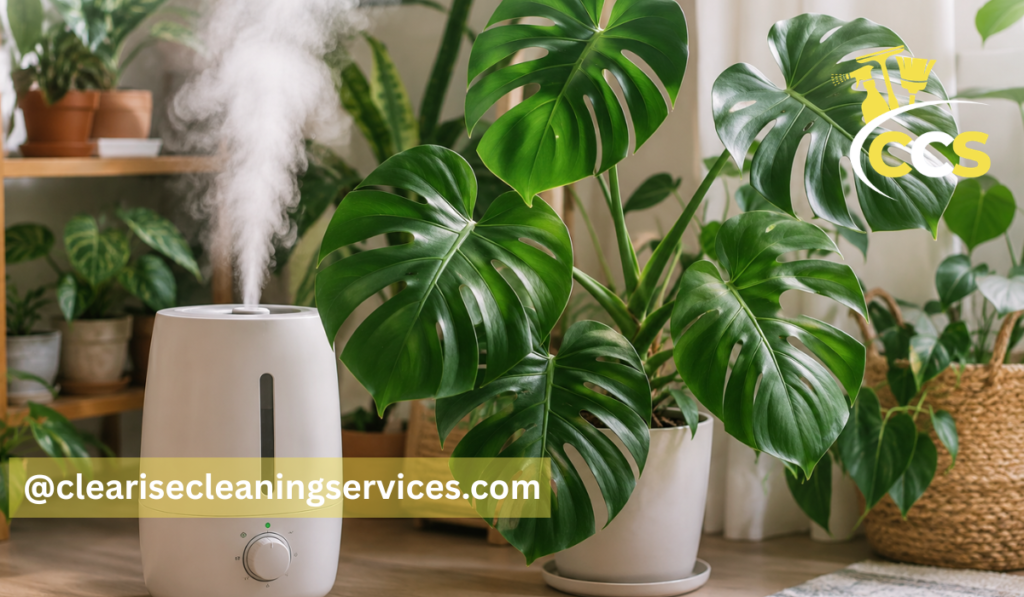
A humidifier for Monstera is a simple indoor device that adds moisture to the air around your plant. This matters because Monstera plants naturally come from warm, tropical areas where the air is more humid than most modern homes. When indoor air becomes too dry, your Monstera may still survive, but it may not grow as strongly or look as fresh as it could.
For most indoor Monsteras, the ideal humidity range is around 50% to 60%. This level is comfortable for the plant without making the room feel damp or unhealthy. Many standard Monstera varieties can tolerate normal home humidity, especially if it stays near 40% or above. However, if your home is dry because of winter heating, air conditioning, desert climate, or poor airflow, a plant humidifier can make a noticeable difference.
A humidifier is helpful when your Monstera shows signs of dry air, such as crispy brown tips, curling leaves, or slow new growth. It is not always necessary if your room already has enough moisture. That is why it is smart to check your room humidity before buying one.
Plant humidifiers are not magic tools, but they can support better indoor growing conditions. When used correctly, they help create a more stable environment for your Monstera, especially when combined with bright indirect light, proper watering, clean leaves, and good airflow.
Quick Guide Table
| Need | Best Choice | Why It Helps |
| Dry indoor air | Room humidifier | Raises humidity around the Monstera |
| Small plant corner | Mini humidifier | Works well for tight spaces |
| Hard tap water | Evaporative humidifier | Helps avoid white mineral dust |
| Accurate care | Hygrometer | Shows real room humidity |
| Healthy leaves | 50%–60% humidity | Supports greener, stronger growth |
Quick Tips for Using a Humidifier for Monstera
- Keep humidity around 50%–60%
- Place the humidifier a few feet away from the plant
- Do not let mist sit directly on the leaves
- Use distilled or purified water if using an ultrasonic humidifier
- Keep gentle airflow in the room
- Clean the humidifier regularly
Why Monstera Plants Benefit From Higher Humidity
Monstera plants are tropical by nature. In their natural environment, they grow under trees where the air is warm, filtered light passes through the canopy, and moisture stays present around the leaves. Indoor homes are very different. Heating systems, air conditioners, closed windows, and dry weather can lower humidity and make the air less comfortable for tropical plants.
Higher humidity helps Monstera leaves stay soft, flexible, and healthy. When the air is too dry, moisture leaves the plant faster through its leaves. This can make the edges dry out, especially on older leaves or large leaves with thin edges. A humidifier for Monstera helps slow this moisture loss by keeping the air around the plant more balanced.
Humidity can also support larger, greener leaves. While light, watering, nutrients, and root health are still more important, better humidity helps the plant use those conditions more efficiently. A Monstera growing in steady humidity often looks fresher and may produce stronger new leaves.
Many Monstera owners also care about fenestration, which means the natural splits and holes in mature leaves. Humidity alone will not create fenestration. The plant also needs maturity, enough light, good care, and room to climb. Still, proper humidity can support healthy new growth, which gives the plant a better chance to develop mature leaf features over time.
Ideal Humidity Level for Monstera Indoors
The best humidity level for Monstera indoors is usually around 50% to 60%. This range gives the plant enough moisture in the air without creating a damp room. It is also a practical target for most homes. You do not need to turn your room into a greenhouse for a Monstera to grow well.
Standard Monstera deliciosa plants are fairly adaptable. Many can live in homes with humidity around 40%, especially if the plant is otherwise healthy. If your Monstera is growing well, producing new leaves, and not showing dry tips, you may not need a humidifier at all.
Too much humidity can become a problem. When humidity stays very high and the air does not move, leaves may stay wet for too long. This can encourage fungal spots, mold, pests, and leaf damage. Wet soil can also dry more slowly, which may increase the risk of root problems if you water too often.
The goal is balance. A humidifier should raise the air moisture gently, not soak the plant or make the room feel heavy. For most homes, keeping humidity near 50% is a safe and useful starting point.
Signs Your Monstera May Need a Humidifier
Your Monstera may need a humidifier if the leaves keep developing brown, crispy tips even when your watering routine is correct. Crispy edges often happen when the air is too dry, especially during winter when indoor heating removes moisture from the air.
Curling leaves can also be a sign of dry air. A Monstera leaf may curl slightly when the plant is trying to reduce moisture loss. However, curling can also happen because of underwatering, root stress, too much sun, or pests, so it is important not to blame humidity too quickly.
Slow or weak new growth may also point to poor growing conditions. If your plant gets bright indirect light, has healthy roots, and is watered properly but still looks tired, low humidity may be part of the problem. Young leaves that unfurl with dry edges or damage can also suggest that the air is too dry.
Air conditioning and heating are common causes of dry indoor air. If your Monstera sits near a vent, radiator, heater, or drafty window, it may struggle more than a plant placed in a stable room. In these cases, a humidifier for Monstera can help, but moving the plant away from direct airflow is just as important.
Best Humidifier for Monstera: Features to Look For
The best humidifier for Monstera is not always the most expensive model. It is the one that fits your room, is easy to clean, and lets you control humidity safely. A good plant humidifier should have adjustable mist output so you can raise or lower the moisture level instead of running it at full power all day.
A built-in humidity sensor can be helpful, but an external hygrometer is often more accurate because you can place it near your plant. Some smart humidifiers can connect to an app or external sensor, allowing you to set a target humidity level. This can be useful if you want steady conditions without constant checking.
Easy cleaning is very important. Humidifiers hold water, and any device that holds water can grow bacteria or mold if ignored. Choose a model with a wide tank opening and simple parts. A hard-to-clean humidifier may become more trouble than it is worth.
Tank size should match your room. A small tank may be fine for a desk or small bedroom, but it may need frequent refilling. A larger tank works better for a plant corner or bigger room. Quiet operation also matters if the humidifier will run in a bedroom, office, or living space.
Best Types of Plant Humidifiers for Monstera
There are two common types of plant humidifiers: ultrasonic and evaporative. Both can work for Monstera plants, but they have different strengths.
Ultrasonic humidifiers create a fine mist using vibration. They are usually quiet, energy-efficient, and popular for indoor plants. Many plant owners like them because they quickly raise local humidity. However, ultrasonic models can release minerals from tap water into the air as white dust. This dust can settle on leaves, furniture, and nearby surfaces. Using distilled or purified water helps reduce this issue.
Evaporative humidifiers use a fan to move air through a wet wick or filter. They do not usually create visible mist, and they are less likely to spread white mineral dust. This makes them a good choice for homes with hard tap water. The trade-off is that they may be slightly louder because of the fan, and the wick or filter needs regular replacement.
Warm mist and cool mist humidifiers can both raise humidity. For most Monstera plants, cool mist is usually enough. Warm mist may make a room feel more comfortable in colder months, but it is not required for plant health. The main focus should be safe humidity control, clean water, and regular maintenance.
Best Humidifier Size for Indoor Monstera Plants
The best humidifier size depends more on the room than on the plant. A large Monstera in a dry, open living room needs more humidifying power than a small Monstera in a compact bedroom. Before choosing a humidifier, think about the space you want to humidify.
For small rooms, shelves, or desks, a mini humidifier can help raise moisture near the plant. These small units are easy to place and simple to use, but they usually have limited tank capacity. They may need refilling often and may not change the humidity in the whole room.
For medium rooms, a humidifier with a larger tank and adjustable settings is often better. It can run longer and keep humidity more stable. For large rooms or plant corners with several tropical plants, a bigger model may be needed. In open spaces, humidity spreads out quickly, so a tiny unit may not be enough.
Room size, airflow, ceiling height, and how dry your home is will all affect results. This is why a hygrometer is useful. It tells you whether your humidifier is actually improving the air around your Monstera.
Best Mini Humidifier for Plants: When It Makes Sense
The best mini humidifier for plants makes sense when you have a small space, a single Monstera, or a plant sitting on a desk, shelf, or nightstand. Mini humidifiers are simple, affordable, and easy to move. They can be helpful for renters, small apartments, or people who do not want a large device running in the room.
However, mini humidifiers have limits. They usually do not hold much water and may only affect the air very close to the device. If your room is large or very dry, a mini unit may run constantly without reaching the humidity level your Monstera needs.
A mini humidifier is best for light support, not full-room humidity control. It can help a young Monstera, a small plant corner, or a temporary dry-air problem. For a mature Monstera with large leaves, especially in a dry climate, a medium-size plant humidifier is usually more practical.
Best Humidifier for Tropical Plants and Plant Collections
If you grow several tropical plants, one humidifier can often support more than just your Monstera. Plants like calatheas, philodendrons, alocasias, ferns, and orchids may also enjoy higher humidity. Grouping these plants together can create a more stable plant area.
When plants are grouped, they naturally release a little moisture through their leaves. A humidifier can improve this effect and help the whole plant corner stay more comfortable. This is often better than trying to humidify one plant by itself in a large room.
The key is to avoid making the area damp. Tropical plants like humidity, but they do not want wet leaves all day. Keep a small fan nearby or make sure the room has gentle air movement. Good airflow helps prevent fungal problems and keeps the growing area fresh.
A good humidifier for tropical plants should have enough tank capacity, adjustable output, and easy cleaning. Smart features are useful but not required. Consistent, safe humidity matters more than fancy settings.
Where to Place a Humidifier Near a Monstera
Placement is very important when using a humidifier for Monstera. The humidifier should be close enough to improve the air around the plant but not so close that mist lands directly on the leaves. A good distance is usually a few feet away from the plant.
Direct mist may seem helpful, but it can cause problems. If water droplets sit on Monstera leaves for long periods, they may lead to spotting, fungal marks, or general leaf damage. The goal is to humidify the air, not spray the plant.
Keep the humidifier away from walls, wooden furniture, curtains, and electronics. Moisture can damage surfaces over time if the mist is aimed in the wrong direction. Place the unit on a stable surface and make sure the mist rises into open air.
Avoid placing your Monstera and humidifier in a closed, stagnant corner. Even if humidity is good, poor airflow can create unhealthy conditions. A room with gentle air movement is much better than a still, damp space.
Using a Hygrometer Before Buying a Humidifier
A hygrometer is a small device that measures humidity in the air. Before buying a humidifier, it is a good idea to use one for a few days. This helps you understand whether your Monstera truly needs extra humidity.
Place the hygrometer near your Monstera, but not directly beside a window, heater, air conditioner, or humidifier. You want to measure the normal air around the plant. Check the reading at different times of day because humidity can change between morning, afternoon, and night.
If your room stays around 50% humidity, you may not need a humidifier. If it often drops below 40%, especially for long periods, a humidifier may help your Monstera grow more comfortably. If the reading is already high, adding more humidity could do more harm than good.
A hygrometer also helps after you buy a humidifier. Instead of guessing, you can adjust the settings based on real numbers. This keeps your plant care simple and prevents over-humidifying the room.
DIY Humidifier for Monstera: Simple Alternatives
A DIY humidifier for Monstera can help a little, but it usually will not replace a real humidifier in a dry room. Still, simple methods may be useful if your home is only slightly dry or you want a low-cost option.
A pebble tray is one common method. You place pebbles in a tray, add water below the top of the stones, and set the plant pot above the water level. As the water evaporates, it may add a small amount of moisture around the plant. The effect is usually limited, but it can help slightly in a small area.
Grouping plants together is another easy method. Plants release moisture through their leaves, so a group of houseplants can create a slightly more humid microclimate. This works best when combined with good airflow and proper spacing.
Some people place bowls of water near heat sources to encourage evaporation. This may add a little moisture to the room, but it is not very controlled. It also will not raise humidity as effectively as a real plant humidifier.
DIY methods are best for mild dryness. If your Monstera has repeated crispy tips and your hygrometer shows low humidity, a proper humidifier will usually be more reliable.
Common Mistakes to Avoid With Monstera Humidifiers
One common mistake is running humidity too high. More humidity is not always better. If the air becomes too damp, your Monstera may face fungal spots, pests, or slow soil drying. Staying near 50% to 60% is usually safer than trying to reach greenhouse levels indoors.
Another mistake is forgetting airflow. Humidity without airflow can create a stale environment. A gentle fan in the room can help keep air moving, but it should not blow directly on the plant all day.
Using hard tap water in an ultrasonic humidifier is also a common issue. Minerals in the water can become white dust and settle on leaves and furniture. Distilled water, purified water, or an evaporative humidifier can help reduce this problem.
Placing the humidifier too close to the plant is another mistake. Mist should not collect on the leaves. If leaves feel wet after the humidifier runs, move the unit farther away or reduce the mist level.
Finally, do not skip cleaning. A dirty humidifier can spread unwanted particles into the air. Follow the cleaning instructions for your model and refresh the water often. Clean equipment is better for your plant and your home.
Conclusion
A humidifier for Monstera is worth using when your indoor air is dry and your plant shows signs of stress, such as crispy tips, curling leaves, or weak new growth. It can help create a more comfortable environment and support bigger, greener, healthier leaves.
The best target humidity for most Monsteras is around 50% to 60%. A standard Monstera can often tolerate lower indoor humidity, but steady moisture in the air can improve its overall appearance and growth. The key is to avoid extremes. Your plant needs balanced humidity, not wet leaves or a damp room.
Choose a humidifier that fits your room size, is easy to clean, and allows good control. Use a hygrometer so you know what your plant actually needs. Keep the humidifier a few feet away from the Monstera, avoid direct mist, use clean water, and maintain airflow.
With the right setup, a humidifier can be a helpful part of Monstera care. It will not replace good light, proper watering, or healthy soil, but it can make your indoor environment much closer to what this tropical plant enjoys.
FAQs
Does A Monstera Really Need A Humidifier?
Not always. A Monstera can tolerate average indoor humidity, but a humidifier helps if your home is dry or the plant has crispy tips.
What Humidity Is Best For Monstera?
The best humidity for Monstera is usually around 50%–60%. This range supports healthy leaves without making the room too damp.
Can I Put A Humidifier Next To My Monstera?
Keep it a few feet away. Direct mist on leaves can cause water spots or fungal issues, so humidify the air instead.
Is A Mini Humidifier Enough For Monstera?
A mini humidifier can help a small Monstera or plant shelf, but it may not be strong enough for a large room or mature plant.
Can Too Much Humidity Hurt A Monstera?
Yes. Very high humidity with poor airflow can lead to fungal spots, pests, and slow soil drying. Balance is important.
Disclaimer: This article is for general plant-care information only. Monstera needs can vary based on room conditions, climate, light, watering habits, and plant health.
Thanks for visiting Clearise Cleaning Services! Discover more helpful tips and expert cleaning insights by exploring our related categories.