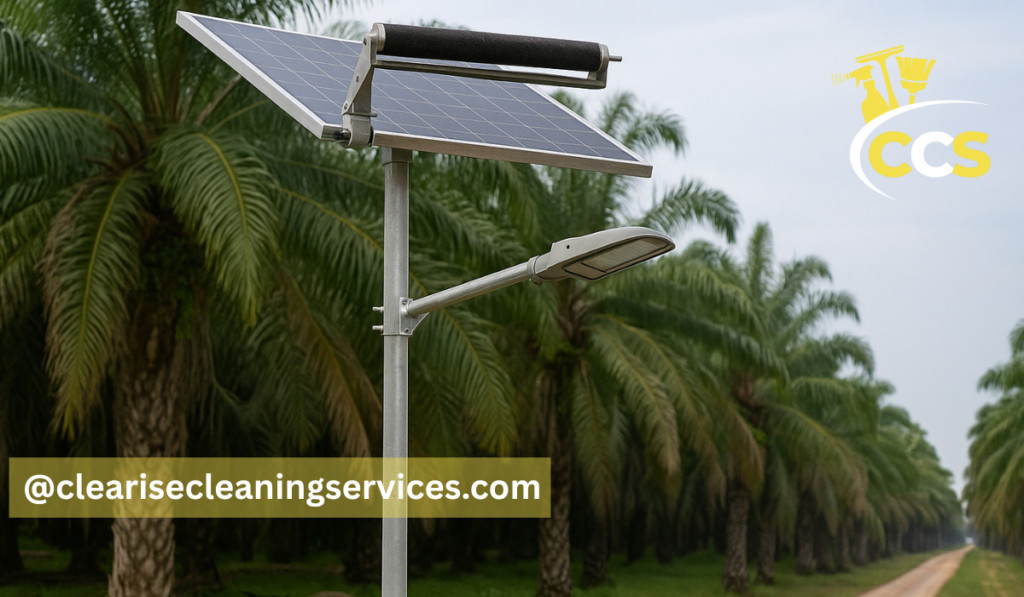
Lighting in palm oil plantations has become an increasingly important topic, especially as plantations expand into remote areas where electrical infrastructure is limited or nonexistent. Reliable lighting supports workers, transportation, security, and ongoing operations, but conventional street lights are difficult and costly to maintain in these environments. Dust, humidity, oil mist from processing facilities, and plantation debris settle on solar panels, reducing energy production and causing lights to fail long before expected. This creates a practical challenge: how do you maintain dependable lighting in a location where cleaning crews cannot constantly attend to equipment?
This is where self-cleaning street lights offer a meaningful advantage. These systems use built-in mechanisms—such as automated brushes, hydrophobic coatings, or smart cleaning cycles—to remove dust and residue from solar panels without manual labor. In palm oil environments, where contamination happens daily, a self-cleaning street light palm oil solution helps preserve solar efficiency, extend equipment life, and keep night-time lighting consistent. It is especially useful for plantation roads, worker housing, processing areas, and perimeter zones that require illumination but are difficult to monitor or service.
In this article, we will explore how self-cleaning street lights work, why they are valuable in palm-oil regions, and what design features matter most for long-term performance. We’ll also discuss key considerations, including system reliability, energy storage, installation planning, and self cleaning street light palm oil cost factors that influence investment decisions. Real-world examples and practical recommendations will be included to help plantation owners and project planners make informed choices, especially in environments where maintenance challenges affect daily operations.
What Is a Self-Cleaning Street Light? (and Why It Matters)
Definition and Core Concept
A self-cleaning solar street light is a solar-powered lighting system designed with built-in technology that removes dust, dirt, and other contaminants from the solar panel surface without requiring manual cleaning. These lights often use components like brushes, wipers, hydrophobic coatings, or automated mechanisms that actively prevent the buildup of debris. The goal is simple: keep the panel clean so it can continue absorbing sunlight efficiently, even in environments where contamination happens frequently.
In palm-oil producing regions, this contamination includes dust, pollen, bird droppings, and a fine oil mist released during fruit processing. When these substances accumulate on a solar panel, they reduce light absorption and energy production, leading to dim lights, shorter operating hours, and premature system failures.
This is where self-cleaning systems differ from traditional solar street lights, which require workers to physically wipe panels at regular intervals. Manual cleaning is not only labor-intensive but also expensive and difficult when lights are spread across long plantation roads. A self-cleaning street light addresses that challenge by maintaining performance automatically, reducing the operational burden and ensuring reliable lighting in locations where technicians are rarely available.
How the Self-Cleaning Mechanism Works: Technical Overview
Self-cleaning solar lights use several types of mechanisms to keep panels clear, and each method is designed to minimize human maintenance:
- Mechanical brush or wiper systems
Some models use a motorized brush or wiper that sweeps across the surface of the solar panel at set intervals. These cleaning cycles might happen once or several times per day, depending on dust levels and energy availability. By physically removing residue, the system prevents major buildup and helps the panel maintain stable energy output. - Nanotechnology or hydrophobic coatings
Another approach involves applying a hydrophobic (water-repellent) or nano-structured coating to the panel surface. These coatings work by reducing adhesion between the surface and particles like dust or oil. When light rain falls—or when the panel vibrates slightly—contaminants slide off. This concept is similar to other “self-cleaning surfaces,” where microscopic structures encourage dirt to detach without scrubbing. - Automation and smart controls
Modern self-cleaning lights may also include sensors or timers that automate cleaning cycles. For example, a system might run a quick cleaning routine twice daily, or trigger it only when power generation drops below a set threshold. Automation ensures consistent performance while minimizing unnecessary energy use. - All-in-one system integration
Many self-cleaning street lights combine all parts—solar panel, battery, LED lamp, controller, and cleaning mechanism—into a compact, all-in-one housing. This reduces installation complexity and makes each unit easier to manage. In remote agricultural areas, where infrastructure development is slow, a modular system like this is a practical advantage.
Together, these technologies allow self-cleaning street lights to operate efficiently in challenging environments with minimal human involvement, which is why they are increasingly considered a smart infrastructure solution in palm-oil producing regions.
Why Palm-Oil Plantations (or Oil Palm Regions) Particularly Benefit from Self-Cleaning Street Lights
Environmental and Operational Challenges in Palm Oil Regions
Palm-oil plantations are demanding environments for outdoor equipment, especially anything that relies on solar power. Processing facilities and plantation areas generate dust, pollen, fine plant fibers, and a light oil mist that can easily settle on exposed surfaces. Over time, this creates a layer of residue that blocks sunlight from reaching solar panels, lowering their efficiency and cutting down the number of hours the lights can operate each night.
On top of contamination, these regions often experience high humidity and frequent rainfall, which can accelerate material degradation. Remote roads and dispersed facilities make access difficult, so routine cleaning becomes time-consuming and expensive. Technicians have to travel long distances to reach equipment, and cleaning requires climbing poles or using ladders — both of which increase safety risks and labor costs.
Another challenge is corrosion. Moisture, plant chemicals, and exposure to oil residues can degrade components like brackets, screws, and lamp housings. Traditional solar street lights are rarely built to withstand this combination of environmental stressors, meaning they may fail earlier than expected or require frequent repair. For plantation operators managing dozens or hundreds of lights, this can quickly turn into a costly and ongoing maintenance burden.
Self-Cleaning Lights as the Solution: Key Advantages for Palm Oil Applications
Self-cleaning street lights are designed to address these specific environmental challenges and reduce the operational burden associated with outdoor lighting in plantations.
- Maintains solar charging efficiency
By keeping the panel surface clean, automated cleaning systems help prevent the performance drop associated with dust and oil buildup. This means lights can charge fully during the day and operate reliably at night. - Reduces or eliminates manual maintenance costs
Because the lights clean themselves, plantation workers don’t need to climb poles or travel long distances to wipe panels. This reduces labor costs and minimizes safety risks. On large plantations, the savings can be substantial. - Improves reliability and uptime
Automated cleaning allows the system to maintain stable output even during peak harvesting or processing periods, when dust and oil contamination are at their worst. This ensures roads, housing areas, and work zones remain illuminated, supporting worker mobility and night-time operations. - Longer lifespan and durability
Self-cleaning lights typically use robust materials, protective coatings, and well-sealed housings to cope with harsh environmental conditions. By reducing contamination and corrosion, the system operates more consistently over time and requires fewer repairs. - Better sustainability
Because the lights use solar energy, and because automated cleaning reduces maintenance trips, fuel use, and waste, self-cleaning systems offer a way to improve lighting infrastructure without increasing environmental impact. For plantations looking to modernize operations while maintaining sustainability goals, they present a compelling option.
Overall, self-cleaning street lights are not just a technological upgrade — they are a practical response to the environmental and logistical demands of palm-oil regions, helping plantations maintain reliable, low-maintenance lighting where it is most needed.
Components and Design: What to Look for in a Self-Cleaning Street Light for Palm-Oil Environments
Choosing the right self-cleaning street light is essential for long-term performance in palm-oil regions. The best systems are built to resist contamination, handle high humidity, and deliver efficient lighting with minimal maintenance. When evaluating options, it helps to understand the core components and design features that influence reliability, energy efficiency, and operating costs.
Solar Panel: Quality, Coating, and Build
The solar panel is the heart of the system, so the materials and coatings used directly affect performance.
Most high-performing lights use monocrystalline photovoltaic (PV) modules, which are known for their higher efficiency and durability compared to polycrystalline alternatives. This matters in plantations where sunlight may be partially obstructed by trees or haze, and where consistent energy production is required to power both lighting and cleaning mechanisms.
To protect the panel, manufacturers often apply anti-dust or hydrophobic coatings. These coatings reduce the adhesion of dust, oil residue, and watermarks, making it harder for particles to stick and easier for rain or wind to remove them. In palm-oil environments, where contamination happens daily, these coatings help slow down the rate of soiling and support the work of mechanical cleaning systems.
Cleaning Mechanism: Brush vs. Coating vs. Hybrid
Different self-cleaning lights use different approaches to remove dust and residue, and each method has practical trade-offs.
- Mechanical brush or wiper systems
These systems involve motorized arms or rails that sweep across the panel surface. They are effective against heavy contamination, including sticky residues that cannot be removed by rain alone. However, they include moving parts, which means they may require occasional inspection or replacement. - Nano-coatings and self-cleaning surfaces
Some manufacturers rely more on coatings than moving components. Hydrophobic or superhydrophobic coatings, occasionally enhanced with materials like titanium dioxide (TiO₂), reduce the attraction between the surface and contaminants. When rainwater flows over the panel, dirt is lifted and washed away. These coatings work best in regions with regular rainfall, though they may struggle with heavier oil residues. - Hybrid systems
In environments with a combination of dust and oil mist, a hybrid approach is sometimes used. These designs combine coatings with a mechanical wiper, giving the system both passive and active cleaning capability. Hybrid models tend to perform better in plantations that experience intense contamination, though they may cost more upfront.
Power Storage and Control: Battery, Controller, and Smart Features
Energy storage and system control determine how reliable the light will be over time, especially in remote settings.
A durable lithium battery, such as LiFePO₄, is commonly used because it delivers long life, stable performance, and high energy density. This type of battery supports both night-time lighting and automated cleaning cycles, even during periods of low sunlight.
A smart solar charge controller with MPPT (Maximum Power Point Tracking) helps the system capture as much energy as possible, adjust to changing light conditions, and manage energy consumption efficiently. This is important when cleaning cycles must run automatically, regardless of weather or dust levels.
Some systems also offer IoT-based monitoring features, giving plantation managers remote access to information like battery status, cleaning activity, and power generation. On large plantations or remote sites, this data can help detect failures early and reduce unnecessary maintenance trips.
LED Lighting and Structural Build
Beyond the power system, the lighting and physical structure also influence long-term usability.
A high-lumen LED fixture—typically in the range of 160 to 200 lumens per watt—provides bright, energy-efficient illumination while minimizing power consumption. This helps maintain good lighting coverage without oversizing the battery or panel.
The structural components, including poles and housings, are often built from corrosion-resistant materials like galvanized steel or aluminum with protective coatings. These materials are designed to withstand moisture, oil exposure, and environmental wear, all of which can be severe in palm-oil regions. Strong, durable construction ensures the lights remain stable and functional in locations without frequent inspection or service.
Implementation in Palm-Oil Plantations: Planning and Deployment Considerations
Introducing self-cleaning street lights into a palm-oil plantation requires more than simply choosing the right product. The environment, infrastructure layout, and long-term maintenance strategy all influence how well the system performs. A thoughtful approach to planning helps ensure that installations operate predictably in a challenging environment and generate value over time.
Site Assessment and Environmental Study Before Installation
A detailed site assessment is essential because environmental conditions in palm-oil regions vary widely between plantations, processing facilities, and remote access roads.
The first step is to evaluate humidity, rainfall patterns, dust levels, oil mist exposure, and soil composition. These factors influence the choice of panel coatings and cleaning mechanisms. For example, areas with heavy oil residue may benefit more from mechanical wipers, whereas regions with frequent rainfall and lighter dust buildup may perform well with hydrophobic coatings alone.
Next, it is important to assess the solar resource, including average daily sunlight and seasonal irradiance. This information determines the required panel size, battery capacity, and potential need for backup or oversized storage during rainy seasons. In documented plantation projects, solar resource analysis and environmental studies were conducted prior to system design, helping ensure that the energy supply matched expected demand.
Lastly, plantation infrastructure should be mapped carefully. Road networks, facility spacing, and terrain conditions influence pole height, spacing between lights, and light distribution patterns. Inconsistent spacing or inadequate height can lead to dark zones, uneven illumination, and potential safety risks. Planning lighting points with these variables in mind helps support safer transportation routes and more reliable operations.
Installation Logistics and Maintenance Planning
For most plantations, deploying all-in-one solar street lights is a practical choice. These units combine the panel, LED fixture, battery, and cleaning mechanism in a single housing, eliminating the need for trenching, wiring, or grid connection. This makes installation faster, reduces infrastructure costs, and allows the lights to be placed in remote areas without power access.
Even with automated cleaning, a maintenance plan remains necessary. Periodic inspection helps identify brush wear, mechanical faults, or battery degradation, which may not be obvious until performance declines. Setting a schedule—such as quarterly visual inspections—can prevent small issues from turning into outages.
Where available, remote monitoring systems add a layer of reliability. These tools track power output, cleaning cycles, and battery health in real time. If contamination suddenly increases or cleaning fails, managers can be alerted before lighting performance drops noticeably. In remote plantations, where travel time is significant, this reduces unnecessary field visits and keeps downtime low.
Cost Considerations (Including Self Cleaning Street Light Palm Oil Cost)
Cost remains one of the most important factors when evaluating lighting options for plantations. While self-cleaning street lights are generally more expensive upfront than standard solar lights, the long-term financial picture often looks different.
A cost comparison should include labor, maintenance, reliability, and downtime. Traditional street lights require frequent manual cleaning, especially in areas exposed to dust or oil contamination. Over time, this can represent significant labor costs, along with fuel, equipment, and safety considerations. Automated cleaning eliminates much of that recurring expense.
Evaluating the total cost of ownership is crucial. This includes the initial purchase price, expected maintenance, replacement of parts such as batteries or brushes, and potential operational benefits. Reliable lighting may extend workable hours, improve transportation safety, or support production during early morning or evening periods.
From an energy perspective, studies comparing cleaning methods have found that self-cleaning mechanisms significantly reduce efficiency loss over time. For example, solar panels equipped with wipers showed lower power loss than uncoated panels or panels with coatings alone. In dusty environments, this improved performance can shorten the payback period and make the higher upfront cost easier to justify.
Ultimately, plantations that evaluate cost through the lens of long-term performance and operational reliability often find that self-cleaning systems deliver better value than cheaper alternatives, particularly in regions where environmental conditions make manual maintenance impractical.
Real-World Use Cases & Evidence: Self-Cleaning Street Lights in Palm / Agricultural / Harsh Environments
Case Studies from Plantations and Agriculture
The idea of using self-cleaning solar street lights in palm-oil regions is not just theoretical. Some manufacturers have already tested and deployed these systems in what is often called the “palm belt”—areas where oil palm cultivation is widespread, and environmental conditions are tough on equipment.
In one notable project, a lighting company installed self-cleaning solar street lights across roads and working areas in an oil-palm region. The goal was to deal with exactly the problems plantation owners often report:
- heavy dust from unpaved roads,
- fine oil mist drifting from processing facilities,
- high humidity and regular rain,
- and the difficulty of sending workers to clean panels along long, remote routes.
After deployment, several clear benefits were observed:
- More stable charging efficiency:
The automatic cleaning and protective coatings helped keep the panels clearer for longer. Even during busy harvest periods, when dust and pollen increased, the lights continued to charge reliably. - Lower maintenance needs:
Because the panels cleaned themselves, staff no longer had to schedule frequent manual cleaning trips. This reduced labor, vehicle use, and the risk of working at height. - Consistent lighting output:
With cleaner panels and healthy batteries, night-time lighting remained more uniform and predictable. Roads, loading points, and housing areas stayed illuminated, directly supporting worker safety and logistics. - Resilience in humid and oily conditions:
The combination of corrosion-resistant materials and self-cleaning technology meant the system could handle the plantation atmosphere better than traditional lights designed for cleaner, urban environments.
For plantation owners and managers, these real-world examples are important. They show that self cleaning street light palm oil solutions are not just a concept on paper but a practical upgrade that has already been tested in conditions similar to their own.
Research Evidence: Self-Cleaning Mechanisms vs Conventional Solar Panels
Beyond field projects, laboratory and field studies on solar panels provide useful insight into how self-cleaning systems perform over time in dusty or polluted environments.
In one controlled study published in a scientific journal, researchers compared three different panel types under heavy dust exposure over several weeks:
- a standard panel with no special treatment,
- a nano-coated panel,
- and a panel fitted with a self-cleaning wiper mechanism.
After about five weeks, the results showed that:
- The standard panel lost roughly a bit more than one-third of its original power output,
- The nano-coated panel performed slightly better but still experienced significant loss,
- The panel with the self-cleaning wiper had the smallest drop, around a little under one quarter of its rated power.
The key takeaway is simple:
When dust builds up, active cleaning systems (like wipers or brushes) can protect performance far better than doing nothing or relying only on coatings. In agricultural and plantation environments—where dust, pollen, and other particles are constantly in the air—this performance gap can quickly translate into real financial differences, shorter payback periods, and more reliable lighting.
For palm-oil plantations, this research supports what field projects already suggest: a self-cleaning mechanism is not just a convenience; it can be the factor that keeps solar lighting viable over the long term.
Potential Challenges and Solutions: What to Watch Out For
Even though self-cleaning street lights are promising, they are not a perfect “fit and forget” technology. Like any technical system, they come with potential challenges. The good news is that most of these can be managed with proper planning.
Mechanical Failure or Wear
Self-cleaning systems that rely on brushes, rails, or wipers naturally include moving parts. Over time, these components can wear out, especially in environments with abrasive dust or sticky residues.
How to manage it:
- Build periodic inspection into your maintenance schedule (for example, every three to six months).
- Keep basic spare parts—such as brushes, wipers, or small motors—on hand.
- Choose models from vendors that provide clear guidance, local support, and replacement kits.
Battery Depletion and Energy Management
Cleaning cycles use energy. If the system runs too many cycles during periods of low sunlight (such as rainy seasons), the battery can drain faster than expected. This may reduce lighting hours at night.
How to manage it:
- Size both the solar panel and battery according to actual environmental data, not just standard catalog values.
- Use smart controllers that limit cleaning frequency or adjust cycles based on available energy.
- In particularly cloudy regions, consider slightly oversized panels or hybrid solutions to ensure energy security.
Corrosion from Oil, Humidity, and Chemicals
Even with coatings, metals exposed to oil vapors, moisture, and agricultural chemicals can degrade over time. This is especially true for bolts, brackets, and joints.
How to manage it:
- Specify corrosion-resistant materials, such as galvanized or powder-coated steel, aluminum with protective treatments, and stainless fasteners.
- Plan occasional visual inspections to catch rust or coating damage early.
- In aggressive environments, discuss additional protection (such as thicker coatings) with the supplier.
Initial Cost and ROI Concerns
A self-cleaning street light usually costs more upfront than a basic solar light or a grid-powered lamp. For some decision-makers, this can be a barrier.
How to manage it:
- Look beyond purchase price and calculate total cost of ownership:
- manual cleaning labor,
- vehicle and equipment costs,
- risk of outages,
- productivity or safety losses when lights fail.
- Use real case studies and performance data to estimate a payback period. Often, the reduction in manual maintenance and improved reliability compensate for the higher initial price over a few years.
Vendor Availability and Customization Needs
In some regions, there may be limited suppliers offering true self-cleaning models, or their designs may not perfectly match local conditions (e.g., specific humidity, road layouts, or oil-mist exposure).
How to manage it:
- Work with vendors who are willing to customize specifications, such as panel size, battery capacity, pole height, and cleaning frequency.
- When possible, run a pilot project with a small number of units before committing to a full-scale rollout.
- Compare multiple suppliers and ask for real performance references from similar environments, not just generic brochures.
Best Practices and Expert Recommendations for Plantation Owners and Infrastructure Planners
Implementing self-cleaning street lights in palm-oil regions works best when decisions are guided by site conditions, energy needs, and long-term maintenance goals. The following practices are commonly recommended by engineers and sustainability planners working in agricultural environments:
- Conduct a comprehensive environmental and site assessment before selecting a model
Each plantation has its own combination of dust levels, oil mist, humidity, and rainfall patterns. Evaluating these conditions, along with plantation layout and solar irradiance, helps determine the appropriate cleaning mechanism, battery size, and system configuration. - Choose a hybrid cleaning mechanism for oil-mist-prone environments
A combination of a mechanical brush and a nano-coating creates redundancy and offers better cleaning coverage. This is often useful in areas where contamination is frequent and varied. - Use high-efficiency PV modules with high-capacity lithium batteries and smart controllers (MPPT)
These components improve energy reliability and ensure that both lighting and cleaning functions can run consistently, even during seasonal changes or high demand periods. - Implement remote monitoring systems
IoT or sensor-based platforms allow managers to keep track of panel cleanliness, battery health, and lighting performance in real time. Remote visibility is particularly valuable for large plantations that are difficult to service in person. - Schedule periodic physical inspections
While automated cleaning significantly reduces daily maintenance, occasional checks help identify mechanical wear, corrosion, or unexpected failures before they cause outages. A quarterly schedule is often adequate. - Plan for a cost-benefit analysis early in the process
Compare initial investment with long-term savings in labor, maintenance, and energy efficiency. Improved safety, fewer interruptions, and potential productivity gains are meaningful benefits that may not be obvious at first glance.
Conclusion
As plantations expand and infrastructure demands increase, reliable night-time lighting has become a critical part of operations. In palm-oil regions, environmental conditions make conventional lighting systems difficult to maintain and prone to early performance loss. Self-cleaning street light palm oil systems offer a practical, long-term solution to this challenge.
By combining solar energy with automated cleaning, these systems help maintain high energy efficiency, reduce maintenance labor, and support safer, more consistent operations. They are designed to withstand humid, oily, and dusty environments where other solar lights struggle to perform.
Beyond convenience, they offer measurable benefits: reduced operating costs, lower downtime, longer equipment lifespan, and a smaller environmental footprint. For plantation owners and project planners, this means better reliability, improved site safety, and a more sustainable approach to infrastructure development.
For these reasons, self-cleaning solar street lights are not a short-term trend, but a thoughtful response to the realities of plantation environments. When selected and deployed carefully, they provide more than illumination — they deliver resilience, peace of mind, and long-term value for agricultural regions where maintenance is difficult and performance matters every day.
FAQs (Frequently Asked Questions)
Why Are Self-cleaning Street Lights Better Than Regular Solar Lights In Palm-oil Plantations?
Plantation environments expose panels to dust, oil mist, and high humidity, all of which reduce solar efficiency. Self-cleaning lights help maintain performance, reduce manual maintenance, and deliver more consistent lighting in demanding conditions.
Do Self-cleaning Solar Panels Really Work?
Yes. Comparative studies show that systems with active cleaning mechanisms experience significantly less performance loss under dusty conditions than untreated or coated panels. This supports long-term energy reliability.
How Often Do The Cleaning Cycles Run?
It depends on the system. Some run fixed cycles (for example, twice a day), while others activate when sensors detect a drop in energy production. The goal is to maintain a clean surface without wasting energy.
What Is The Approximate Cost Premium (self Cleaning Street Light Palm Oil Cost) Compared To Standard Lights?
Costs vary depending on the design, region, and technical specifications. While upfront prices are typically higher than conventional systems, reduced maintenance and improved performance often make them cost-effective over a few years.
Are These Lights Suitable Only For Palm-oil Plantations?
No. Self-cleaning solar street lights can work well in any setting where dust, pollution, or limited access make manual cleaning difficult. This includes desert regions, rural roads, construction zones, and industrial sites.
Disclaimer: This article provides general information about self-cleaning street lights and their potential use in palm-oil environments. The content is based on available research, case studies, and industry practices, but real performance and costs may vary depending on product design, installation conditions, and regional requirements. Readers should consult qualified engineers, suppliers, or local experts before making purchase or installation decisions, especially for large-scale or high-cost projects.
Thanks for visiting Clearise Cleaning Services! Discover more helpful tips and expert cleaning insights by exploring our related categories.