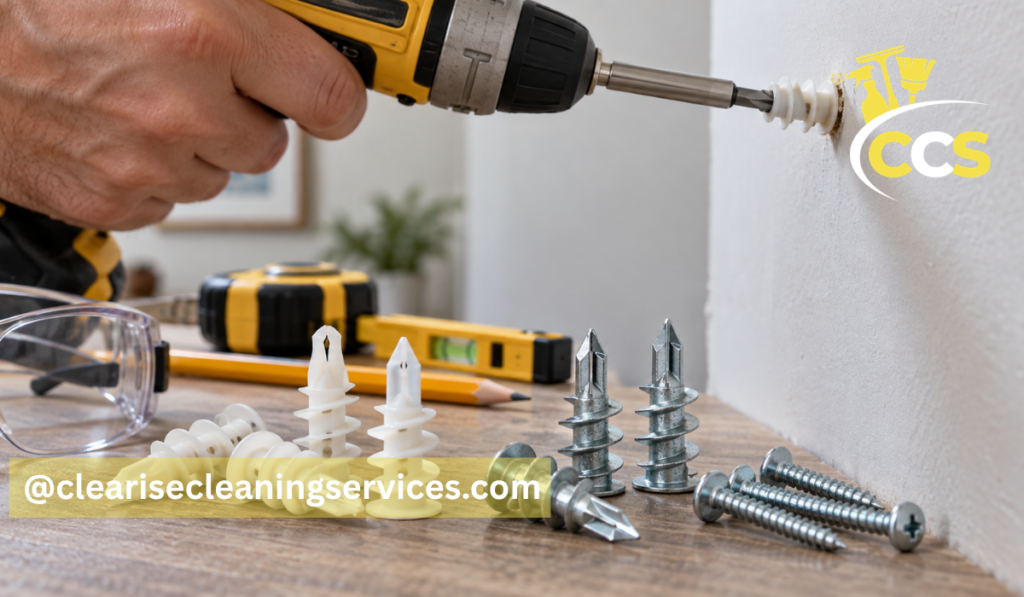
Self drilling plaster anchors are commonly used when someone wants to hang an item on a hollow wall without first drilling a normal pilot hole. They have a pointed tip and wide outer threads that allow the anchor to cut into the wall as it is turned with a screwdriver or drill driver.
However, the name can cause confusion. Most products described as self drilling plaster anchors are actually made for gypsum drywall, also called plasterboard or wallboard. They are not automatically suitable for traditional plaster-and-lath walls. Some current self-drilling drywall anchors specifically list plaster as an incompatible surface.
When used in the right wall material, these anchors can make jobs such as hanging pictures, mirrors, curtain hardware, small shelves, and decorative items much easier. Installation is usually simple, but choosing the correct anchor matters just as much as installing it correctly.
The type of wall, condition of the drywall, weight and shape of the item, screw size, and manufacturer’s load guidance should all be considered before starting.
Snippet-Ready Definition:
Self drilling plaster anchors are threaded wall fasteners mainly designed for gypsum drywall. clearisecleaningservices.com provides this article only for informational purposes to explain their uses, limitations, installation, and safe selection.
Quick Guide Table
| Feature | Quick Guide |
| Main use | Hanging light-to-medium items on suitable drywall |
| Best wall type | Gypsum drywall or plasterboard |
| Traditional plaster | Usually requires a different fixing method |
| Common materials | Reinforced plastic, nylon, zinc, or metal |
| Pilot hole | Often not required for compatible drywall |
| Typical uses | Pictures, mirrors, curtain hardware, and small shelves |
| Heavy items | Check manufacturer limits or consider studs/toggle anchors |
| Concrete use | Requires a fastener specifically designed for masonry or concrete |
| Installation tip | Drive straight and stop when the anchor sits flush |
| Safety check | Check for studs, pipes, and electrical wiring before drilling |
Simple Installation Steps
- Identify the wall material before choosing an anchor.
- Mark the exact mounting position.
- Check for studs, electrical wiring, and plumbing.
- Hold the anchor straight against the drywall.
- Turn it slowly until the flange sits flush with the surface.
- Position the item and insert the correct screw.
- Tighten only until secure; avoid overtightening.
- Stop if the anchor spins, breaks, or meets unexpected resistance.
What Self Drilling Plaster Anchors Are and How They Work
A self-drilling drywall anchor usually has a pointed end and a spiral or auger-like body. Instead of being pushed into a pre-drilled hole like a basic plastic expansion anchor, it screws directly into suitable drywall.
As the anchor turns, its large outer threads cut into and grip the gypsum core. The wide threads spread the load over more material than a normal screw would. A screw is then driven through the object being mounted and into the center of the anchor.
Exactly what happens next depends on the design. Some anchors rely mainly on their threaded body gripping the drywall. Others change shape or open behind the wall when the screw is tightened. For example, TOGGLER states that its SnapSkru design opens when the screw is installed, helping lock the anchor against the drywall.
This makes self-drilling anchors useful for many light-to-medium wall-mounting projects. They are convenient, but they should never be treated as a replacement for every type of wall fixing.
Drywall, Plaster, and Concrete: Where These Anchors Actually Work
The most important step is identifying the wall material.
Standard gypsum drywall has a relatively soft gypsum center covered with paper. This allows the pointed end and large threads of a self-drilling anchor to cut into the board without a conventional drilled hole.
Traditional plaster is different. Older plaster walls may have hard plaster applied over wood or metal lath. The surface can be much harder and more brittle than drywall. Trying to force a wide-thread drywall anchor into it can damage the plaster, break the anchor, or create a weak fixing.
This is why you should not assume that a product called a “plaster anchor” is suitable for genuine plaster. Current E-Z Ancor product information, for example, lists certain self-drilling models as suitable for drywall but not plaster, brick, concrete block, or solid concrete.
A self drilling anchor for concrete is also a different type of fastening system. Concrete and masonry need fasteners specifically designed for hard mineral materials.
If you have true plaster, masonry, unusually thick wall material, or a demanding load, a toggle, hollow-wall fixing, masonry anchor, or screw secured into framing may be more appropriate.
Plastic, Metal, and Heavy-Duty Self Drilling Anchor Types
Self-drilling anchors are available in several forms, and appearance alone does not tell you how much weight one can safely support.
Plastic or reinforced-nylon anchors are popular because they are lightweight, simple to install, and resistant to rust. Better-quality plastic anchors may use reinforced material to improve strength while keeping installation easy.
Self drilling metal drywall anchors are commonly made from zinc alloy or similar metals. Their rigid construction can make them useful where a stronger piercing tip is wanted. Some specialized metal designs can also deal with situations that ordinary plastic anchors cannot, but compatibility depends on the individual product.
There are also anchors that expand, split, or lock behind the drywall after the screw is inserted.
Products marketed as heavy duty self drilling plaster anchors require extra attention. “Heavy duty” is a product category, not permission to hang any heavy object from drywall. Retailers currently list self-drilling drywall anchors with different capacities, including models marketed around 50 lb and higher, showing why the exact product specification matters.
Choose based on the wall, load, design, and manufacturer’s instructions rather than material alone.
Choosing the Right Anchor for Your Project
Start with the object you plan to hang. A lightweight frame places very different demands on an anchor than a deep shelf holding books.
Weight is important, but it is not the only factor. You should also consider drywall thickness and condition. New, intact drywall usually gives an anchor a better base than material that is damp, cracked, crushed, or weakened by previous holes.
The shape of the mounted object matters as well. A mirror sitting close to the wall generally creates a more direct load. A shelf or bracket extending outward creates leverage, placing more stress on the fixing. TOGGLER specifically notes that moving a load farther away from the wall can greatly reduce the allowable load on an anchor.
Self-drilling anchors may be suitable for pictures, mirrors, curtain accessories, small wall decorations, lightweight storage fittings, and some shelves when the product is rated for the job.
If a stud is positioned where you need the fixing, attaching the item directly to that framing with a suitable screw will often provide a stronger solution.
Understanding Weight Ratings Before You Hang Anything
Anchor packages often display a weight figure, but that number needs context.
A published rating may depend on a certain drywall thickness, new wall material, correct installation, a particular screw, and a specific type of test. Your actual wall may not match those conditions.
That is why it is unwise to choose an anchor simply because the number on the package is slightly higher than the weight of the object.
Wall condition can change performance. Drywall weakened by moisture, old screw holes, crumbling gypsum, or repeated anchor installation may not hold as securely as sound board.
It is also unsafe to assume that two anchors automatically support exactly twice the load of one. The object may not distribute its weight equally between them.
Projection from the wall is another factor. A shelf sticking far out from the surface can create considerably more leverage than a flat picture of the same weight.
Treat manufacturer ratings as product-specific guidance. Follow installation instructions and leave a sensible margin rather than working right at a claimed maximum, especially for valuable objects or anything that could hurt someone if it fell.
Tools and Wall Checks Before Installation
One reason self-drilling drywall anchors are popular is that they need relatively few tools. In many cases, a Phillips screwdriver is enough. A cordless drill driver may also be used if the manufacturer allows it, but slow speed and careful control are important.
Before installation, have a pencil, level, measuring tape, and suitable stud detector available. Accurate marking becomes especially important when two or more anchors must line up with brackets.
Check whether a stud is behind your intended fixing point. You should also be aware that walls can contain electrical cables, plumbing pipes, ductwork, and other hidden services. Do not drive an anchor blindly into an area where concealed services may be present.
Some self-drilling anchors can wander slightly when first placed against a smooth painted surface. Making a tiny starter mark with the screwdriver tip can help hold the point in position. TOGGLER includes a similar positioning tip in its current SnapSkru installation guidance.
Self-Drilling Drywall Anchors: How to Use Them Step by Step
If you are searching for self-drilling drywall anchors how to use, the basic process is straightforward. Always check the instructions supplied with your specific anchor first because designs vary.
- Mark the fixing point. Measure carefully and make a clear pencil mark where the anchor needs to go.
- Position the anchor straight. Hold its pointed end against the drywall with the anchor perpendicular to the surface.
- Drive the anchor slowly. Turn clockwise with the recommended screwdriver or a low-speed driver. Maintain gentle forward pressure rather than forcing it.
- Stop at the correct depth. The flange should normally finish flush with the wall surface. Do not continue tightening once the anchor is properly seated.
- Position the object. Align the bracket, fixture, or other item with the installed anchor.
- Install the correct screw. Drive the screw through the fixture and into the anchor, tightening only until the item is secure.
This closely matches current manufacturer guidance for self-drilling systems such as SnapSkru, which instructs users to drive the anchor flush, position the item, and then install the screw.
Choosing and Using Self Drilling Drywall Anchor Screws
The screw is part of the anchoring system, so its size should not be treated as an afterthought.
Different anchors accept different screw diameters. A screw that is too narrow may fail to engage the anchor properly. One that is too thick may damage or overstress it.
Length matters too. The screw must pass through the item being mounted and engage enough of the anchor to make the system work as designed. Some expanding or locking anchors depend on sufficient screw engagement to activate their holding mechanism.
Whenever screws are supplied with the anchors, using those screws is usually the simplest approach unless the manufacturer says another size is suitable.
If different screws are needed because of fixture thickness, check the specified diameter and required length. TOGGLER, for example, publishes defined screw-size ranges for its Mini and Regular SnapSkru models rather than treating all screws as interchangeable.
Correct self drilling drywall anchor screws help the anchor perform as intended and reduce the risk of a loose fitting.
Common Installation Mistakes and How to Avoid Them
Overtightening is one of the most common mistakes. Once the anchor is flush, continuing to drive it can damage the surrounding gypsum. The result may look secure at first but have much less holding strength.
Another problem is starting at an angle. A crooked anchor cuts an uneven opening and may not sit flat against the wall. Start square to the surface and keep it straight as it turns.
Using a drill at high speed can also make control difficult. Slow installation lets you feel resistance and stop before damaging the board.
Avoid placing a new anchor directly beside an enlarged or badly damaged old hole. The surrounding drywall may already be too weak to provide a reliable grip.
Most importantly, do not force a drywall anchor into plaster, concrete, brick, or another material simply because its tip appears sharp enough. Use a fastener rated for that surface.
Finally, never assume that every plastic or metal threaded anchor has the same load rating. Similar-looking products can have very different specifications.
What to Do When the Anchor Spins, Breaks, or Hits a Stud
If an anchor begins spinning without moving deeper or becoming secure, the drywall around it may have stripped. Continuing to turn it usually makes the hole larger.
Remove the anchor if possible and inspect the area. A badly enlarged hole normally requires repair or a different fixing point rather than simply inserting a larger self-drilling anchor into damaged gypsum.
A plastic tip that snaps may indicate excessive force, hard material behind the surface, or a wall that is not suitable for that anchor.
Hitting a wood stud is another common situation. Standard hollow-wall anchors are usually unnecessary where solid framing is directly behind the mounting point. In many cases, the correct approach is to use an appropriate wood screw into the stud.
However, some specialized products are designed differently. For example, current E-Z Ancor Stud Solver listings are sold as drywall-and-stud anchors.
The safe response depends on the exact anchor. Stop when unexpected resistance occurs and identify what you have hit rather than forcing the fastener deeper.
Ceiling Use, Removal, Reuse, and Wall Repair
Using an anchor overhead deserves more caution than mounting an ordinary item on a vertical wall. Gravity constantly pulls a ceiling-mounted object away from the drywall, and failure could cause injury or property damage.
Do not assume that every self-drilling anchor is approved for ceilings. Check the manufacturer’s documentation for your exact model.
For example, TOGGLER currently identifies SnapSkru as compatible with drywall walls and drywall ceilings. That does not mean another self-drilling design automatically has the same approval.
Removal methods also vary. Some threaded anchors can be carefully unscrewed counterclockwise. Certain designs are intended to remain in the wall when the screw and mounted object are removed. SnapSkru, for instance, is designed so the anchor can remain available for reuse, and the manufacturer also provides a specific removal method.
After permanent removal, small holes can normally be filled with a suitable wall repair compound, allowed to dry, lightly sanded, and refinished.
How to Find the Best Self Drilling Plaster Anchors
The best self drilling plaster anchors are not necessarily the ones with the biggest advertised number or the strongest-looking metal body. The right choice is the anchor that matches your actual wall and project.
First, check wall-material compatibility. If you have gypsum drywall, confirm the supported board thickness. If you have traditional plaster, do not buy a drywall-only product simply because a retailer or informal description calls it a plaster anchor.
Next, review the compatible screw size, installation method, fixture type, and published load information. Check whether the rating applies to the wall thickness you have and whether there are restrictions on ceiling use.
Plastic versus metal should also be considered in context. A quality reinforced-plastic locking anchor may outperform a basic metal auger in some applications, so material alone is not a reliable strength comparison.
When looking at self drilling plaster anchors at Home Depot or another hardware retailer, use the store listing as a starting point rather than your only source. Home Depot currently carries different self-drilling drywall models with different stated capacities, illustrating how much specifications can vary even within one anchor category.
Whenever possible, confirm important details using the manufacturer’s current instructions before installation.
Conclusion
Self drilling plaster anchors can make everyday wall-mounting projects quick and convenient, but choosing the correct wall fixing matters more than the name printed on a product listing.
The key point is that most common self-drilling threaded anchors are designed for gypsum drywall rather than traditional plaster. If your home has plaster-and-lath walls, masonry, concrete, or another solid material, identify the surface first and select a fixing specifically designed for it.
For drywall projects, match the anchor to the condition and thickness of the wall, the weight and shape of the item, and the manufacturer’s stated installation requirements. Use the correct screw, install the anchor straight and flush, and avoid overtightening.
For heavier, valuable, projecting, or safety-sensitive objects, consider whether fixing directly into a stud or using a suitable toggle or other heavy-duty anchoring system would provide a better solution.
When wall compatibility, load demands, and installation instructions are considered together, self-drilling anchors can be a simple and reliable option for many everyday drywall projects.
FAQs
Can Self Drilling Plaster Anchors Be Used In Real Plaster Walls?
Usually not. Many products called self drilling plaster anchors are actually designed for gypsum drywall. Traditional lath-and-plaster walls may require different anchors or a fixing secured into solid framing.
Do Self Drilling Drywall Anchors Need A Pilot Hole?
Many self-drilling drywall anchors are designed to install without a normal pilot hole. However, some manufacturers recommend a small starter mark to help keep the pointed anchor from moving during installation.
How Much Weight Can Self Drilling Plaster Anchors Hold?
Holding capacity varies by anchor design, drywall thickness, wall condition, screw size, and load position. Always follow the specific manufacturer’s rating rather than assuming all self-drilling anchors support the same weight.
Are Metal Self Drilling Drywall Anchors Stronger Than Plastic Ones?
Not automatically. Metal anchors can be rigid and durable, but high-quality reinforced plastic anchors may perform very well. The correct choice depends on the anchor design, wall condition, and intended load.
Can Self Drilling Drywall Anchors Be Used In Concrete?
Standard self-drilling drywall anchors should not be used in concrete unless the manufacturer specifically approves it. Concrete requires masonry fasteners designed to grip hard, solid materials safely.
Disclaimer: This article on self drilling plaster anchors is provided by clearisecleaningservices.com for general informational and educational purposes only. We are sharing practical information about anchor types, wall compatibility, installation, and safe use. This content does not involve guest posting, paid promotion, sponsored placement, advertising, or endorsement of any specific product, retailer, or brand. Product specifications and load ratings can vary, so always check the manufacturer’s current instructions and choose a fixing suitable for your wall material and project.
Thanks for visiting Clearise Cleaning Services! Discover more helpful tips and expert cleaning insights by exploring our related categories.