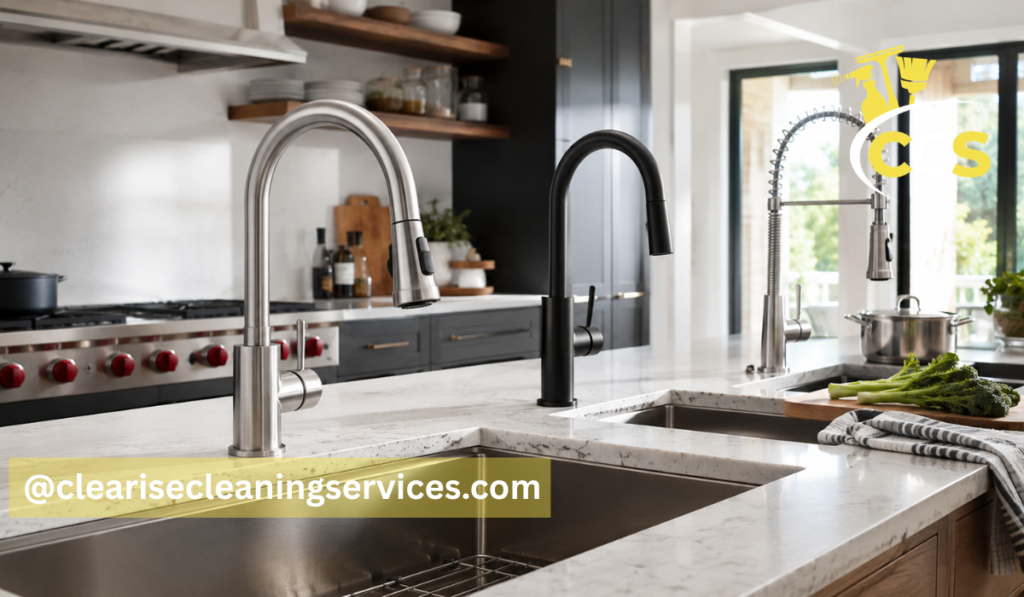
Kitchen faucets may look like a small part of the kitchen, but they affect many everyday tasks. You use the faucet when washing vegetables, filling pots, cleaning dishes, rinsing the sink, and getting drinking water. A faucet that matches the sink and the way your household works can make these jobs easier and more comfortable.
Choosing between kitchen faucets should involve more than picking a finish that looks attractive. Important factors include faucet type, spout height, spout reach, sprayer design, mounting configuration, handle controls, finish, and compatibility with your existing sink or countertop. Current faucet buying guidance from major manufacturers and retailers similarly recommends considering size, sink configuration, spray needs, finish, and household use before making a decision.
The right faucet therefore depends on your kitchen. Someone with a deep farmhouse sink and large cookware may need something very different from a person with a compact sink beneath a low cabinet. Understanding the basic choices first makes it much easier to narrow down the options without paying for features you do not need.
Quick Guide: Kitchen Faucet Types
| Faucet Type | Best For | Main Benefit | Consider Before Buying |
| Pull-Down | Deep or large sinks | Easy rinsing and pot filling | Needs enough vertical clearance |
| Pull-Out | Small or shallow sinks | Longer flexible reach | Usually has a lower spout |
| Single-Handle | Everyday kitchens | Simple one-handed control | Check handle clearance |
| Touchless | Busy households | Hands-free operation | Requires batteries or power |
| Commercial-Style | Large sinks, frequent cooking | Flexible sprayer and wide reach | Taller design needs more space |
| Two-Handle | Traditional kitchens | Separate hot and cold controls | May require multiple mounting holes |
Quick Steps for Choosing Kitchen Faucets
- Check how many mounting holes your sink or countertop has.
- Measure the available spout height and reach.
- Choose between pull-down, pull-out, standard, or commercial-style designs.
- Decide whether you need a built-in sprayer or separate side sprayer.
- Choose single-handle, two-handle, touch, or touchless controls.
- Select a finish that suits your kitchen and is easy to maintain.
- Check installation requirements, warranty, and replacement-part availability before buying.
Main Types of Kitchen Faucets
Kitchen faucets come in several common designs. A single-handle faucet uses one lever to control both water temperature and flow. It is convenient when you need to turn the water on with one hand. A two-handle faucet has separate hot and cold controls and often suits traditional or bridge-style kitchens.
Pull-down and pull-out models include a movable spray head. Pull-down faucets usually have a taller curved spout and a spray head that moves downward toward the basin. Pull-out designs generally have a lower profile and a head that extends outward on a flexible hose. Major retailers currently categorize both as common residential faucet types.
Touch faucets are activated by touching an approved area of the fixture, while touchless faucets use sensors so water can be started without touching the faucet. Some newer models also offer smart functions such as voice control.
Bridge faucets connect the hot and cold controls through a visible horizontal section above the sink, giving them a more traditional appearance. Commercial or pre-rinse faucets usually have a tall spring-style neck and flexible spray head. They can be useful for larger sinks and frequent washing, although their height makes them less suitable for tight spaces.
Pull-Down vs. Pull-Out Kitchen Faucets
The difference between pull-down and pull-out faucets is mainly the direction and design of the spray head.
With a pull-down model, the head is pulled down from a high-arc spout toward the sink. The tall shape provides generous clearance underneath, which can be useful when filling stockpots, washing baking trays, or cleaning large cookware.
Kitchen faucets with pull-out spray, by comparison, allow the head to extend outward from the faucet body. Pull-out models often have longer hoses and lower spouts, making them easier to use around shallow sinks or areas where cabinets, shelves, or windows restrict vertical space. Lowe’s currently highlights reduced height and extended outward reach among the main advantages of pull-out designs.
Sink depth should also influence the choice. A very tall faucet paired with a shallow basin can sometimes create more splash around the countertop. A deep sink usually handles a high-arc pull-down faucet more comfortably.
Neither style is automatically better. Pull-down faucets often work well with large, deep sinks, while pull-out faucets can be practical where horizontal reach and a lower profile matter more.
Kitchen Faucets With Sprayer: Features That Make a Difference
A sprayer makes it much easier to direct water exactly where it is needed. Modern kitchen faucets with sprayer often place the spray head directly inside the spout, although separate side sprayers are still available.
Integrated spray heads commonly provide a normal stream for filling containers and a wider spray for rinsing food, dishes, or the basin. Some models also include a pause button or a stronger cleaning spray. Available spray functions differ by manufacturer and model, so the feature names themselves matter less than whether they help with your normal kitchen tasks. Kohler, for example, currently offers faucets with several task-specific spray patterns.
Hose reach is especially important with wide or double-bowl sinks. The spray head should comfortably reach the areas you regularly clean without requiring you to stretch the hose to its limit.
Also look at how the spray head returns to the spout. Some faucets rely on a hose weight beneath the sink, while others use magnetic docking to help hold the head securely in position.
A separate side sprayer can still be useful, but it normally needs its own sink or countertop opening. This should be considered before purchasing a faucet for an existing sink.
Spout Height, Reach, and Sink Clearance
Spout dimensions can affect daily use just as much as faucet style.
A high-arc faucet creates more working space above the sink. This makes it easier to place tall pitchers, buckets, and large pots under the water stream. However, a tall faucet requires enough open space above and behind the sink.
A low-arc faucet takes up less vertical space and can work better below cabinets, shelves, or windows.
Reach is equally important. Ideally, the water should fall comfortably into the usable part of the basin rather than too close to the back wall or directly against the front of the sink. Lowe’s current guidance specifically recommends measuring faucet height, reach, and surrounding clearance before choosing a model.
Consider sink depth as well. A combination of strong water flow, a tall spout, and a shallow sink may increase splashing.
If your faucet sits beneath a window, check how the window opens. Also measure the distance to shelves or cabinets before selecting a tall commercial-style or high-arc design.
Kitchen Faucet Mounting Configurations and Sink Hole Compatibility
Before buying a faucet, check how many mounting holes are already present in your sink or countertop. This simple step can prevent installation problems later.
A one-hole configuration commonly supports a single-body faucet. Two-hole setups may combine the main faucet with another component, while three-hole configurations can accommodate separate hot and cold handles or certain faucet-and-accessory arrangements. A fourth opening may be used for a side sprayer, soap dispenser, or another accessory.
Some single-hole faucets include or accept a deck plate. The plate sits across the countertop and can cover unused openings, allowing certain newer faucet designs to work with an older multi-hole sink. Home Depot’s current installation guidance notes that the installation process depends partly on the number of holes and sink style.
Do not assume every deck plate fits every faucet. Check the manufacturer’s installation specifications.
When replacing an existing multi-handle faucet, measure the distance between the mounting holes as well as counting them. Compatibility is more important than appearance at this stage.
Single-Handle, Touch, and Touchless Faucet Controls
Single-handle kitchen faucets are popular because one lever controls both temperature and water flow. They can be particularly convenient when one hand is holding a pan or food.
Two-handle faucets provide separate hot and cold controls. Some people prefer the traditional appearance and more deliberate temperature adjustment, although they generally require using two controls.
Touch and touchless technologies add another option. A touch faucet reacts when a designated part of the faucet is touched. A touchless faucet instead uses a sensor, allowing water to start through hand movement or presence. Kohler currently offers touchless models activated by hand movement, while Moen has offered hands-free systems combining sensor and manual lever control.
Some smart faucets add app or voice-control functions. These features may be useful in certain households, but they should be treated as conveniences rather than necessities.
Electronic faucets also need a power source. Before buying one, check whether it uses batteries, an electrical adapter, or both, and whether normal manual operation remains available if electronic functions cannot be used.
Kitchen Faucet Materials, Colors, and Finishes
Finish affects both the appearance of a faucet and how easily everyday marks can be seen.
Polished chrome has a bright reflective appearance and works with many kitchen styles, although fingerprints and water spots can be more visible. Brushed nickel and stainless-look finishes have softer surfaces that may make everyday marks less noticeable.
Matte black kitchen faucets create stronger contrast and are often paired with modern or industrial interiors. Brass, bronze, and brushed gold tones provide a warmer look and may fit traditional, transitional, or contemporary kitchens depending on the faucet shape.
Current product ranges also show that popular finishes are available across modern touchless and pull-down designs, including stainless, chrome, matte black, brushed nickel, and bronze options.
Do not choose by color alone. Read the manufacturer’s cleaning instructions because finish care varies. Mild cleaning is generally safer than aggressive scrubbing, while abrasive products can damage certain coated or decorative finishes.
A good choice should look appropriate beside the sink, cabinet hardware, appliances, and lighting while remaining practical to maintain.
Commercial-Style and Specialty Kitchen Faucets
Commercial-style faucets borrow the exposed spring and flexible spray design associated with professional food-preparation areas. Residential versions provide a similar appearance in a size intended for home kitchens.
Their main advantage is flexible movement. The spray head can usually be moved around a large basin, making it useful for rinsing cookware and cleaning sink corners. Home Depot currently lists spring-hose, high-arc models among common commercial-inspired residential options.
However, these faucets can be tall. Measure the area carefully if your sink sits under an upper cabinet or shelf.
Bridge faucets offer a different specialty style. Their visible connection between hot and cold controls creates a traditional architectural look and can suit farmhouse or classic kitchens.
Specialty styling should still serve a practical purpose. If you regularly wash oversized cookware, the reach of a commercial-style sprayer may be genuinely useful. If you rarely use the sink heavily, the exposed spring may simply be an aesthetic preference.
Matching Kitchen Faucets to Sink Size and Everyday Use
A faucet should feel proportional to the sink it serves.
Deep single-bowl sinks can usually accommodate high-arc pull-down faucets comfortably. They provide space for large cookware and make good use of a flexible sprayer.
Divided or double-bowl sinks may benefit from a faucet with generous swivel range and hose reach so both bowls can be reached easily.
For compact kitchens or shallow sinks, a lower faucet can be more comfortable and may reduce unnecessary splash. A large commercial-style unit can visually overwhelm a small basin and take up more space than needed.
Think about your routine. Frequent cooks may appreciate a strong sprayer and space for filling tall cookware. Families may value simple one-handed controls or hands-free operation. People who mainly use the sink for light rinsing may not need advanced sprays or smart features.
The best match balances dimensions, reach, controls, and visual style instead of choosing a faucet because one feature looks impressive.
Comparing Kitchen Faucet Brands and Places to Buy
Brand reputation can help narrow the market, but it should not replace product-level comparison.
When looking at Moen kitchen faucets or Kohler kitchen faucets, compare the exact models for spray functions, spout dimensions, installation requirements, finish, replacement parts, and warranty terms. Electronic features can have different warranty conditions from the mechanical faucet itself. For example, Moen currently publishes separate warranty terms for some MotionSense electronic components.
The same approach applies to Delta, Kraus, American Standard, and other established brands. A model that fits your sink correctly is more useful than choosing a brand first and trying to make the faucet fit afterward.
When shopping for kitchen faucets on Amazon, confirm the exact manufacturer model number, seller, included accessories, installation parts, and applicable warranty before ordering.
For Lowe’s kitchen faucets or Home Depot kitchen faucets, useful filters include faucet type, finish, handle style, mounting configuration, sprayer design, and brand. Both retailers currently organize large selections around these practical characteristics.
If the same faucet appears at several retailers, compare identical model numbers rather than relying only on ratings or temporary discounts.
Installation, Maintenance, and Long-Term Reliability
A faucet that looks simple from above can have several important components below the sink. Before installation, check the supplied water lines, mounting hardware, available space, and connection requirements.
Pull-down and pull-out faucets commonly use a hose and counterweight beneath the sink. The weight needs enough clear space to move freely. If it catches on cleaning bottles, pipes, or stored items, the spray head may not retract correctly.
Long-term reliability also depends on components such as the cartridge, hose, connections, and spray-head docking system. Replacement-part availability can therefore matter as much as the initial appearance.
Routine care is normally simple. Mineral deposits can collect around the aerator and spray openings, especially in areas with hard water. Follow the manufacturer’s instructions for cleaning these parts rather than using sharp tools or aggressive chemicals.
Treat decorative finishes carefully as well. Avoid abrasive pads unless the manufacturer specifically says they are safe.
Finally, review the warranty before buying. Coverage may differ for finishes, mechanical parts, electronic systems, and commercial use.
How to Identify the Best Kitchen Faucets for Your Budget
There is no single model that deserves to be called one of the best kitchen faucets for every household. A high-priced smart faucet can be poor value if its special features are rarely used, while a simple model can be an excellent purchase if it fits the sink correctly and performs reliably.
Google’s current people-first content guidance also favors useful information created for readers rather than content designed mainly to manipulate rankings, so meaningful comparisons should be based on real specifications and user needs instead of unsupported “best” labels.
Before spending your budget, use this practical checklist:
- Faucet and sprayer type
- Spout height and horizontal reach
- Existing sink-hole configuration
- Sprayer hose reach and docking method
- Useful spray settings
- Single-handle, touch, or touchless controls
- Finish and cleaning requirements
- Installation compatibility
- Replacement parts and warranty
- Overall value for your normal kitchen routine
Treat correct fit, reliable controls, comfortable reach, and suitable water delivery as essential features. Touchless sensors, voice control, unusual finishes, and extra spray modes can be useful, but they are optional for many households.
Spend more only when the additional feature solves a real problem or makes a task you perform regularly easier.
Conclusion
Choosing between kitchen faucets becomes easier once you focus on how the faucet will actually work with your sink. Start with faucet type, spout height and reach, sprayer functionality, mounting holes, controls, and available installation space. Then consider finish and design.
Measure the sink area before buying, especially the mounting holes, spout clearance, distance to cabinets or windows, and the space available beneath the sink for hoses and hardware. These basic checks can prevent many compatibility problems.
The right faucet does not have to be the most expensive, newest, or most heavily promoted model. It simply needs to suit your sink and make normal kitchen work easier. When practical fit comes before trends and unnecessary extras, it becomes much easier to choose a kitchen faucet that remains comfortable and useful for years.
FAQs
What Type Of Kitchen Faucet Is Best For Everyday Use?
A single-handle pull-down faucet works well for many kitchens because it combines easy temperature control, good sink clearance, and a flexible sprayer. The best option still depends on your sink size and routine.
Are Pull-down Or Pull-out Kitchen Faucets Better?
Pull-down faucets usually suit deeper sinks and large cookware, while pull-out faucets provide greater outward reach and often work better with shallow sinks or areas with limited vertical clearance.
How Do I Know If A Kitchen Faucet Will Fit My Sink?
Check the number and spacing of mounting holes, faucet height, spout reach, countertop thickness, and available space below the sink. Always compare these measurements with the manufacturer’s installation specifications.
Are Touchless Kitchen Faucets Worth Buying?
Touchless faucets can be convenient when your hands are dirty or full. However, they usually cost more and require a power source, so consider whether hands-free operation will be useful in your daily routine.
Which Kitchen Faucet Finish Is Easiest To Maintain?
Brushed nickel and many stainless-look finishes tend to hide fingerprints and minor water marks better than highly polished surfaces. Cleaning requirements vary by manufacturer, so always follow the specific finish-care instructions.
Disclaimer: This article provides general information to help readers understand and compare kitchen faucets. Faucet specifications, installation requirements, warranties, finishes, features, prices, and availability can vary by model and manufacturer. Always check current product documentation, sink measurements, plumbing compatibility, and manufacturer instructions before purchasing or installing a faucet.
Thanks for visiting Clearise Cleaning Services! Discover more helpful tips and expert cleaning insights by exploring our related categories.