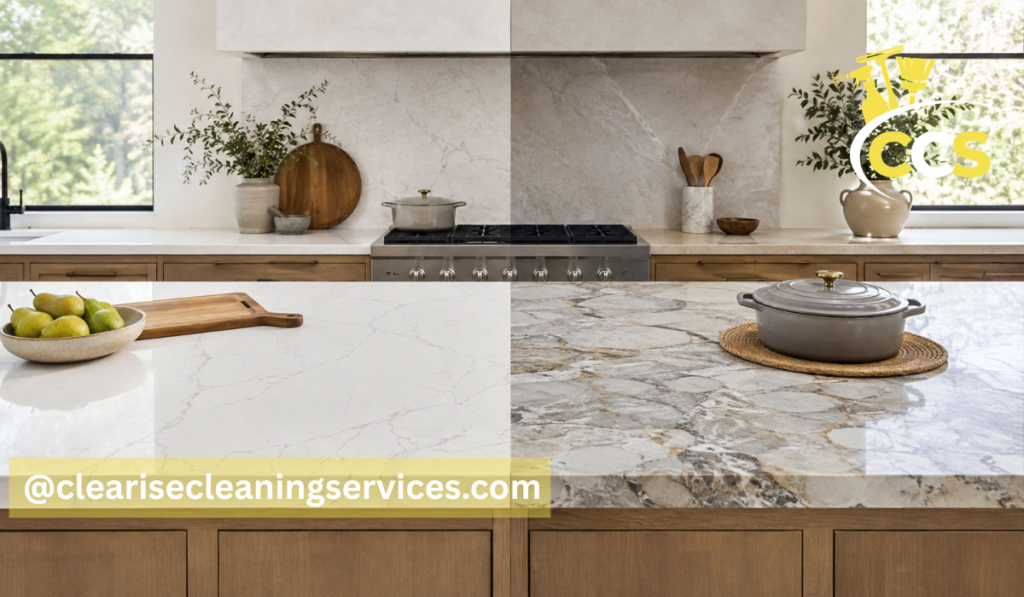
The most important difference in the quartz vs quartzite comparison is simple: quartz countertops are engineered surfaces, while quartzite is natural stone. Engineered quartz is made by combining quartz minerals with binders, pigments, and other ingredients. Quartzite begins as quartz-rich sandstone and changes into a much harder metamorphic rock through heat and pressure inside the earth.
The similar names make these materials easy to confuse, especially because both can be sold in pale colors with marble-like veining. Yet they behave differently in daily use. Before choosing either one, it helps to compare appearance, heat resistance, staining, sealing, maintenance, cost, and how the surface will be used in your kitchen. Neither material is automatically better for every home.
Snippet-Ready Definition:
Quartz vs quartzite mainly differs in origin: quartz countertops are engineered using quartz minerals and binders, while quartzite is a natural metamorphic stone known for unique veining, hardness, and strong heat resistance.
Quartz vs Quartzite Quick Guide
| Feature | Quartz | Quartzite |
| Material Type | Engineered surface | Natural stone |
| Appearance | More consistent patterns | Unique natural veining |
| Heat Resistance | Moderate; use trivets | Generally higher |
| Stain Resistance | High and nonporous | Varies by slab and sealing |
| Sealing | Usually not required | May require sealing |
| Maintenance | Relatively easy | Low to moderate |
| UV Exposure | Some products may discolor | Generally better suited to sunlight |
| Best For | Easy upkeep and consistent design | Natural beauty and heat tolerance |
| Cost | Varies by brand and design | Varies by rarity and slab quality |
Quick Steps for Choosing Between Quartz and Quartzite
- Choose quartz if easy cleaning and predictable colors are your main priorities.
- Consider quartzite if you prefer genuine natural stone and unique veining.
- Think about how often hot cookware will be placed near the countertop.
- Check the sealing requirements of the exact quartzite slab you are considering.
- Compare complete installed prices, including fabrication, cutouts, edges, and labor.
- View natural quartzite slabs in person before approving fabrication.
Quartz vs Quartzite Quick Comparison
A quick side-by-side view makes the main differences easier to understand. Exact performance can vary by quartz brand and by the mineral makeup, porosity, finish, and treatment of a particular quartzite slab, so these points should be treated as general guidance rather than fixed rules.
| Feature | Quartz | Quartzite |
| Origin | Manufactured surface | Natural stone quarried from the earth |
| Composition | Quartz minerals combined with binders and pigments | Metamorphic rock made mostly of quartz |
| Appearance | Controlled colors and more repeatable patterns | Natural veining and slab-to-slab variation |
| Porosity | Generally nonporous | Varies by stone |
| Sealing | Usually not required | May benefit from sealing |
| Heat tolerance | Heat resistant, but direct high heat can damage resin | Naturally more heat tolerant |
| UV exposure | Some products may discolor with prolonged UV exposure | No resin binder, but outdoor suitability should still be checked |
| Maintenance | Low routine maintenance | Simple cleaning, with possible sealing depending on the stone |
| Cost | Varies by brand, design, fabrication, and installation | Varies by rarity, slab quality, fabrication, and installation |
| Best for | Buyers wanting design consistency and easy upkeep | Buyers wanting natural variation and stronger heat performance |
Quartz usually offers more predictable color and easier routine care. Quartzite offers genuine natural-stone character and stronger natural heat resistance, but it deserves more attention when selecting and maintaining the exact slab.
How Quartz and Quartzite Are Made
Engineered quartz is not a slab of quartz cut directly from the ground. Manufacturers use quartz minerals along with resin or other binders and pigments, then form the mixture into a dense slab. The exact formula varies by manufacturer; for example, Caesarstone describes some of its quartz surfaces as containing up to 90% quartz minerals.
Quartzite forms naturally. Quartz-rich sandstone is buried and exposed to heat, pressure, and geological change. The quartz grains recrystallize and bond together, creating a dense metamorphic rock. This process is why genuine quartzite is hard and durable.
This also explains the difference between natural quartz vs quartzite. Quartz is a mineral. Quartzite is a rock made largely from that mineral. A quartz countertop, meanwhile, is a manufactured product that uses quartz as one of its main ingredients. The shared word “quartz” does not make the three terms interchangeable.
Appearance, Colors, Veining, and Slab Variation
Quartz gives manufacturers considerable control over color and pattern. It can be made in quiet solid shades, speckled designs, or patterns inspired by marble and other natural stones. Because the pattern is manufactured, it is generally easier to coordinate several pieces in a large kitchen, although exact pattern matching still depends on the design and fabrication layout.
Quartzite has natural movement that cannot be repeated exactly. One slab may have soft cream waves, while another from the same stone family may show stronger veins, mineral streaks, or changes in tone. That individuality is a major reason people choose it.
For quartzite, a small showroom sample may not represent the whole slab. It is wise to view and approve the actual slabs that will be cut for the project, especially when an island, waterfall edge, or full-height backsplash needs careful vein placement. Natural stones can also be polished, honed, or given other finishes, but availability depends on the stone and fabricator. Appearance matters, but it should be considered alongside care and performance.
Durability: Scratches, Chips, Etching, and Everyday Wear
Both materials can work well in active kitchens, but durability is more complicated than a single hardness number. Quartz mineral itself ranks 7 on the Mohs hardness scale. Finished engineered quartz, however, also contains binders and pigments, so the performance of the countertop cannot be judged only by the hardness of the mineral inside it. Manufacturers describe quartz surfaces as scratch resistant rather than scratch proof.
Genuine quartzite is very hard because it consists largely of interlocking quartz grains. Natural-stone educational guidance notes that real quartzite can scratch glass and does not etch from normal kitchen acids such as lemon juice or vinegar. That distinction is useful because some stones sold under loose trade names may actually be marble or another material with different behavior.
Neither countertop should be treated as indestructible. Heavy impacts near sink cutouts or edges can chip stone or engineered surfaces. Use cutting boards rather than cutting directly on the countertop, and place heavy cookware down carefully. These habits protect the surface, its edges, and your knives.
Heat Resistance and Sunlight Exposure
Heat is one of the clearest practical differences in quartz vs quartzite. Engineered quartz contains resin or similar binders, and direct contact with very hot cookware can scorch, discolor, or otherwise damage the surface. Quartz manufacturers therefore recommend using trivets or hot pads rather than moving a pan straight from the stove or oven onto the counter.
Quartzite is naturally more tolerant of heat because it is a mineral-based natural stone without the polymer binder found in engineered quartz. Even so, using a trivet remains a sensible habit. It helps protect sealers and reduces unnecessary exposure to sudden temperature changes, especially around an existing fissure, repair, or vulnerable edge.
Sunlight also deserves attention. Some engineered quartz products are intended mainly for indoor use, and manufacturer warranties may exclude damage connected with UV exposure or outdoor installation. Cambria, for example, lists UV exposure and outdoor installation among exclusions in its product terms. Quartzite does not contain the same resin binder, but the chosen sealer, installation method, and local climate should still be discussed with the supplier before outdoor use.
Stain Resistance, Porosity, and Sealing
Engineered quartz is valued for its nonporous surface. Major manufacturers state that their quartz does not require routine sealing, and normal spills have less opportunity to soak into the surface than they would with a porous natural stone. That does not mean stains are impossible, so spills should still be cleaned promptly.
Quartzite is different because porosity varies. Some quartzites are tightly bonded and absorb very little liquid, while others are more porous and can benefit from an impregnating sealer. Natural Stone Institute guidance also cautions against assuming every natural stone must be sealed in exactly the same way; the decision depends on the stone and its application.
For that reason, the often-repeated rule that every quartzite countertop must be resealed once a year is too simple. Ask what sealer was used, how long it is expected to perform, and how to test when protection is weakening. On either surface, it is better to wipe up oil, wine, coffee, sauces, and strongly colored spills quickly rather than leaving them for hours.
Cleaning and Long-Term Maintenance
Daily cleaning is straightforward for both surfaces. For quartz, warm water, a soft cloth, and mild soap are commonly recommended by manufacturers. Strong chemicals, highly abrasive cleaners, and rough scrubbing pads can affect the finish or leave dull areas, so follow the care guide for the exact brand you buy.
Quartzite should also be cleaned gently. Natural Stone Institute guidance recommends a neutral cleaner, stone soap, or mild dishwashing detergent with warm water for natural stone surfaces. Acidic or aggressive cleaners are unnecessary for routine care, even though genuine quartzite itself is resistant to common kitchen acids. A sealer or nearby filler may have different chemical resistance from the stone.
Over the long term, quartz is usually the simpler choice because it does not normally need resealing. Quartzite care depends more on the individual slab and its treatment. If you prefer a countertop that requires as little monitoring as possible, that difference may matter more than small differences in scratch resistance.
Quartz vs Quartzite Cost: What Really Affects the Price
Quartz vs quartzite cost cannot be reduced to one reliable nationwide number. Prices change by location, supplier, design, slab size, labor rates, and the complexity of the kitchen. A basic quartz pattern may cost much less than a premium design, while an abundant quartzite may be less expensive than a rare imported slab.
The material price is only part of the budget. Fabrication, installation, sink and cooktop cutouts, edge profiles, seams, backsplash work, slab thickness, transport, and difficult access can all affect the final quote. Large islands or layouts that require matching veins may also need additional material.
With quartz, brand, color, pattern technology, and slab requirements often drive price differences. With quartzite, rarity, quarry source, slab quality, thickness, pattern, and fabrication difficulty can matter. Natural stone can also involve future sealing or professional stain treatment in some cases.
The fairest comparison is therefore two complete installed quotes for the actual materials you are considering, not two advertised slab prices.
Quartz vs Quartzite Pros and Cons
The most useful quartz vs quartzite pros and cons comparison is based on lifestyle rather than trying to name a universal winner.
| Material | Main advantages | Main drawbacks |
| Quartz | Consistent design, nonporous surface, no routine sealing, easy everyday cleaning | More sensitive to high heat; some products are not suitable for prolonged UV or outdoor exposure |
| Quartzite | Genuine natural stone, unique veining, strong scratch and heat resistance | Slab variation, possible sealing needs, and greater importance of verifying the exact stone |
Quartz is attractive for someone who wants predictable design and low routine maintenance. Quartzite makes sense for someone who values a one-of-a-kind natural slab and wants better natural heat tolerance.
Your priorities should decide the winner. A household that cooks heavily may value quartzite’s heat performance, while a homeowner who wants minimal maintenance may prefer quartz. Neither choice removes the need for sensible care.
Quartz vs Quartzite in the Kitchen
When comparing quartz vs quartzite in the kitchen, think about how you actually cook and clean. Quartz works especially well for homeowners who want a smooth, nonporous work surface, predictable colors, and no regular sealing. It can be a practical choice for islands and food-preparation areas as long as hot cookware is kept on trivets.
Quartzite may suit people who want real stone and expect frequent activity around ranges and ovens. Its natural heat resistance is an advantage, while its hard quartz-rich structure handles normal kitchen wear well. The tradeoff is that you should understand the porosity and sealing needs of the exact slab before installation.
Also consider sunlight. A kitchen with intense direct sun or an outdoor cooking area requires more product-specific planning if engineered quartz is being considered. Your preferred appearance, tolerance for maintenance, cooking habits, and willingness to inspect natural slabs should matter more than a simple “quartz is better” or “quartzite is better” claim.
Quartz vs Quartzite vs Granite
Granite is another natural stone and often appears in the same countertop shortlist. Like quartzite, it is quarried rather than manufactured. It offers natural pattern variation, strong heat resistance, and good durability. Its porosity varies, so sealing may be recommended depending on the particular granite and sealer.
| Feature | Quartz | Quartzite | Granite |
| Type | Engineered | Natural metamorphic stone | Natural igneous stone |
| Pattern | More controlled | Naturally varied | Naturally varied |
| Heat | Use trivets | Strong natural resistance | Strong natural resistance |
| Sealing | Usually none | Depends on stone | Depends on stone |
| Stain care | Generally strong resistance | Depends on porosity and sealing | Depends on porosity and sealing |
| Maintenance | Usually lowest | Low to moderate | Low to moderate |
For the simplest routine care, quartz often has the advantage. For light, flowing natural patterns and strong heat performance, quartzite can be appealing. Granite is a broad alternative for buyers who want natural stone, many color choices, and proven kitchen durability.
The best quartz vs quartzite vs granite comparison is always between the exact slabs or products available to you rather than assumptions about each material category.
Common Quartz vs Quartzite Confusion Before Buying
Taj Mahal quartzite is a good example of why names matter. Taj Mahal is sold as a natural quartzite with a warm, light background and flowing veins. At the same time, manufacturers now offer engineered quartz designs created to resemble the Taj Mahal look. Similar appearance does not make the materials the same, so confirm whether a showroom sample is natural quartzite or engineered quartz before comparing price and care requirements.
The quartz vs quartzite rockhounding comparison has a different meaning from the countertop debate. In geology, quartz is a mineral that can occur as crystals or masses in many rocks. Quartzite is a metamorphic rock composed mainly of quartz and formed from quartz-rich sandstone. A rockhound identifying a specimen is therefore asking a geological question, not choosing between two types of countertop.
Quartz vs quartzite Reddit discussions can be useful for learning what homeowners worry about, but they also show why anecdotes need context. Recent countertop discussions include conflicting experiences and claims about staining, sealing, heat, and maintenance. One owner may report trouble with a particular slab while another reports years without staining.
When buying quartzite, verify the stone with a knowledgeable supplier or fabricator if the labeling is uncertain. Natural-stone educational resources warn that some marbles and other stones have historically been marketed with misleading “quartzite” names. The exact stone matters because genuine quartzite behaves differently from marble when exposed to scratching and acids.
Conclusion
The quartz vs quartzite decision comes down to what you value most. Quartz provides an engineered, consistent surface with simple cleaning and no routine sealing. Quartzite provides genuine natural variation, excellent hardness, and stronger natural heat resistance, but its porosity and care needs should be evaluated slab by slab.
Before buying, compare more than color and price. Think about hot cookware, direct sunlight, stain concerns, maintenance, your kitchen layout, and how much natural variation you want. If quartzite is your choice, view the actual slab and confirm its identity and sealing needs. If quartz is your choice, read the manufacturer’s care and warranty information for that specific product.
Both can make durable and attractive countertops when they are selected for the right setting and cared for properly. The better choice is the one whose real-world strengths and limitations fit the way you use your kitchen.
FAQs
Is Quartzite Better Than Quartz?
Neither is better for everyone. Quartz usually offers easier maintenance and consistent patterns, while quartzite provides natural variation and better heat tolerance. Your cooking habits, design preferences, and maintenance expectations should guide the decision.
Which Is More Expensive, Quartz Or Quartzite?
Either material can cost more depending on the product. Quartz pricing varies by brand and design, while quartzite pricing depends heavily on rarity, slab quality, fabrication difficulty, and installation requirements.
Does Quartzite Need To Be Sealed?
Many quartzite countertops benefit from sealing, but there is no universal rule that every slab must be resealed annually. Porosity, finish, sealer type, and everyday use determine when resealing may be needed.
Can You Put Hot Pans On Quartz Or Quartzite?
Direct high heat can damage engineered quartz, so trivets are recommended. Quartzite handles heat better, but using a trivet is still sensible because it can protect sealers and reduce thermal-shock risks.
Which Is Easier To Maintain, Quartz Or Quartzite?
Quartz is generally easier to maintain because its nonporous surface normally requires no sealing. Quartzite is also relatively easy to clean, but some slabs may need periodic sealing and additional natural-stone care.
Disclaimer: This article provides general information about quartz vs quartzite countertops. Performance, maintenance, sealing requirements, heat tolerance, warranties, and costs can vary by product and individual stone slab. Always follow the manufacturer, stone supplier, and professional fabricator’s recommendations before purchasing, installing, or maintaining a countertop.
Thanks for visiting Clearise Cleaning Services! Discover more helpful tips and expert cleaning insights by exploring our related categories.