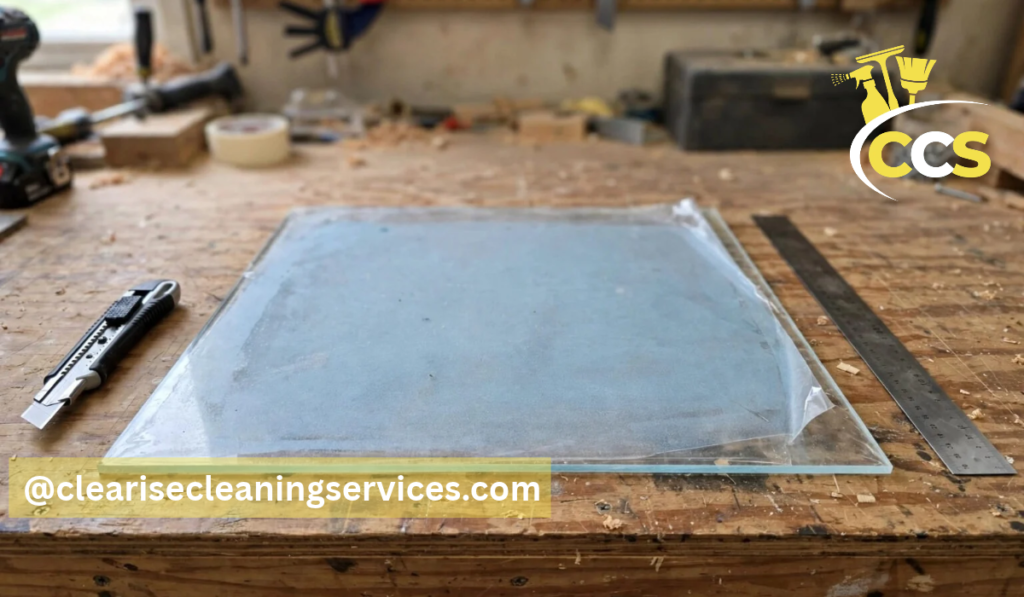
Plexiglass looks like glass, but it behaves nothing like it. Score it wrong and it snaps in the wrong place. Saw it with the wrong blade and the edge melts, chips, or cracks across the whole sheet. Cutting plexiglass is not hard once you know the rules, and most home projects need nothing more than a utility knife and a straight edge. This guide explains which method fits your sheet, which tools to use, and how to get a clean edge the first time.
What Is Cutting Plexiglass?
Cutting plexiglass means cutting a sheet of acrylic plastic, also known as PMMA, to size by scoring and snapping thin sheets or by sawing thicker sheets with a fine-tooth, carbide-tipped blade. Plexiglass is a brand name for acrylic sheet, so plexiglass and acrylic are the same material in most home stores.
Acrylic is lighter than glass, much harder to shatter, and easy to scratch, which is why new sheets arrive covered in a thin protective film on both sides. Leave that film on while you cut: it protects the surface from scratches, clamps, and tool marks, and you should only peel it off when the piece is finished and in place. The material cuts cleanly when the tool and the thickness match, and it cracks when they do not.
Plexiglass, Acrylic and Glass: What Is the Difference?
Plexiglass and acrylic are the same material, a clear plastic called PMMA, while glass is a different material entirely, heavier and more brittle, that needs a glass cutter and a different technique. Knowing this saves you from buying the wrong blades and the wrong guides.
| Feature | Plexiglass / acrylic | Glass |
|---|---|---|
| Material | PMMA plastic | Silica glass |
| Weight | About half the weight of glass | Heavy and rigid |
| Breaking | Cracks if cut wrong, but does not shatter | Shatters into sharp pieces |
| Scratching | Scratches easily; film protects it | Hard to scratch |
| Cutting tool | Utility knife or fine-tooth saw | Glass cutter and breaking pliers |
| Outdoor use | Good; weathers well | Good; heavier and more fragile |
Home stores may label the same sheet as plexiglass, acrylic, or acrylic sheet, and the cutting advice is the same for all of them. Polycarbonate is a different plastic, tougher and more flexible, and it cuts differently, so check the label before you start. If the label says acrylic or PMMA, this guide applies.
Choosing the Right Method by Thickness
The right method for cutting plexiglass depends on thickness: score and snap sheets up to 3/16 inch thick, use a circular saw, table saw, or jigsaw for thicker sheets, and use a jigsaw or rotary tool for curves and shapes. Picking the method first stops the two most common failures, snapping a thick sheet and melting a thin one.
| Sheet thickness | Best method | Why |
|---|---|---|
| Up to 3/16 inch | Score and snap with a utility knife | Clean, quiet, no power tool needed |
| Over 3/16 inch, straight cuts | Circular saw or table saw | Fast, straight, handles thick sheets |
| Any thickness, curves | Jigsaw or rotary tool | Turns corners a straight saw cannot |
| Thick or complex work | Ask a shop to cut it | Laser or CNC cutting gives the cleanest edge |
Thin sheets are too flimsy to saw accurately, and the blade can grab and crack them, so scoring is both easier and safer. Thick sheets are too strong to snap cleanly, and trying will usually break them along the wrong line. For anything over a quarter inch thick, a power saw is the honest answer, and for very thick sheets or detailed shapes, a local plastics shop with a laser or CNC cutter will do a better job than any home tool.
Tools You Need for Cutting Plexiglass
For cutting plexiglass you need a sharp utility knife and a metal straight edge for thin sheets, or a circular saw with a fine-tooth carbide-tipped blade for thick sheets, plus safety glasses, gloves, painter’s tape, and clamps. The blade matters more than the saw.
For scoring, use a new, sharp utility knife blade and a metal ruler or straight edge that will not move while you cut. A dull blade tears instead of scoring and needs more force, which is how slips happen. For sawing, fit a carbide-tipped blade in the fine, finish, or plywood variety, with evenly spaced teeth of uniform height and no rake, or a blade made specifically for acrylic. A coarse wood blade with large teeth will chip the edge badly. Painter’s tape along the cut line protects the surface and reduces chipping, and clamps hold the sheet still so it cannot vibrate. A circular saw is the most common home choice for straight cuts in thick sheets, and our guide to the Makita track saw explains a guided option that helps keep long cuts straight.
Safety First: Gear and Setup
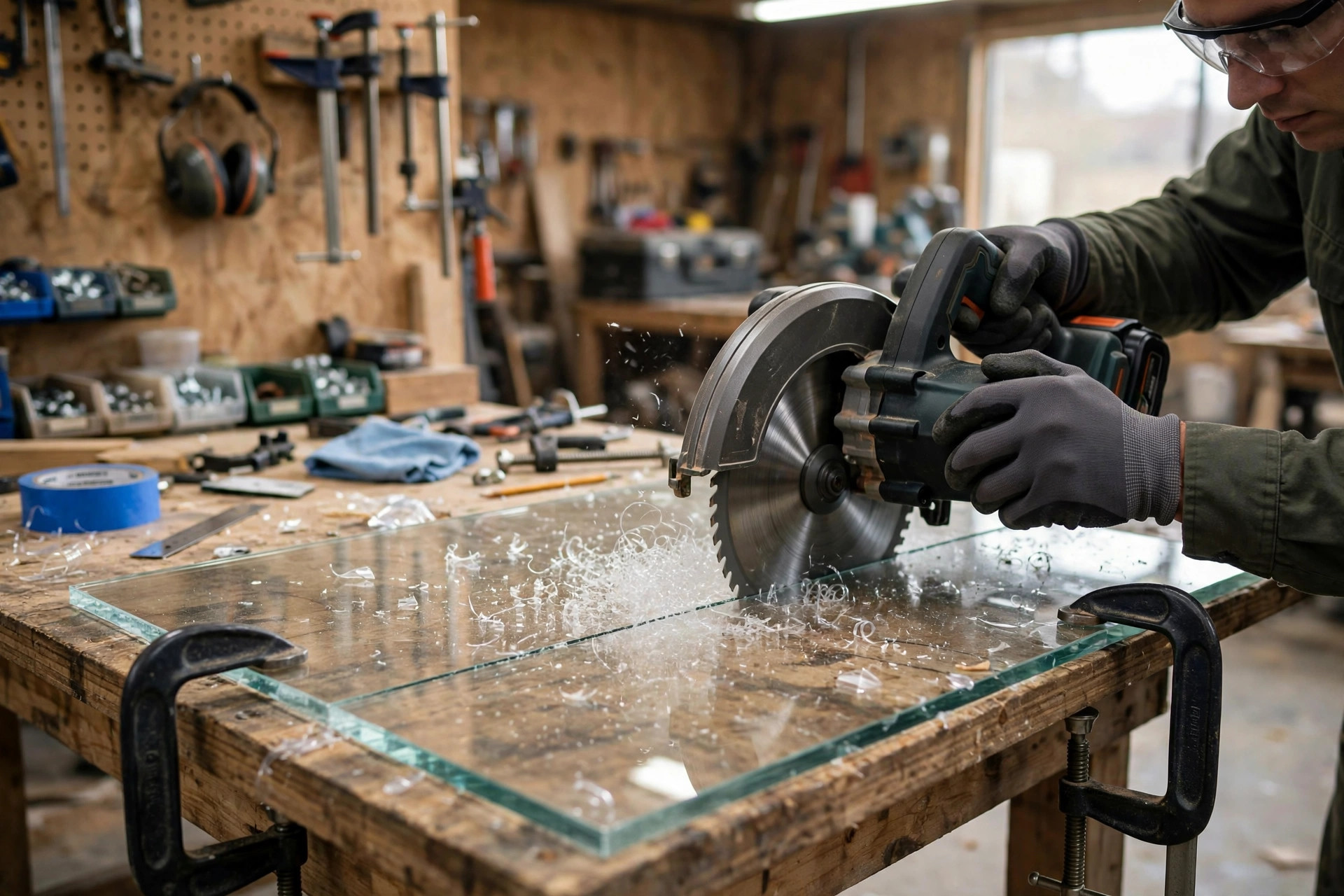
Cutting plexiglass safely means wearing safety glasses and gloves, keeping the protective film on, supporting the sheet near the cut line, and keeping hands, hair, and clothing away from any saw blade. Acrylic does not shatter like glass, but cutting still throws sharp chips and fine dust.
Wear safety glasses for every method, including scoring, because a snapped edge can throw small sharp pieces. Add gloves and long sleeves for sawing, and a dust mask and hearing protection for power tools. Work on a flat, clean surface and wipe the sheet before you cut. Support the sheet within a few inches of the cut line on both sides, so it cannot flex or vibrate, and never prop up the off-cut section when using a circular saw, because the material can buckle and bind the blade, causing a dangerous kickback. If a blade starts to overheat, stop and let it cool, since an overheated blade melts the plastic and makes cracking more likely.
How to Cut Plexiglass With a Utility Knife: Score and Snap
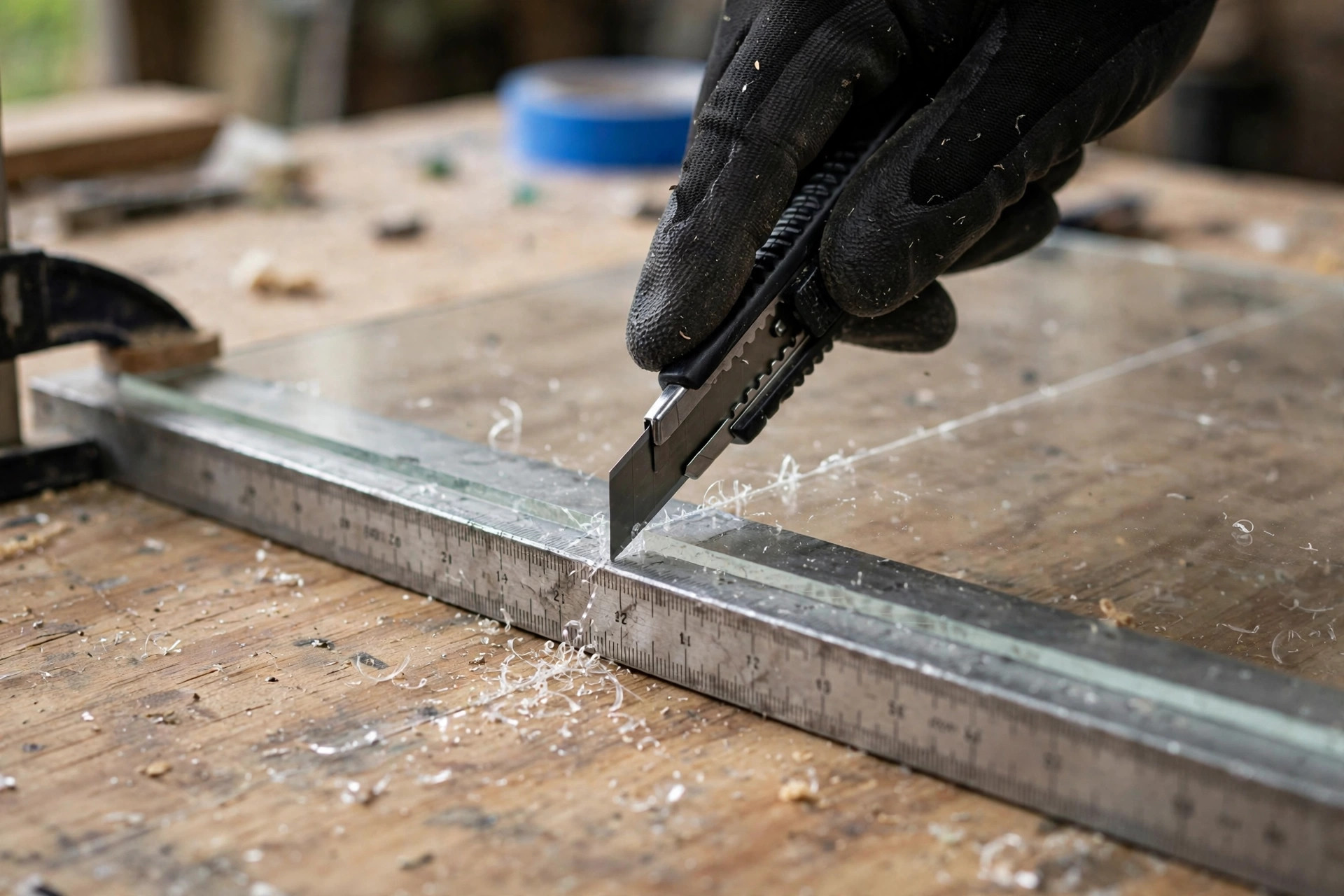
To cut plexiglass with a utility knife, leave the film on, mark the cut line, score it firmly along a metal straight edge about ten times, then snap the sheet over a table edge with a quick, even press. This method suits straight cuts in sheets up to 3/16 inch thick.
- Leave the protective film on. Do not peel it off. Mark the cut line on the film with a dry-erase marker or on painter’s tape, so the mark wipes off later.
- Clean the surface. Wipe the area along the cut line with a clean cloth, because grit can push the blade off course and spoil the score.
- Clamp the straight edge. Line a metal ruler or straight edge up with the mark and clamp it in place, or hold it firmly so it cannot shift.
- Score lightly first. Run the knife along the straight edge with light pressure, focusing on accuracy rather than force, to set a true groove.
- Score again and again. Repeat the same line about ten to twelve times, pressing a little harder each pass, until you have a deep, even groove in the plastic.
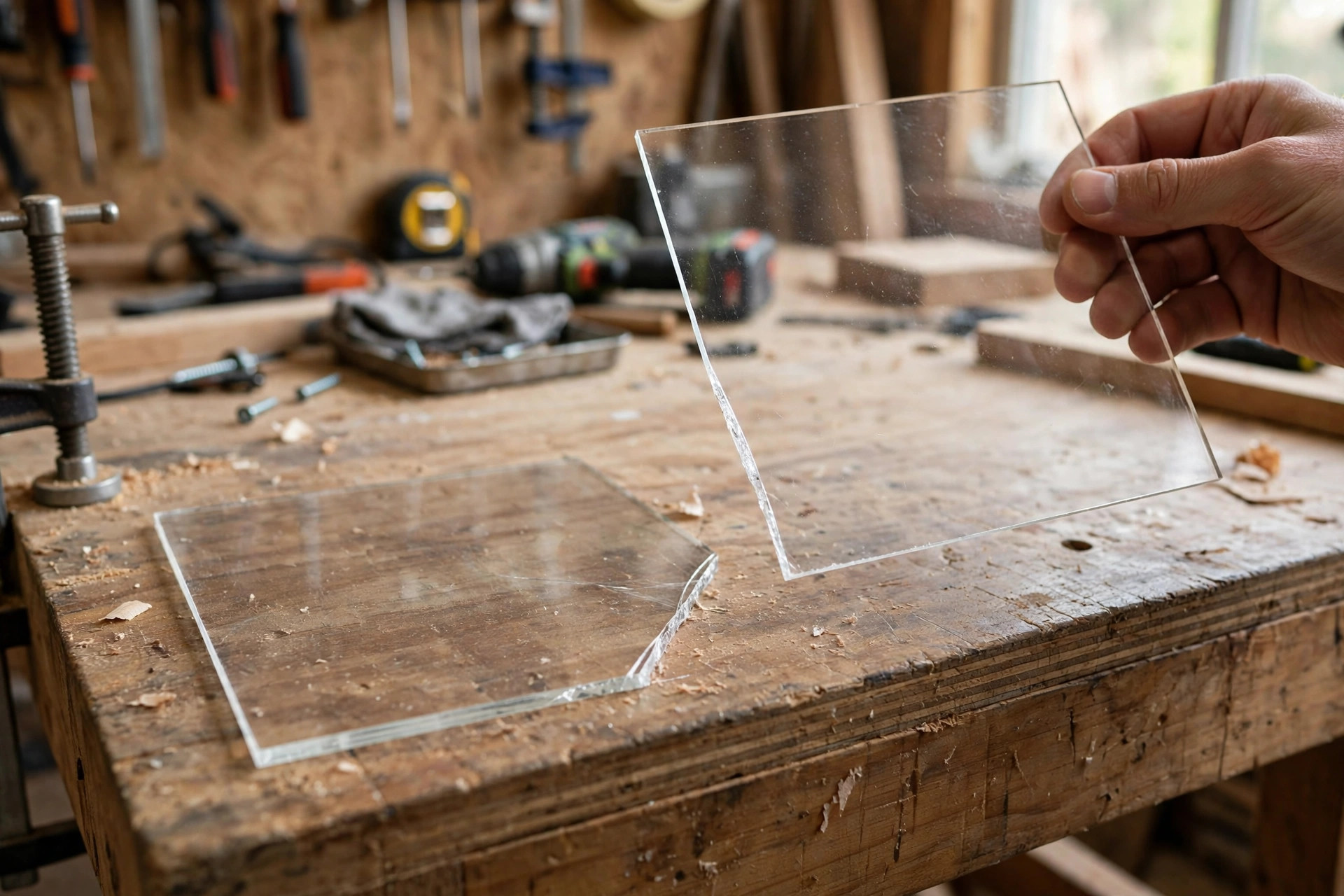
- Snap the sheet. Move the sheet so the scored line sits just past the edge of a table, hold the main sheet down firmly, and press the off-cut down with a quick, even motion until it snaps cleanly.
- Check the edge. The snapped edge will be slightly rough. Smooth it with fine sandpaper, as described in the finishing section below.
How to Cut Plexiglass With a Circular Saw
To cut plexiglass with a circular saw, fit a fine-tooth carbide-tipped blade, tape the cut line, support the sheet so the off-cut falls away freely, set the blade just deeper than the sheet, and push the saw through in one steady pass. This method suits straight cuts in sheets thicker than 3/16 inch.
Start by covering the cut line with painter’s tape and marking the line on the tape, which reduces chipping and keeps the mark visible. Set the blade depth so it extends only slightly past the sheet, which reduces vibration and chipping. Support the sheet so the cut piece can fall away freely, and never prop up the off-cut, because it can buckle and bind the blade. Since a circular saw blade cuts upward through the material, the top surface is more prone to splintering, so place the side you want to look best face down. Push the saw in one steady pass at a consistent speed: stopping mid-cut lets heat build up in one spot, which melts the plastic and leaves a rough edge. If the blade overheats, stop and let it cool, or use water cooling if your blade allows it.
Curves and Shapes: Jigsaw and Rotary Tool
For curves and shapes in plexiglass, use a jigsaw with a fine-tooth blade for larger curves or a rotary tool for small details, cutting slowly and letting the tool do the work. A straight saw cannot turn, and forcing it will crack the sheet.
Mark the shape clearly on the film or on painter’s tape, and drill a starter hole inside the waste area if you need to cut an enclosed shape. Fit a fine-tooth blade made for plastic or metal, tape the base of the jigsaw so it cannot scratch the surface, and cut slowly with light pressure, keeping the sheet well supported near the cut. Let the blade cut at its own pace: pushing hard builds heat, and heat melts the edge and can crack the sheet. For tight curves, make relief cuts in the waste area first so the off-cut falls away in pieces instead of binding the blade. A rotary tool works for small cutouts and rounded corners, but it is slow for long cuts.
Finishing the Edge Smooth
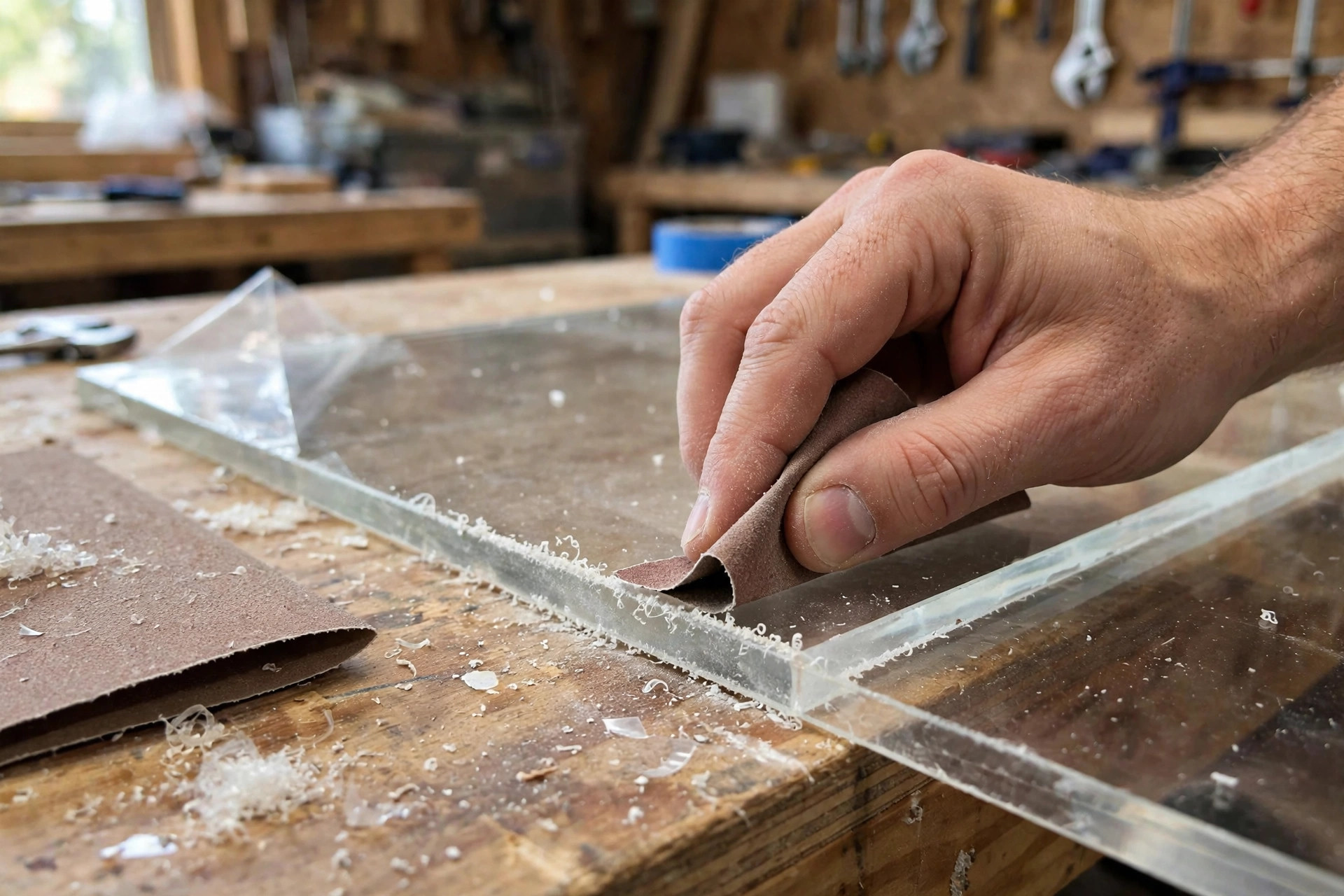
To finish a cut plexiglass edge, sand it with fine sandpaper, moving from coarse to fine grit, then polish it with a plastic polish or a soft cloth for a clear, smooth finish. A raw sawn edge looks cloudy and rough, and a few minutes of finishing makes a visible difference.
Start with 220-grit sandpaper to remove the roughest marks, then move to 400-grit and finish with 600-grit or finer, sanding in one direction along the edge rather than across it. Keep the paper flat against the edge so you do not round the corners unevenly. For a clear, glossy edge, rub the sanded edge with a plastic polish or a small amount of toothpaste on a soft cloth, working along the edge until it turns clear. Remove the protective film only after the edge is finished and the piece is ready to install.
Common Mistakes and How to Avoid Cracks
The most common cutting plexiglass mistakes are removing the protective film too early, scoring too shallow, using a coarse blade, stopping mid-cut with a saw, and leaving the sheet unsupported near the cut line. Each one has a simple fix, and most cracked sheets fail for one of these five reasons.
| Problem | Likely cause | Fix |
|---|---|---|
| Sheet snaps off line | Score too shallow or uneven | Score 10 to 12 firm, even passes |
| Chipped edge | Coarse blade or no tape | Fine-tooth carbide blade; tape the cut line |
| Melted, rough edge | Blade overheating or stopping mid-cut | One steady pass; let the blade cool |
| Cracks near the cut | Sheet flexing or off-cut propped up | Support both sides; let the off-cut fall free |
| Surface scratches | Film removed before cutting | Keep the film on until the piece is finished |
If a crack does start, stop cutting at once: continuing will usually drive it further across the sheet. A small crack near the edge can sometimes be saved by cutting the piece slightly smaller, past the crack. Measure twice and cut once, because a miscut in acrylic cannot be glued back invisibly. Before you drill a hole in a finished piece, check the spacing rules for drilling, since the same support and patience apply; our guide to how far apart studs are is a useful reminder of why measuring first matters in any home project.
When to Ask a Shop to Cut It
Ask a plastics shop to cut your plexiglass when the sheet is very thick, the shape is complex, you need many identical pieces, or the piece is expensive and a mistake would waste it. A shop with a laser or CNC cutter gives a cleaner edge than any home tool, and the cost is often lower than replacing a ruined sheet.
Most local plastics suppliers and some hardware stores offer cutting, and many will cut a sheet you bought from them for a small fee. Bring exact measurements and a simple drawing, and ask how they finish the edges. For repeated pieces, such as shelf panels or window replacements, a shop cut is faster and more consistent than cutting each one by hand. If you only need one small piece, scoring it yourself is cheaper, but if the sheet is thick, curved, or costly, paying for a professional cut is the safer choice. Precise cuts matter in wood too, as our dado joint guide shows.
Conclusion
Cutting plexiglass comes down to matching the method to the thickness: score and snap sheets up to 3/16 inch thick, saw thicker sheets with a fine-tooth carbide-tipped blade, and use a jigsaw for curves. Keep the protective film on, support the sheet near the cut, tape the cut line, and cut in one steady pass. Finish the edge with fine sandpaper, and ask a shop to cut the piece when it is thick, complex, or too costly to risk. Follow those rules and your acrylic will cut cleanly the first time.
Frequently Asked Questions
Can you cut plexiglass with a utility knife?
Yes, cutting plexiglass with a utility knife works for sheets up to 3/16 inch thick. Score the line about ten times along a straight edge, then snap the sheet over a table edge.
What is the best saw blade for cutting plexiglass?
Use a fine-tooth, carbide-tipped blade made for plastics or non-ferrous metals, with evenly spaced teeth and no rake. A coarse wood blade will chip the edge badly.
How do I cut plexiglass without cracking it?
Support the sheet near the cut line, keep the protective film on, use the right blade, and cut in one steady pass. Let an overheated blade cool before you continue.
Should I remove the protective film before cutting plexiglass?
No. Keep the film on through all cutting and finishing work. It protects the surface from scratches, clamps, and tool marks until the piece is installed.
Can I cut curves in plexiglass?
Yes, use a jigsaw with a fine-tooth blade for larger curves or a rotary tool for small details. Cut slowly, support the sheet well, and make relief cuts in the waste area.
Disclaimer: This article is provided purely for informational purposes. clearisecleaningservices.com only provides information about cutting plexiglass and does not offer cutting services, product sales, guest posting, paid promotion, or advertising. Power tools carry real risk, so wear safety glasses, gloves, and hearing protection, follow the tool manufacturer’s instructions, and ask a professional if you are unsure about any cut.
Thanks for visiting Clearise Cleaning Services! Discover more helpful tips and expert cleaning insights by exploring our related categories.