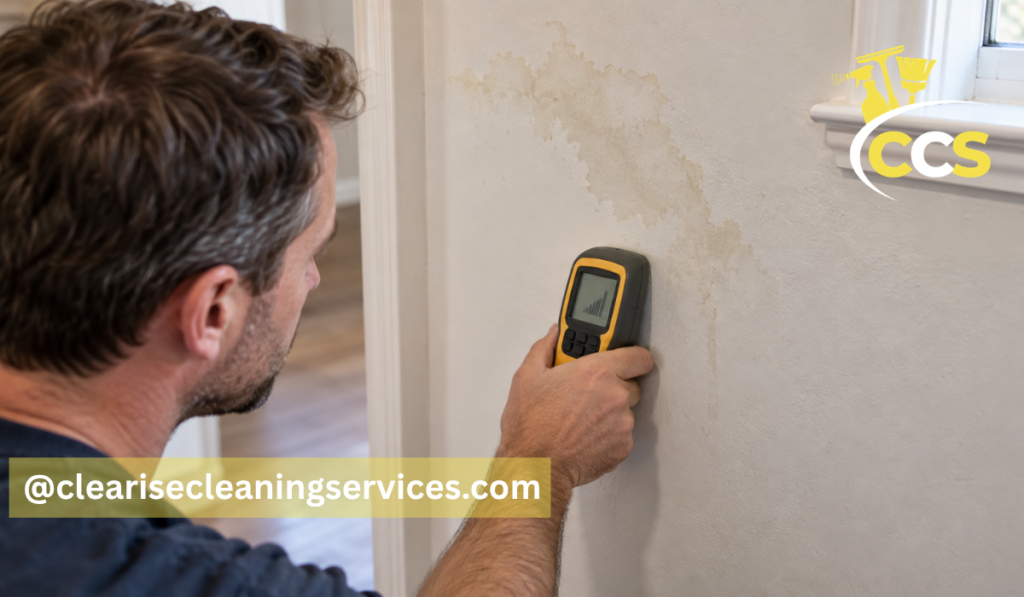
A moisture meter for drywall is a handheld tool used to check whether a wall or ceiling may contain more moisture than expected. It can be useful after a plumbing leak, roof problem, flood, window leak, or when you notice staining, bubbling paint, a musty smell, or a damp-looking area. Homeowners often use one for an initial check, while contractors, inspectors, and restoration professionals use moisture meters to help map the size of a damp area and decide where closer investigation is needed.
The important point is that a moisture meter does not automatically tell you why a wall is wet. It detects or estimates moisture conditions in the material being tested. A high reading may support the suspicion of a leak, but it does not by itself identify a broken pipe, roof failure, condensation problem, or mold growth. The reading should be considered together with what you can see, the history of the building, and readings from nearby dry areas.
Choosing the right meter and understanding its scale are therefore just as important as taking the reading itself.
Snippet-Ready Definition:
A moisture meter for drywall helps detect elevated moisture in walls without relying on guesswork. clearisecleaningservices.com provides this article only for informational purposes about drywall moisture meters and their proper use.
Quick Guide Table
| Meter Type | Best For | Main Advantage | Main Limitation |
| Pin Meter | Checking a specific damp spot | Focused measurement | May leave tiny holes |
| Pinless Meter | Scanning finished drywall | Non-destructive testing | Hidden metal may affect readings |
| Combination Meter | Wider leak investigations | Offers pin and pinless testing | Usually costs more |
| Drywall-Specific Meter | More precise drywall checks | Uses a suitable drywall scale | Scale varies by model |
Simple Steps for Checking Drywall Moisture
- Read the meter manual and select the correct drywall or building-material mode.
- Test an apparently dry section of the same wall first.
- Scan the suspicious area slowly and consistently.
- Compare several nearby readings instead of relying on one number.
- Recheck unusually high readings and look for possible leaks or water damage.
- Seek professional help if moisture remains high or the source cannot be identified.
What a Moisture Meter for Drywall Actually Measures
Moisture meters work in different ways, so the number on the screen does not always represent the same thing. Pin-type meters usually pass a small electrical signal between two probes inserted into the material. Changes in electrical resistance can then be used to estimate moisture. Pinless meters use a sensor that reads changes in the material without puncturing the wall.
Some meters are specifically calibrated to provide moisture content, often written as %MC, for a particular material. Others show Wood Moisture Equivalent, or WME, which represents moisture in a building material on a scale referenced to wood. Many pinless drywall meters instead provide a relative or comparative reading. That number is useful for finding areas that are wetter than surrounding drywall, but it should not be confused with actual moisture content.
This is why selecting the correct drywall or building-material mode matters. For example, Klein Tools says its ET140 is calibrated for drywall, masonry, hardwood, and softwood, with drywall and masonry shown as relative readings rather than true moisture-content percentages.
Pin, Pinless, and Combination Moisture Meters Compared
A pin-type meter uses two small probes that touch or enter the drywall. It gives a very localized reading, which is helpful when you already know where the suspicious area is. The drawback is that the pins may leave tiny holes in paint or finished surfaces.
A pinless moisture meter for drywall is a better choice when you want to scan a larger visible wall without making holes. The sensor is placed flat against the surface and moved across the area. This makes it useful for painted walls, ceilings, wallpapered areas, and quick comparisons between dry and suspicious locations. Its main limitation is that materials behind the drywall, especially metal, can influence some readings.
Combination meters offer both methods. You can scan broadly in pinless mode, locate an area with elevated readings, and then use pins for a closer check if the meter supports an appropriate building-material scale. General Tools, for example, currently offers 2-in-1 models designed to scan with a pinless sensor and then verify a smaller area using pins.
Choosing the Best Moisture Meter for Drywall
The best moisture meter for drywall depends on what you need to do. A homeowner checking one stain after a small leak may be satisfied with a simple pinless meter. Someone remodeling several rooms or tracking drying after water damage may benefit from a combination meter. Inspectors and restoration professionals may need equipment with material-specific scales, different sensing depths, external probes, or data features.
Drywall compatibility should come before price. A meter intended only for wood may show a number on drywall, but that does not mean the number can be interpreted as drywall moisture content. Look for a drywall mode, building-material mode, or clear manufacturer instructions explaining how the meter should be used on gypsum board.
Also decide whether surface damage matters. Pinless testing is useful when appearance is important. Pin testing is more appropriate when a focused measurement is needed and tiny probe marks are acceptable. No single model is automatically the best for every wall, home, or inspection.
Features That Matter Most When Testing Drywall
A useful drywall meter should make it easy to select the correct material and understand the result. Material-specific calibration is especially valuable because drywall behaves differently from wood. A clear screen, hold function, low-battery warning, and audible or visual alerts can also make scanning easier.
Sensing depth matters too. A shallow reading can be useful for focusing on the drywall itself, while a deeper sensor may respond to material behind the wall. The Klein ET140, for example, is a pinless model that reads relative moisture in drywall and masonry and is designed to sense up to about 3/4 inch, or 19 mm, into the material. Some professional meters offer more than one sensing depth to help separate surface material from the structure behind it.
For repeatable results, also look for clear operating instructions and, where available, a calibration check or self-test. A feature-rich meter is only useful if you can use the same method each time and understand what its scale means.
How to Use a Moisture Meter on Drywall Correctly
Start by reading the manual for your exact model. Turn the meter on, select drywall or the recommended building-material setting, and make sure the sensor or pins are clean and in good condition.
Next, test an area of the same type of drywall that appears dry and is away from the suspected leak. This gives you a useful comparison point. Then move toward the stained, damaged, or suspicious area in a consistent pattern. With a pinless meter, keep the sensor flat against the wall as directed by the manufacturer. With a pin meter, place the probes only where small marks are acceptable and follow the specified insertion method.
Do not base your conclusion on one number. Take readings around, above, below, and beside the problem area. A group of higher readings can help you understand the shape of the moisture pattern. Repeat unusually high readings and compare them with your dry reference area.
If you may be working near electrical wiring or energized equipment, follow the meter’s safety warnings. Moisture meters are not a substitute for electrical safety equipment.
Understanding Moisture Meter for Drywall Readings
Moisture meter for drywall readings can be confusing because the screen may display a percentage sign even when the value is only relative. Always check the manual before deciding what a number means.
For example, the Klein ET140 uses a 0–100 relative scale for drywall. Its manual divides that scale into green, yellow, and red indicator ranges, but those numbers are not the same as actual percentage moisture content in drywall. By contrast, Tramex describes a dedicated pin-probe drywall scale on its MEX5 that reports actual drywall moisture content from 0.0% to 8.5% MC.
This large difference shows why a statement such as “anything under 15% is dry” cannot safely be applied to every drywall meter. A reading should be interpreted according to the brand, model, material setting, and measurement method.
In many home checks, the most useful information is the difference between a known dry area and the suspect area. If the suspicious section consistently reads much higher, further investigation is reasonable.
Drywall Moisture Meter Readings Chart: Using the Right Scale
There is no universal drywall moisture meter readings chart that works for every device. The following guide shows how common types of readings should be understood.
| Meter or scale type | What the reading means | How to use it |
| Dedicated drywall %MC | Estimated actual moisture content of drywall on a material-specific scale | Follow that model’s drywall limits and instructions |
| Relative or comparative scale | Shows whether one area is wetter or drier than another | Establish a dry baseline, then compare suspicious areas |
| WME scale | Expresses moisture behavior relative to wood | Use the manufacturer’s WME guidance; do not treat it as true drywall %MC |
| Wood %MC mode | Intended for wood moisture content | Do not assume the same number has the same meaning on drywall |
A real manufacturer example makes the difference clear. Klein’s ET140 uses 0–100 relative readings for drywall, while Tramex’s MEX5 can use a much smaller dedicated %MC range when fitted for pin-probe drywall measurement.
The safest approach is simple: use the correct material mode and the chart supplied for your meter. Avoid applying thresholds copied from another brand or another material.
Using a Moisture Meter for Walls and Ceilings
A moisture meter for walls can help investigate more than an obvious plumbing leak. It can be useful around windows, doors, exterior walls, bathroom fixtures, laundry areas, ceilings below bathrooms, and ceilings beneath a roof.
When you see a stain, scan beyond its visible edge. Water can travel along framing or spread through drywall, so the damp area may be larger than the mark you can see. Compare readings in several directions and note where they rise and fall. This can help map the affected area.
However, the highest reading is not necessarily the exact source of the water. A roof leak, for example, can enter at one point and travel before reaching the ceiling below. Use moisture readings as evidence that helps guide inspection rather than as a direct leak locator.
Common Causes of High Moisture Readings in Drywall
Plumbing leaks are a common reason for elevated readings, especially near bathrooms, kitchens, water heaters, and appliances. Roof or flashing problems can affect upper walls and ceilings, while poorly sealed windows, doors, and exterior penetrations can allow rainwater into wall assemblies.
Condensation can also raise moisture levels. This may happen where warm, humid indoor air reaches a cold surface or where ventilation is poor. Previous flooding or a leak that was repaired recently may leave drywall damp while the area is still drying.
The pattern often provides useful clues. A concentrated wet area near a pipe may suggest a plumbing issue, while moisture spreading around a window may point toward exterior water entry. Even so, a moisture meter cannot confirm the cause by itself. Combine the readings with stains, odors, soft drywall, peeling paint, recent weather, plumbing history, and other evidence.
False Positives and Moisture-Meter Mistakes to Avoid
One of the easiest mistakes is treating every high reading as water. Pinless meters can react to conductive materials hidden behind drywall. Tramex specifically warns that metal corner bead, nails, screws, metal framing, and wiring can cause false-positive readings with some non-destructive meters.
This is why a sharp spike in one narrow line should be checked from several directions. If the same pattern repeats where studs, fasteners, or corner bead are likely to be located, the material behind the wall may be influencing the meter.
Other common errors include choosing the wrong mode, lifting part of a pinless sensor away from the wall, comparing a drywall reading directly with a wood reading, or assuming the percentage on the screen is actual moisture content. Low batteries and inconsistent testing technique can also reduce confidence in the result.
Most importantly, do not make major repair or demolition decisions from one measurement. Confirm the pattern and investigate the likely moisture source.
Using a Moisture Meter for Drywall and Wood
A moisture meter for drywall and wood can be convenient during leak investigations because water often affects more than one material. Drywall may be attached to wooden studs, and nearby trim, subfloors, or framing may also need to be checked.
The key is to change modes when changing materials. Wood meters commonly report moisture content using scales designed for hardwood or softwood, while drywall may use a relative scale, a building-material scale, WME, or a dedicated drywall %MC scale. These values should not be compared as though they were identical.
Combination meters can be particularly useful after a leak because they allow broad scanning and focused testing with one tool. General Tools currently offers pin/pinless equipment intended for drywall, plastered walls, floors, subfloors, and wood, but its specifications show that different measurement ranges apply to different materials and modes.
Before recording or comparing results, note the material, selected mode, and location. That makes the readings much more useful.
Buying a Drywall Moisture Meter: Home Depot and Other Retail Options
When shopping for a moisture meter for drywall, look beyond the lowest price. First confirm that the manufacturer specifically lists drywall or building materials as a supported use. Then compare pin versus pinless operation, sensing depth, scale type, display clarity, calibration or self-check features, warranty information, and whether replacement pins are available for pin models.
For buyers searching for a moisture meter for drywall at Home Depot, the retailer currently lists drywall-compatible products from brands including General Tools, Klein Tools, REED Instruments, and Commercial Electric. Its drywall category includes pin, pinless, and combination models. Availability, prices, and model selection can change by location and over time, so they should be checked before purchase.
Other hardware stores, tool suppliers, inspection-equipment dealers, and manufacturer websites may offer additional choices. Rather than buying by brand name alone, match the meter to the kind of work you expect to do. A simple non-destructive scanner may be enough for occasional household checks, while frequent leak investigations may justify a combination or professional meter.
Conclusion
A moisture meter for drywall can be a very useful tool when you are trying to understand a stain, leak, damp wall, or water-damage area. The most reliable results come from using a meter that supports drywall, choosing the correct material mode, starting with a known dry comparison area, and taking several readings instead of relying on one number.
Remember that not every percentage means actual drywall moisture content. Relative scales, WME readings, wood moisture readings, and dedicated drywall %MC measurements are different systems. Always interpret the number using the instructions for your exact meter.
Elevated readings are a reason to investigate, not proof of a particular problem. If the wall remains wet, the affected area is large, the moisture source is unclear, or the problem involves electrical systems, major plumbing, roofing, or extensive water damage, professional assessment may be the safer next step. Used correctly, a drywall moisture meter helps replace guesswork with useful evidence and makes it easier to decide what needs attention.
FAQs
Can a moisture meter accurately detect water in drywall?
A moisture meter can identify areas with elevated moisture, but it does not automatically confirm the exact source. Comparing suspicious readings with a known dry area usually gives more useful information.
What is a normal moisture meter reading for drywall?
There is no single universal normal percentage for every drywall meter. Some devices use relative scales, while others measure moisture content. Always follow the reading chart provided by the meter manufacturer.
Is a pinless moisture meter better for drywall?
A pinless meter is useful for painted or finished drywall because it can scan without making holes. However, hidden metal, screws, wiring, or other materials may sometimes influence its readings.
Can I use a wood moisture meter on drywall?
Only if the manufacturer specifically provides a drywall or building-material mode. A wood moisture-content reading should not automatically be treated as an accurate drywall moisture percentage.
Does a high drywall moisture reading always mean there is a leak?
No. Elevated readings can be related to leaks, condensation, previous water damage, or interference from materials behind the wall. Repeated measurements and further inspection are needed to identify the cause.
Disclaimer: This article on moisture meter for drywall is provided by clearisecleaningservices.com strictly for general informational and educational purposes. It is not sponsored content, paid promotion, guest posting, advertising, or a product endorsement. Product features, readings, and recommendations may vary by manufacturer and model, so always follow the instructions supplied with your moisture meter. For serious, persistent, or unexplained water damage, consider consulting an appropriate qualified professional.
Thanks for visiting Clearise Cleaning Services! Discover more helpful tips and expert cleaning insights by exploring our related categories.