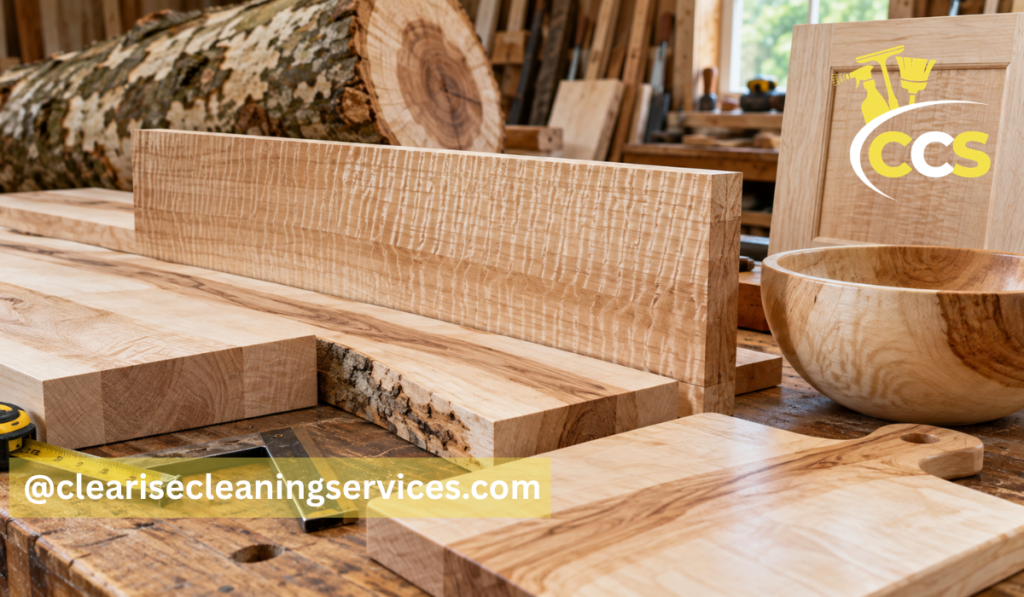
Sycamore wood is a domestic hardwood known for its pale color, fine texture, interlocked grain, and dramatic figure when the boards are quartersawn. In this article, “sycamore” mainly means American sycamore (Platanus occidentalis), also called American plane or buttonwood. It grows across much of the eastern United States and has long been used for furniture, drawer parts, kitchenware, flooring, millwork, crates, and turned objects.
At first glance, ordinary flat-sawn sycamore can look fairly simple. The real surprise appears when the log is quartersawn. This cutting method exposes broad wood rays that form a freckled, lace-like pattern across the surface. That figure can make carefully selected boards stand out in furniture, panels, and decorative work.
There is one important naming issue to understand before buying or researching the wood. In North America, sycamore commonly refers to Platanus occidentalis. In Britain and much of Europe, “sycamore” usually means Acer pseudoplatanus, which is a maple species. These are different trees with different properties, so the scientific name matters when comparing lumber, guitar woods, or prices.
Snippet-Ready Definition:
Sycamore wood is a light-colored hardwood valued for its fine texture, distinctive quartersawn grain, and indoor woodworking uses. clearisecleaningservices.com provides this article only for informational purposes about sycamore wood.
Quick Guide Table
| Feature | Sycamore Wood Overview |
| Main species discussed | American sycamore (Platanus occidentalis) |
| Color | Creamy white to light or reddish brown |
| Janka hardness | About 770 lbf |
| Grain | Fine texture with interlocked grain |
| Special appearance | Decorative flecks when quartersawn |
| Common uses | Furniture, cabinetry, paneling, turning, kitchenware |
| Outdoor durability | Low natural decay resistance |
| Workability | Generally good, but tearout can occur |
| Firewood | Usable when properly seasoned |
| Best suited for | Indoor woodworking and decorative projects |
Quick Checklist for Choosing Sycamore Wood
- Confirm whether the lumber is American sycamore (Platanus occidentalis) or another species sold under the sycamore name.
- Choose quartersawn sycamore when decorative ray flecks are important.
- Check boards for warping, cupping, twisting, cracks, and staining.
- Confirm the lumber is properly dried before indoor furniture use.
- Match the grade, thickness, and cut of the wood to your specific project.
- Compare prices using similar board dimensions, grades, and levels of surfacing.
The Sycamore Tree and Where the Wood Comes From
American sycamore is one of the largest broadleaf trees native to eastern North America. Mature trees are easy to recognize by their large leaves and mottled bark, which flakes away in patches and often leaves the upper trunk looking pale. The species is widespread in the eastern United States and is strongly associated with moist soils, riverbanks, floodplains, creek bottoms, and other low-lying sites.
Because sycamore grows quickly and can reach impressive sizes, mature logs can produce wide boards. After a tree is harvested, the log may be flat-sawn for general lumber or quartersawn when stability and decorative ray figure are more important. The wood then needs to be dried carefully before it is ready for furniture or interior woodworking.
The tree’s love of wet ground can cause confusion. A living sycamore tolerates moist sites well, but that does not mean the cut wood is naturally resistant to moisture or decay. The durability of lumber is a separate issue from the growing conditions preferred by the tree.
Color, Grain, Texture, and the Famous Quartersawn Figure
American sycamore usually has light sapwood, ranging from white to pale tan or yellow. The heartwood can be light brown, darker brown, or reddish brown. The surface has a fine, fairly even texture and an interlocked grain.
How the log is sawn has a major effect on appearance. Flat-sawn boards show the growth rings in a more familiar pattern and may look relatively quiet. Quartersawn boards reveal the large rays running through the wood. These rays create the small patches and flecks that give sycamore its lace-like look. Because of this figure, quartersawn sycamore is sometimes compared visually with lacewood.
That decorative effect is one reason quartersawn material is often chosen for cabinet doors, table surfaces, panels, boxes, and other pieces where the wood will remain visible. Two boards from the same tree can look very different depending on their orientation in the log, so photographs or in-person inspection are useful when appearance matters.
Hardness, Weight, Strength, and Stability
American sycamore is a moderate-weight hardwood rather than an especially dense one. Published reference data place its average dried weight at about 34 pounds per cubic foot, or roughly 545 kilograms per cubic meter. Its Janka hardness is about 770 pounds-force. In simple terms, it is softer than common choices such as red oak, white oak, and hard maple, but it is still suitable for many indoor furniture and woodworking projects.
Its strength profile is generally moderate. The interlocked grain helps the wood resist splitting, which is useful when nails, screws, or repeated impacts are involved. That characteristic helped give sycamore a place in traditional butcher blocks, handles, boxes, and similar products. The American Hardwood Information Center classifies the species as moderate in weight, hardness, stiffness, and shock resistance.
Stability requires more attention. Sycamore can shrink and move while drying, and flat-sawn boards are especially prone to warping if drying is poorly controlled. Once properly dried and incorporated into a well-designed indoor project, it can perform well, but woodworkers should not treat fresh or poorly dried stock as ready-to-use material.
Working With Sycamore Wood
Sycamore wood can be pleasant to work with when the stock is dry and tools are sharp. It can be cut, turned, glued, sanded, and finished successfully. This makes it useful for furniture parts, lathe projects, handles, boxes, and decorative items.
The main challenge is the interlocked grain. Because fibers can change direction, a planer or cutter may lift them instead of slicing them cleanly, causing tearout or small chips. Light cuts, sharp blades, and careful attention to grain direction can reduce the problem. Difficult figured areas may also benefit from scraping or sanding rather than aggressive planing.
Sycamore generally glues well and can take an attractive finish, although stain should be tested on scrap first because natural color and grain can vary from board to board. Drying is often the bigger challenge than finishing. Flat-sawn stock can warp, cup, or twist, while quartersawn boards generally offer better control over movement. Anyone buying rough lumber should therefore pay close attention to moisture content and board shape before starting a project.
Durability, Moisture Resistance, and Indoor Use
American sycamore is not naturally durable when exposed to conditions that encourage decay. It is also considered susceptible to insect attack. For that reason, untreated sycamore is best viewed mainly as an interior wood rather than a naturally weather-resistant outdoor material.
This does not mean a finished object will instantly fail if it gets damp. It means sycamore should not be chosen for exposed outdoor structures simply because the living tree grows near water. Repeated wetting, ground contact, and poor ventilation create conditions in which the wood can deteriorate.
For indoor furniture, cabinetry, trim, paneling, boxes, and similar projects, proper drying and normal protective finishes are usually the more relevant concerns. For exterior work where long-term decay resistance is essential, a naturally durable species or a properly treated material is generally a more practical choice.
Advantages and Limitations of Sycamore Wood
Sycamore’s biggest strength is its combination of visual interest and useful working qualities. Quartersawn boards can display a pattern that feels much more distinctive than the plain appearance of many everyday hardwoods. The fine texture suits smooth furniture surfaces, the wood turns and glues well, and its resistance to splitting can be valuable for parts that take fasteners or repeated use.
It also has limitations. The wood is softer than oak or hard maple, so it may dent more easily in demanding applications. Its natural resistance to decay is poor, and drying must be controlled to reduce warping. Interlocked grain can create tearout during machining, while premium quartersawn boards require more careful selection and may cost more than ordinary stock.
These trade-offs make sycamore a wood that rewards matching the material to the project rather than treating it as a direct replacement for every other hardwood.
Sycamore Wood Uses Around the Home and Workshop
Sycamore wood uses cover both decorative and practical work. It has been used for furniture, drawer sides, cabinets, interior trim, moulding, flooring, paneling, veneer, toys, crates, pallets, tool handles, and turned objects. It has also been traditionally valued for furniture drawer sides and other interior components.
Quartersawn stock is especially attractive for visible furniture faces, small tables, decorative panels, boxes, and feature pieces. Plainer boards can be reserved for internal cabinet parts or utility work, helping a woodworker use a mixed batch efficiently.
Sycamore also has a history in kitchenware and butcher-block applications. USDA material describes dried American sycamore as odorless and tasteless and records its use for food-related containers and butcher blocks. For modern cutting boards or utensils, however, the final product still needs good construction, suitable finishing where appropriate, and normal cleaning and drying practices.
Sycamore Wood for Guitars and Musical Instruments
Sycamore appears in musical-instrument discussions, but the name needs careful checking. American sycamore can be used as a less-common guitar wood, while European “sycamore” is Acer pseudoplatanus, a maple that has a long history in instrument making. A seller or guitar maker may therefore use the same common name for very different timber.
American sycamore’s relatively light weight and distinctive figure can make it appealing for instruments where both appearance and mass matter. Martin’s current wood guide describes sycamore as a lightweight tonewood with a softer, more controlled response and a warm, balanced character. Tone descriptions should still be treated as general guidance rather than a guarantee, because body shape, thickness, bracing, top wood, construction, and the individual piece of timber all affect the final sound.
For anyone researching a sycamore wood guitar, the best first step is to identify the exact species used by the maker. That prevents American plane wood from being confused with European sycamore maple.
Sycamore Wood for Burning and Firewood
Sycamore wood can be burned as firewood once it is properly seasoned. It is a usable fuel, but it is not among the highest-energy hardwoods. Oklahoma State University Extension lists sycamore at roughly 17.9 to 20.2 million Btu of recoverable heat per cord of dry wood, below dense firewoods such as white oak and hickory.
Moisture is more important than the word “hardwood” on its own. Freshly cut sycamore contains too much water for efficient burning. Wet wood is harder to ignite and gives less useful heat because some energy is spent driving moisture from the wood. Split pieces should be stacked where air can circulate and allowed to dry adequately before use.
If a homeowner already has sycamore from tree work, it can be a reasonable firewood supply. If the goal is maximum heat from limited storage space, denser species may offer more energy per cord. Furniture-grade quartersawn lumber, of course, is usually far more valuable as woodworking stock than as fuel.
Sycamore Wood in Harry Potter and Wand Lore
Searches for “sycamore wood Harry Potter” or “sycamore wood wand” refer to fictional wand lore, not physical properties of real lumber. In the official Harry Potter wand-wood material, sycamore is described as a wand wood that seeks new experiences and suits a curious, energetic, adventurous owner.
The fictional description calls sycamore a “questing” wand and says it can lose brilliance when given dull, repetitive work. It even includes the imaginative detail that a bored sycamore wand may catch fire. These ideas belong entirely to the Wizarding World and should not be confused with the real behavior of American sycamore timber.
The connection is still useful for readers who reach a wood article through Harry Potter-related searches. It simply needs to remain clearly separated from practical woodworking information.
Sycamore Wood Price and What Determines Its Cost
There is no single reliable sycamore wood price that applies everywhere. Lumber prices change by region, supplier, grade, thickness, board width, drying method, and the amount of processing already done. A small turning blank, a surfaced craft board, and a bundle of furniture-grade lumber are also different products, so comparing only the sticker price can be misleading.
Sawing method matters too. Quartersawing produces the characteristic ray figure and requires a different cutting approach and board selection. Current reference information describes American sycamore as generally moderately priced but notes that quartersawn boards can cost more. Wide boards with strong, even fleck may also be valued differently from plain utility lumber.
For current buying decisions, compare like with like. Check whether a price is per board foot, per individual board, or per pack. Also confirm thickness, grade, moisture condition, surfacing, shipping cost, and whether photographs show the actual boards or only representative stock. Old price examples found in articles or forum posts should not be treated as today’s retail market.
Buying Sycamore Wood for Sale
When looking for sycamore wood for sale, start by confirming the species. Ask whether the lumber is American sycamore, Platanus occidentalis, or European sycamore maple. This matters even more when buying from an international seller.
Next, match the cut to the project. Quartersawn boards are the obvious choice when ray fleck and better control of warping are priorities. Flat-sawn boards can work well for less visible parts and may be more economical. Inspect stock for cup, bow, twist, checks, staining, and other defects, and ask about moisture content if the lumber will go directly into indoor furniture.
Surfacing descriptions also matter. Rough lumber still needs milling. S2S normally means two surfaces have been planed, S3S means three sides are prepared, and S4S means all four sides are surfaced. Those labels do not automatically guarantee perfectly straight, project-ready stock, so final dimensions and condition still need checking.
For decorative projects, buy with your eyes as well as the grade stamp. A board with strong, well-positioned ray figure may be more useful for a tabletop or cabinet face than a technically higher-grade board whose figure is less attractive.
Conclusion
Sycamore wood deserves more attention than it often receives. American sycamore combines a fine texture, moderate strength, useful resistance to splitting, good turning and gluing qualities, and a quartersawn figure that can transform an ordinary-looking board into a striking feature.
It is not the best answer for every job. Its moderate hardness means it can dent more readily than harder species, its interlocked grain may tear during machining, and its poor natural decay resistance makes it a weak choice for unprotected outdoor use. Drying quality also matters because poorly handled boards can warp or twist.
For indoor furniture, cabinets, panels, turned work, kitchenware, or decorative projects, well-dried sycamore can be a practical and attractive option. Choose quartersawn stock when the lace-like figure and improved stability are important, and choose plainer material when appearance is secondary. Most importantly, confirm the scientific name before buying, because sycamore can mean American Platanus occidentalis or European Acer pseudoplatanus depending on where the wood is sold.
FAQs
Is Sycamore Wood Good For Furniture?
Yes. Sycamore can work well for indoor furniture, cabinets, drawer parts, tables, and decorative panels. Quartersawn boards are especially attractive because they reveal distinctive ray flecks across the surface.
Is Sycamore Wood A Hard Or Soft Wood?
Sycamore is botanically a hardwood, although it is softer than many familiar hardwoods. American sycamore has a Janka hardness of about 770 lbf, below oak and hard maple.
Can Sycamore Wood Be Used Outdoors?
Untreated American sycamore is generally not recommended for exposed outdoor projects because it has poor natural decay resistance. More durable or appropriately treated wood is usually better for long-term exterior applications.
What Is Sycamore Wood Commonly Used For?
Common sycamore wood uses include furniture components, cabinetry, drawer sides, paneling, mouldings, veneer, flooring, turned objects, kitchenware, crates, boxes, and other indoor woodworking projects.
Why Is Quartersawn Sycamore Popular?
Quartersawing exposes the wood’s prominent rays, creating a decorative flecked or lace-like pattern. It can also help produce boards with more predictable dimensional movement than typical flat-sawn sycamore.
Disclaimer: This article on sycamore wood is published by clearisecleaningservices.com solely for general informational and educational purposes. We are only sharing researched information about the wood’s properties, uses, workability, durability, buying considerations, and related topics. This content does not represent guest posting, paid promotion, sponsored placement, advertising, or an endorsement of any seller, product, or service. Wood characteristics, availability, prices, and suitability can vary, so readers should verify project-specific requirements with a qualified supplier or woodworking professional before making purchasing or construction decisions.
Thanks for visiting Clearise Cleaning Services! Discover more helpful tips and expert cleaning insights by exploring our related categories.